





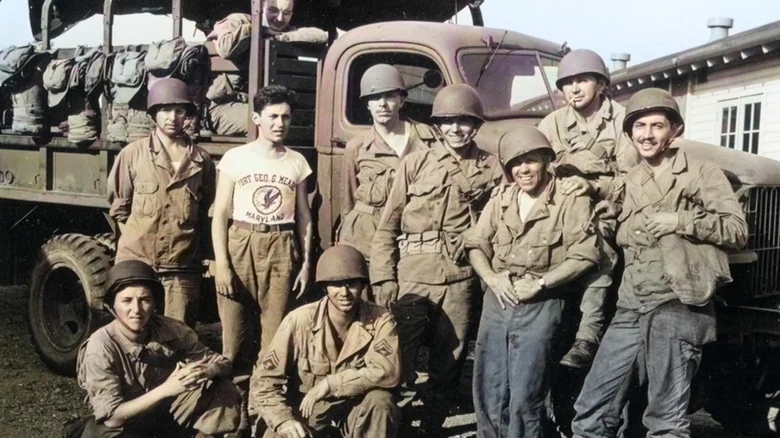
At no point would individuals carrying paintbrushes, rubber decoys and loudspeakers be mistaken for a traditional military force, and that, indeed, was the entire point. In the concluding years of World War II, a covert operations unit of the U.S. armed forces known as the Ghost Army transformed deception into a strategic tool, smartly turning creative thinking into a weapon against Nazi forces to gain tactical superiority over them.
While this unit was formally designated as the 23rd Headquarters Special Troops, its reality was unlike anything else in the army. Its ranks were manned by artists, set designers, architects and sound engineers — many scouted from art schools and ad houses. Some from amongst this creative collective were individuals who would later become popular figures in American culture — at the time, however, they were given a single mission: to use ruses and outwit the German command.
Dummy artillery and air-filled tanks — convincing from afar — were positioned across fields to impersonate massive military formations. This was how the battlefield was defined by perception rather than brute force. Precisely calibrated sound simulations roared through towering loudspeakers, replicating the grinding of steel and carrying for several klicks. Meanwhile, radio operators intentionally transmitted staged, false unit communications. The soldiers would also actively participate in this act, displaying falsified insignia and disseminating misinformation in nearby towns.
The impact was dramatic, rather cinematic and almost surreal. Visualise a peaceful, quiet Normandy countryside that suddenly erupts with the sounds of a marching army — except the army wasn’t actually real. Using the darkness as concealment, the Ghost Army would set up their mock equipment, stage their performance and then retreat before sunrise — leaving the enemy chasing ghosts. Yet, this was far more than a mere performance; it had direct strategic consequences.
By deceiving the German forces about the scale and positioning of the Allied tactics, the ghost army drew the enemy’s attention away from real military operations. In a few cases, they pulled entire divisions of the German forces away from vulnerable sectors — reducing resistance to the surging battalions. Historians believe that the ghost army’s deceptive tactics saved tens of thousands of lives.
The story of the Ghost Army raises important ethical concerns about combat deception. Although diversionary tactics and strategy have always been a part of war, this specific unit obscured the distinction between military operations and artistic expression — manipulating the enemy’s perception through sensory deception. Was it a natural progression of tactical decoys or a migration toward behavioural influence?
In multiple ways, their actions foreshadowed modern information warfare — where conquering the mind is as crucial and significant as seizing the territory. In the current era, warfare has segued into the realm of algorithmic trickery and disinformation, highlighting that deception has transmuted rather than disappeared. For ages, the work of the Ghost Army remained confidential, their artifice buried in classified files. The unit was declassified only decades later, in the 1990s; its influence persists, emphasising that the most potent tool in the arsenal is a successfully planted lie.