





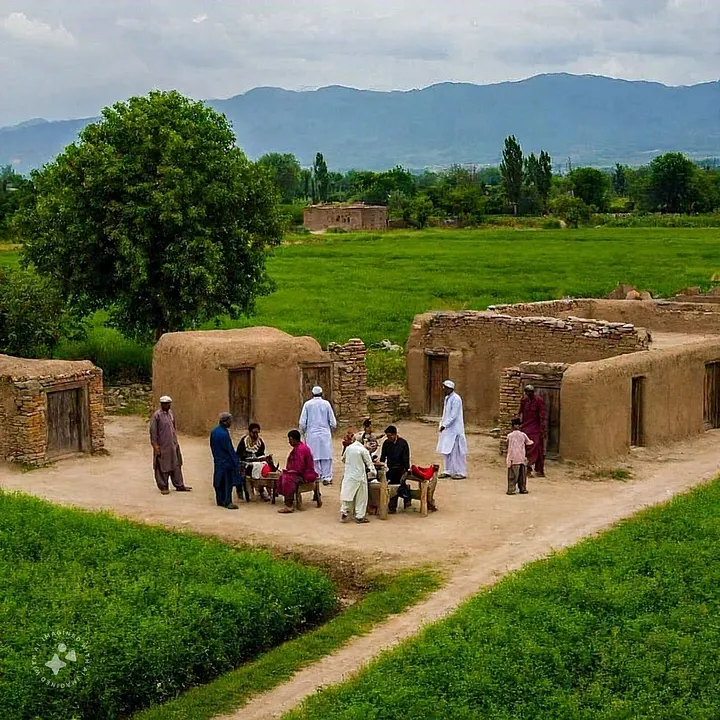
Before nation-states drew their tidy lines across maps, the village was the original unit of human organisation, operated on a shared understanding that the people in power today rarely grasp: that you cannot afford to spark strife against someone whose goat grazes beside yours every morning.
Village structures have historically fallen into two broad types. Hierarchical systems led by a hereditary headman, a khan, or a mukhiya, which placed decision-making authority with a single figure whose legitimacy was derived from lineage and land. Communal systems distributed that authority across an assembly of elders or households. Yet what both shared, often more striking than their differences, was an informal architecture of peace — a set of unwritten rules and oaths that limited dissent among neighbours across generations.
Anthropologists have long noted that the intimacy of village life, where there is a close-knit community of shared activities, creates powerful incentives for conflict resolution. A grudge, left unaddressed, isn’t kept in the shadows for long. So villages invented their own courts without needing the urban city to assist them.
Consider, for a moment, a village in the Khyber Pakhtunkhwa province of Pakistan. Two families, the Khans and the Bangash, have been feuding for three years over a strip of irrigated land to grow sugarcane. Heavy rains shifted a canal embankment, sparking the argument. Words were exchanged, a fence was moved, and then a nephew was beaten at the bazaar. Now both families have stopped attending the same mosque on Fridays.
The matter is brought before the jirga (a council of male elders drawn from neutral clans in the area). The jirga is not a court in any formal sense. There are no lawyers or appeals procedures. What it has is something arguably more powerful: the moral authority of community consensus.
The proceedings continue for two days, typically in the hujra (the men’s communal guesthouse). Each family presents its account. They will then reach a decision. Consider having a trusted elder from a third clan redraw the land boundary. Both families, in conclusion, will slaughter a goat and share a meal together as a binding act of reconciliation. The agreement is not even written down. It doesn’t need to be.
There is something intuitive to contrast the village jirga with the machinery of modern international diplomacy, particularly as we witness the deterioration of this machinery under the weight of the Middle East’s ongoing crises.
Contemporary diplomacy is not wholly unlike that of the jirga: neutral parties, shared norms, face-saving mechanisms, and the assumption that sustained dialogue are preferable to escalation.
What has changed, particularly after the Gaza conflict in October 2023, is the collapse of those very mechanisms. The UN Security Council is best paralysed by veto politics. Even if ceasefires are reached, they are seldom as welcoming as the shared meals between two dissenting village families.
The jirga elder possesses something that the diplomat in the air-conditioned chamber increasingly lacks: dignity for the opposition as a living, breathing, and sovereign entity, not merely a country to be frequently attacked on superficial claims. The jirga elder wasn’t given authority through government but from demonstrated wisdom and community trust. Contemporary mediators, increasingly busy with unstoppable calls and contacts during times of conflict, carry none of that accountability.