




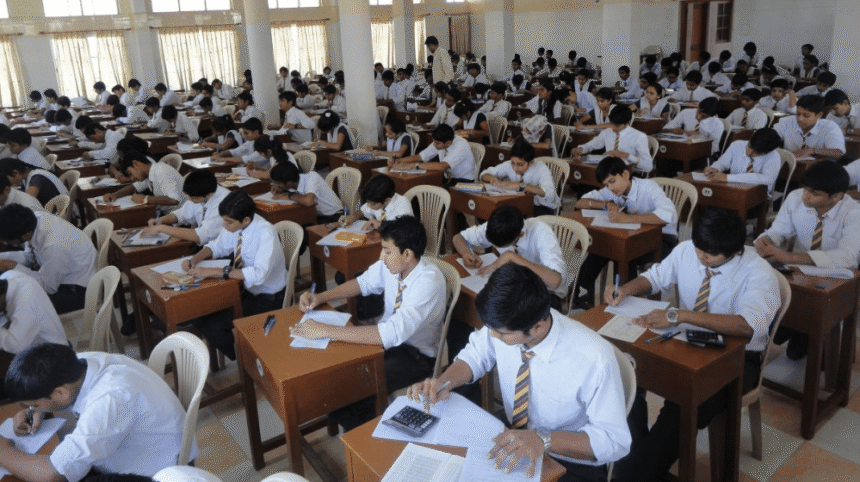
Head filled with pressure, rooms in a mess, study tables tired of the entire burden in the form of heavy books, helpers, guides, guess papers, printed notes, and so much more. Parents in a constant sense of emergency and children who seem unable to free themselves from an unseen pressure and sense of an unending competition. This is the scene of a normal household in Pakistan during exam season, and it feels like this scene is not going anywhere for the coming decades, as it has been standing its ground for as long as we can look back.
Unfortunately, instead of developing basic skills like creativity, critical thinking, problem-solving, and individual thinking, Pakistan’s examination system is participating as a constant obstacle in students’ mental and psychological development. The system prefers to reward rote memorisation over conceptual and critical clarity that fosters psychological distress, making students unable to cope with their physical and mental health crises and failing them to move successfully in a modern global economy.
In Pakistan, exams have nothing to do with critical or creative understanding of the concepts, nor do they encourage students to apply the concepts that they have studied. The system is simply designed to test memory and how strong the ‘ratta’ (rote learning) of a student can be. If we analyse BISE board papers, we can clearly see the repeated patterns of the exact same questions from textbooks, and that is a major reason we are witnessing a hype of ‘past papers’ and ‘guess papers’ culture among the students. This poor exam culture encourages students to rote learn to secure the highest marks; the more word-for-word answers you write, the more chances you have of getting good grades, and the higher the chances of getting admission to good universities by making it to merit lists.
Nevertheless, on the downside of this culture, nobody is willing to understand the crisis of discouraging analytical thinking, critical and creative approaches, and questioning the patterns. These crises are not merely limited to learning and attempting patterns; the structural and administrative obstacles are working hand in hand in these crises.
In Pakistan, a very well-known cause of the failure of the exam system is the outdated, flawed, and sometimes corrupt system of logistics and administration. A proper security system in exam halls during exams is so rare that it leads to cheating, bribing, paper leaking, and disadvantaging honest students from getting the positions they deserve. This failure of the administrative system is elevating cheating and the “Boti” culture, which students consider safe to do to achieve a higher position on result sheets. Subjective and flawed marking is probably the third major obstacle of Pakistan’s examination system, where examiners are underpaid and overworked with checking thousands of sheets. This overwhelming burden leads to horrible marking, where handwriting, pages’ length, and overall presentation of the paper are preferred more than the substance and clarity.
In order to understand the structural failure of this system, we can analyse the administrative systems of BISE and CAIE, and the results seem clear. The CAIE clearly approaches exams from a different angle by preparing students mentally and psychologically for the future; the latter focuses heavily on memory tests, creating a major gap between younger generations.
On one hand, whereas international exam systems in Pakistan focus on forward and progressive approaches, the ‘do or die’ nature of the local examination system destroys students’ social, physical and mental wellbeing. In a culture where students’ worth is measured by their position on the whiteboard, grades on sheets, and overall percentage achieved in final exams, students are left with no option but to practise unethical ways to secure good marks or to destroy their mental peace and try way too hard to prove themselves. According to studies, 66 to 88 per cent of students struggle with mild to severe anxiety, depression, and overwhelming pressure during exams. During recent years, a tragic spike in student suicides has been noticed during the announcement of board results. Miserably, this flawed system ruins the students’ golden teenage years by making them memorise definitions, be depressed over grades, overthink family pressure, and underestimate their capabilities and worth, instead of empowering them to learn important life skills, pursue arts, and prioritise their creativity and overall well-being.
Even after all those years of unrewarded struggles, students end up realising that they have earned the degrees, but they could not develop employable skills or a portfolio that could help them secure a worthy job. The increasing rate of unemployment and mismatched jobs clearly indicates an emergency to bring change and dismantle the obstacles not only in the examination system but also in the overall education system.
Pakistan’s examination system needs an urgent transition toward Student Learning Outcomes (SLOs), where exam questions are supposed to verify students’ individual thinking, concept clarity, and creative approaches instead of repeating century-old patterns of textbook reproduction. The examination system requires an urgent exit from a single, high-stakes, 3-hour-long exam towards a more continuous approach by assessing students throughout the year. This can be done by introducing different activities, including practical and realistic projects that can improve students’ problem-solving and creative skills; presentations that can build students’ public speaking skills; quizzes that can help students be aware of current affairs and general knowledge; and other activities like these.
Pakistan’s education system needs to understand and acknowledge the importance of critical reforms within the system to make it more available and welcoming for the students instead of making it an impossible bridge that is hard to cross yet needs to be crossed in any way possible. Our socio-economic future is heavily dependent on the youth of Pakistan and their approach toward the national and global economy, and unluckily, if the exams remain the biggest outdated obstacle in their way, the country’s progress stalls.
The duty falls upon Pakistan’s education system to feel the urgency of making the overall system more accessible for students’ personal, social, cultural, and economic well-being instead of pushing youth into a dark well with no knowledge of survival in the midst of modern world crises. It is our right to be accessed with proper education to leave a mark in this world by growing into more informed individuals who are well aware of themselves, their duties, and their rights because only this can motivate us to appear as future leaders on global platforms who hold the power to change the world.
“Education is the most powerful weapon which you can use to change the world.”
– Nelson Mandela