





The Politics of Being Seen
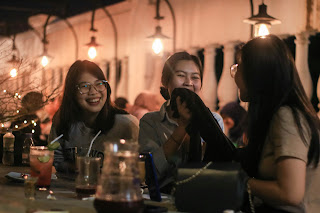
For decades, the rule governing women’s movement through cities has been simple: get inside by 7 pm, no entry in public places, and have a reason for not being seen and heard. Safety for women has been framed as an object women must foster on themselves through caution, absence, and shrinking their presence in public spaces. But as time has passed, visibility itself has become the argument. The evening walks, cycling groups, meetings, and all-girls dinners are now spreading across cities in Pakistan that oppose the old logic entirely. A woman taking a walk alone at 9 pm is not asking for permission anymore; she is asserting that the street belongs to her as much as it belongs to anyone else. Groups of women are gathering in parks for meetups, in cafés for hangouts, riding bicycles and scooties down the road past sunset, and sitting in restaurants and bookstores long after the sun has set — when “respectable” women were expected to be caged inside homes after a certain time. This particular visibility is gained through years of hard work, because no woman can simply go outside and sit comfortably in a place reserved for men. Gatherings and meetups were once considered a luxury for women needing an occasion to justify them. Now, without needing any such occasion, they have matured into organised movements. The scale has changed, but the idea behind it remains the same: public places should not be considered a privilege reserved only for men.
What Reclamation Is
Alongside walks and meetups, a quieter reclamation is taking shape inside cafés and libraries where book clubs, reading hours, workshops, and other thought-provoking evening gatherings have become a regular fixture on calendars across cities, drawing girls out who otherwise have no reason to be out past sunset. They take part in pottery workshops, crochet, or calligraphy practice, and reclaim the space that was once reserved only for men or privileged people. What makes these evenings significant is not only the skills that are learnt, but the idea of movement and women’s empowerment through public networks and places. Young girls — especially teenagers and those in their early twenties — sit beside women experienced in their careers and life, absorbing confidence as well as craft, and learning that ambition and friendship are not exclusive or reserved for any one gender. Each such evening builds a new social gathering, built with women showing up for each other and themselves, after dark, without an apology. Enthusiasm for such movements often works against structural gaps and government indifference.
Equality Measured in Access
There is a reason urban planners and sociologists treat access to public spaces as equally shared for both men and women. Parks, libraries, cafés, and streets are the city’s shared commons — funded by all, open to all, and meant to serve all. When half of the population is curfewed, whether planned or self-imposed, the promise of the government breaks down. Equality is not merely about wages or representation in parliament; rather, it concerns the liberation of a woman — whether she can sit alone on a bench at 8 pm without calculation, without any strategy to get back, and without needing company. Similarly, women organising such movements are not claiming to have solved this major problem in developing countries. Most describe their efforts as a beginning rather than an end, because it is a way of making the absence of half the population in public spaces after dark feel strange again. Hence, there is power in such strangeness. The work of changing policies, infrastructure, and policing will take longer than expected, but the walks, rides, and café meetups will matter not as a substitute, but as a precondition. Every policy meant to hide women’s identity past the dark hours will require pressure to transform.