





A few days ago, as I headed to my university on the Orange Train, I noticed a middle-aged man while stepping out of the GPO station. He was in paint-stained clothes, cleaning motorcycles and cars under the harsh afternoon sun. The drivers around him handed him fifty or a hundred rupees before moving on their way. My brother asked him, “Uncle, you seem like a painter. Why are you doing this?”
You might wonder: does this have anything to do with masculinity? Well, it absolutely does.
The man looked at us and took a moment before replying. “My daughter needs five thousand rupees before tonight for a school function.”
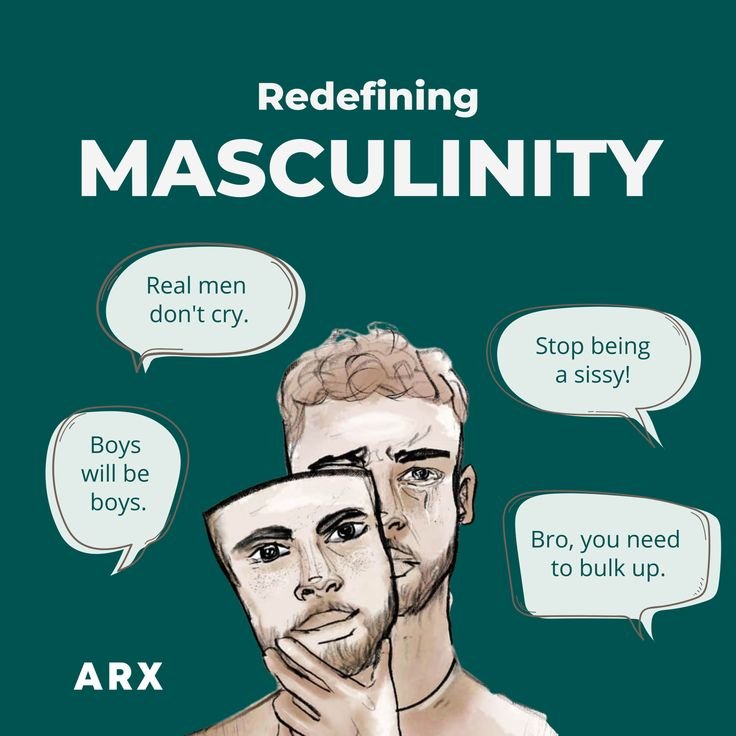
We walked away, but his words lingered in my thoughts for days. They brought back memories of my school days. A little boy had fallen while playing basketball. Before tears could fall from his eyes, an elderly woman gently reminded him, “Men don’t cry. You are a man now. Wipe away your tears.”
I often wonder why men are confined to a silent prison of expectations. Are they expected to endure without shattering, succeed without seeking help, provide without complaint, and suffer alone? Why, and for how long? How many are actually free from these expectations? Hardly any. Do we all really need to redefine masculinity? As societies evolve, so does our perception. The real challenge is not to abandon tradition, but to acknowledge that resilience and vulnerability can coexist within any man or woman.
Masculinity has long been associated with physical strength, financial success, and being a provider. Our priority should be to broaden our definition rather than replace it. I believe we simply need to allow men to be honest, complete human beings possessing both strength and fragility.
Have you ever thought about who teaches a boy what it means to be a man? Is it a classroom? A textbook? An identity card? Definitely not. The lesson begins at home, travels through school corridors, and follows men into their workplaces: “Be a man. Be brave. Men don’t cry.”
Although this lesson is never included in any curriculum and nobody explicitly teaches it, this script has been internalised and performed across every society. Do we expect a fresh male graduate to be financially stable and ready to shoulder heavy responsibilities within a short span? We do.
Yet the world has never been strictly black and white. Consider a Gen Z man who prepares breakfast and helps with domestic chores while his wife pursues her career. Does his masculinity shrink? Does it make him any less of a man, or does our definition simply fail to evolve? What is your answer? I often wonder whether we celebrate men and women for who they actually are, or simply for the roles they have been assigned to perform since birth.
Why is our societal perspective so limited as to confine men into labels of bravery and women into labels of weakness? Masculinity has historically been measured by endurance rather than expression across cultures and generations. Why, in our society, would an elite-class daughter rarely be permitted to marry a salesman? A man’s worth is still heavily judged by his financial success and ability to protect. A society that allows men to embrace both strength and vulnerability is not weakening its traditions; it is strengthening them. It liberates men to be honest individuals.
The world advances every day in artificial intelligence, yet how can we measure the cost of emotional silence? Can we quantify it through a thermometer, or hear its ache through a stethoscope? Silence never leaves visible bruises that can be bandaged; instead, it creates an invisible void. That is why many men hide their fears and anxieties beneath a smile — because silence remains unseen. But for how long?
Imagine if asking for help marked you as a failure. Imagine if weakness invited harsh judgement. This is not a film script, but an everyday reality for many men. They are expected to perform continuously without pausing, even through severe hardship.
Every day, while scrolling through the news, horrific incidents — such as acid attacks, sexual violence, and domestic abuse — appear on our screens. Most of these crimes are committed by men. They are never simply the result of strength, and I am in no way justifying them. Yet it raises a vital question: what understanding of manhood are we passing on to future generations? When men are taught to suppress their fears and emotions in the name of manhood, do those feelings simply fade away, or do they re-emerge through destructive acts?
I do not intend to reinterpret masculinity as an excuse to validate immoral conduct, nor am I painting men as blameless beings. All I wish is to question the assumptions that have bound us for ages. Why do we assume that a man seeking support is somehow shrinking from his responsibilities? What if he is actually broadening his capacity to fulfil them? We assume that men do not cry, and that a man shedding tears falls short of masculinity. But what if those tears simply show that he is building the strength to confront challenges with greater determination?
If we expect men to care, protect, and shoulder responsibilities, shouldn’t we build a society that cares for them in return?
Cultures have never remained frozen in time; they evolve because people do. The fundamental values we admire in men are timeless and do not need to be discarded. However, we must evolve our narrow modes of emotional expression.
Can a man be a caring father and a loyal husband while still admitting his anxieties or insecurities? Can he be financially unstable yet still progressing daily? Our answers should be shaped by our understanding of what it means to be a human being. Why do we view ourselves as men or women before identifying as humans? I still remember that painter, and I question whether our society, which applauds his determination, would also show him the compassion needed to accept his fears and insecurities.
Rethinking masculinity is not about erasing cultural identity or abandoning responsibility; it is an invitation to liberate the definition of manhood.
Masculinity needs to be freed from silence and emotional suppression. This shift will benefit society as a whole. Before we redefine what it means to be a man, perhaps we must first recall what it means to be a human.