





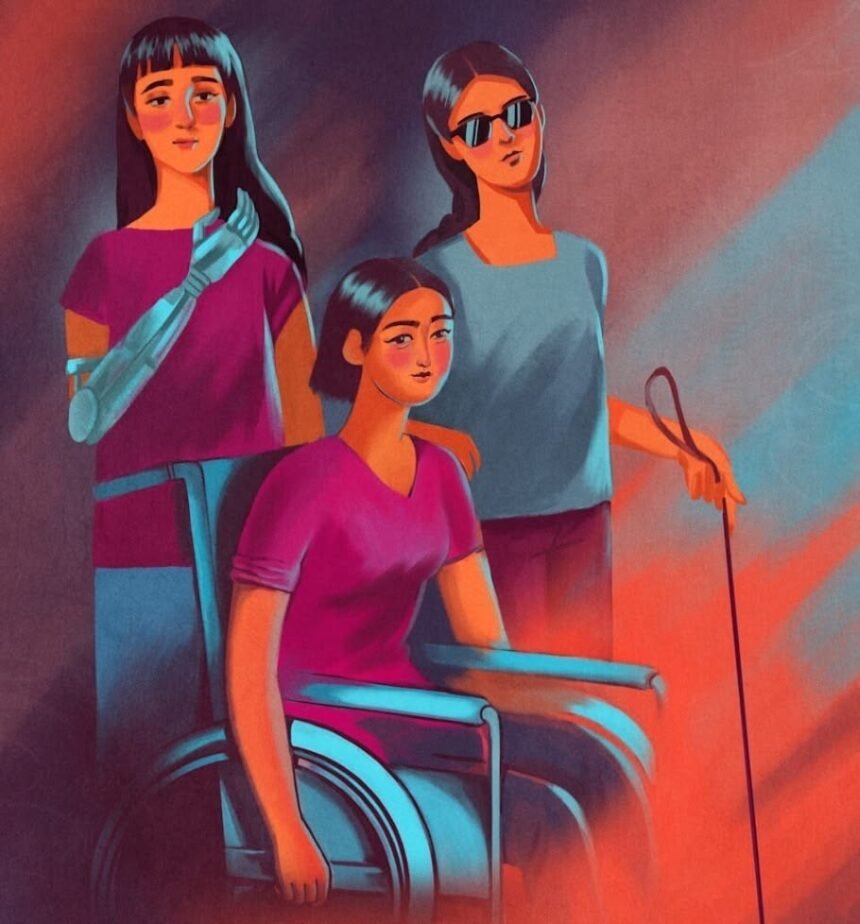
Gender has always influenced women’s experiences in the world and in society at large. For the longest time, it has shaped their access to education and employment, the healthcare they receive, their ability to move freely, and the expectations and standards society places on women regarding marriage and family life. These experiences cannot be separated from other identities that women embody. Hence, for women living with disability, their identity of “woman” and “disability” overlap and have an impact and influence on how society views them, the institutions that they have access to and the opportunities that are made available to them. To fully comprehend the experiences of women living with disability, we must understand the interaction between the two; however, we must also consider that not all women have the same experiences.
Before we get to the meat of the main argument of the article let’s first unpack the concept pf “double barrier”, we can understand the concept through Sherry R. Fairchild who explains it as the double discrimination of gender and disability status, that women with disabilities confront major obstacles even more boldly to achieve equality and full participation in society (2002) in simpler terms these are the discriminatory practices against women because of their gender and discriminatory practices against disability, Fairchild further goes to mention the obstacle that people with disability may face which can manifest as obstacles, such as societal attitudinal barriers, physical environmental conditions, institutional practices, isolation and poverty, functional/mobility limitations, and often chronic conditions and diseases. These factors impact how women experience the world and how society views, treats, and behaves towards them.
For women living with disabilities, education and gender expectations intersect. According to an article by Women Enabled International Facts, “Girls with disabilities are often kept in the home, and their births may not be registered because of assumptions about their abilities or embarrassment on the part of the family.
As a result, girls with disabilities are frequently invisible to the education system,” and even though there has been progress in the inclusion of people living with disabilities in education and institutions like universities, “Harmful stereotypes about the abilities and potential of girls with disabilities contribute to a perception that they are not worthy of an education”, and they might face challenges in moving around the institution, and they also indicated how many of the “special schools” are located in the urban areas. Hence, this comes with another challenge of transportation, not forgetting Educational materials that are extra and are made available in alternative formats, such as Braille, large print, accessible multimedia, Easy Read, plain language, or sign language, so they can learn. Global estimates indicate that only 41.7% of girls with disabilities have completed primary school (Women Enabled International Facts). All this just shows how gender and disability interact and shape the access that women have to education.
This goes further into the working environment, where women with disabilities face double discrimination in the workplace because of their gender and their disability status. According to an article by O’Hara, research has found that disabled women are significantly less likely to secure employment (2004). Even if they do get employment, they are bound to face discrimination from people who lack awareness about their disability, and they might find difficulties adjusting or keeping up with the tasks required of them, meaning that they might require extra help. And lastly, another factor that might affect them is the environment; some work environments may not have been made to accommodate people living with disabilities. Women living with disabilities may face discrimination from people, may have organisational barriers and environmental barriers; hence, the work environment is also shaped by the two identities of gender and disability.
Healthcare is another space where a woman with a disability can mean navigating more than one barrier at once. In the healthcare space, they may lack access to medical information, financial resources, and additional personal assistance. The access may manifest in physical barriers, such as a lack of ramps at some healthcare facilities, and in information that people who are blind or deaf might be unable to access. It does not end there; it also extends to healthcare facilities, where women face additional challenges, according to an article by Hiwot Temesgen Andualem et al.
There is not enough inclusion of people with disabilities in health sector policies; there is a lack of knowledge about their Sexual and Reproductive Health needs; there are misconceptions and poor attitudes of healthcare service providers and society; lack of social support, communicative and attitudinal barriers, lack of trained providers, inaccessible facilities, lack of transportation, high costs of care, unnecessary referrals, and risk factors like being low-income or experiencing violence are among the barriers to accessing Sexual and Reproductive Health services for people with disabilities.
This also connects with many opinions that people have around whether women with disabilities deserve to be mothers and deserve to be involved romantically. As many of them are looked at as “asexual” because of their disability and unfit for marriage or even fit to be romantically involved with someone. Hence we have people who criticise woman with disability for wanting to be mothers with the claim that they will not be able to take care of them and the children will struggle.
But we have to keep in mind that these experiences are not the same for every woman with a disability as experiences differ. Factors such as family, culture, type of disability, economic circumstances and personal choice all shape how women experience relationships and family life. The point is not that disability determines a woman’s ability to marry or become a mother, but that society’s expectations and assumptions can influence the choices and opportunities available to her.
Women with disability face double discrimination for their gender and disability as these identities overlap. Fairchild suggested that “We need to become effective advocates to ensure that appropriate, funded legislation and policies are developed and implemented.”, even though we have laws that recognise all human being as we equal, it must not end up on the paper only it must be put into action, educational and work environment need to progress further to include women with disability both with architecture and working process so that they can participate fully as society members.
In healthcare there need to be more training of the workers to prevent mistreatment, educate the women more about their bodies , communicate with healthcare workers and make informed decisions about their own bodies. Public spaces and transport systems need to be designed in ways that allow people with different disabilities to move independently. In these ways we can minimise the double discriminations against women living with disabilities.