Pakistan is living longer. But who is paying the price for that extra time?
As Pakistan’s population lives longer than ever before, the labour of caring for its elderly is falling almost entirely on women inside joint family homes. It is unpaid, unmeasured, and unprotected by law. This investigation looks at a crisis hiding in plain sight.
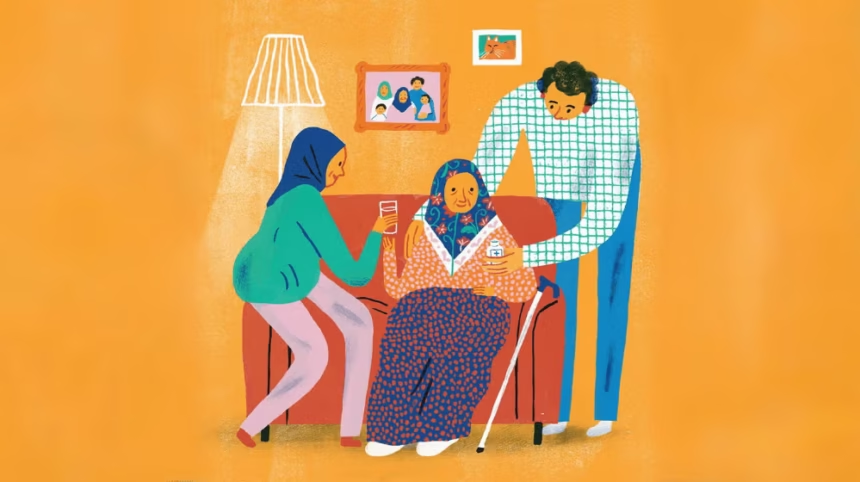
It is 5:40 a.m. in a middle-class home in Peshawar. Amna is already awake. She is 34 and is a schoolteacher. That is her profession, but what often goes unnoticed is this: she is a mother of two, a cook, a cleaner, and, unofficially, a full-time nurse. Before she wakes her children for school, she has to follow a routine – one that has not changed in years. The list goes something like this: check her mother-in-law’s blood pressure, prepare her food, lay out the morning’s seven tablets, and hand them over to her. By eight, she will have followed the invisible protocol: cooked breakfast, bathed and dressed her mother-in-law, talked her out of confusion over an event that happened 20 years ago, and left for a job that pays roughly PKR 35,000 a month.
The other job, well, came as an invisible deal – one that does not pay. It is best described as a debt you owe for being a woman. It starts before sunrise and never really ends. (Amna’s name has been changed to protect her privacy. Her routine, drawn from published caregiver research and echoed across countless Pakistani households, is illustrative of a pattern lived out daily in millions of homes.)
Her story has no headline of its own, and that is the point. Eldercare in Pakistan, and across much of the developing world, is not treated as work at all. It is treated as something women simply do. Behind that assumption sits a mounting demographic, economic, and human rights crisis that policymakers have barely begun to address.
A Global Emergency Hiding in Plain Sight
The scale of unpaid care work is huge once it is actually measured. Women worldwide perform an estimated 16 billion hours of unpaid care work every single day. Sixteen billion – let that sink in. This involves cooking, cleaning, and looking after children and the elderly.
A UN Working Group on discrimination against women reported that women and girls shoulder 76 per cent of unpaid care responsibilities globally, worth an estimated 10.8 trillion US dollars a year if it were ever paid for. If counted at all, unpaid care work would exceed 40 per cent of GDP in some countries – more than the entire manufacturing or transport sector.
The consequence is what UN Women calls “time poverty”: less time for paid work, education, rest, or any life outside the home. Estimates from the International Labour Organisation found that 748 million people worldwide were kept out of the labour force due to care responsibilities. Of those, 708 million were women, compared with only 40 million men. Caregiving is one of the single largest forces pushing women out of paid employment anywhere on earth.
Pakistan’s Ageing Clock Is Ticking Faster Than Its Safety Net
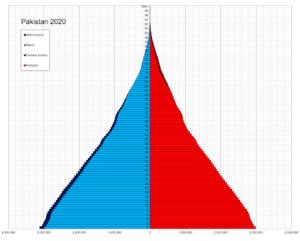
Pakistan is often described as a young country, and demographically it still is. But it is ageing too, and quickly. Roughly 13.7 million Pakistanis are now over 60, about 7 per cent of the population. That figure is expected to nearly double by 2030 and keep climbing towards mid-century as life expectancy – now around 68 years overall and higher still for women at roughly 70 to 71 years – continues to rise. Women are likely to spend more of their later years both needing care and, earlier in life, providing it.
Formal support has been consistently unable to keep up. Only about 2.3 per cent of Pakistanis above the legal pension age receive any public pension, according to research cited by The Friday Times. That leaves the overwhelming majority of older citizens, and the relatives who look after them, with no institutional cushion at all. Health financing makes things worse: roughly 89 per cent of Pakistan’s private health spending is paid out of pocket. Every hospital visit, medicine strip, or diagnostic test for an ageing parent is quite literally paid for out of a family’s – usually a woman’s – daily budget and time.
“It’s What Daughters Do”: The Cultural Script
Ask why it is women who take on this labour, and the answer in most Pakistani households is not economic. It is cultural. A qualitative study published in BMC Geriatrics, based on interviews with daughters and daughters-in-law providing care for the elderly in Karachi, found that caregiving is treated as an unquestioned obligation, rooted as much in religious and social expectations as in affection. Daughters described the work as a kind of role reversal for the parents who once cared for them. Daughters-in-law, notably, said their sense of duty came less from personal attachment than from obligation to their husband’s family – an obligation few felt able to refuse.
A separate study in the Journal of Ageing Research, based on focus groups and interviews with 52 women caregivers in Sargodha district, Punjab, found that women were the primary decision-makers on everything from medicine schedules to when, or whether, to take an ageing relative to hospital. One daughter-in-law caregiver, describing her role in managing her mother-in-law’s medication, put it simply: “I usually give her medicine, but she also remembers it from the tablet box.” Rural caregivers in the same study reported that a single hospital trip could take up to an hour each way and cost money most families could not easily spare – a burden absorbed silently, and repeatedly.
The Triple Shift: Health, Home, and a Job
Researchers have a name for this: the “triple shift”. Paid work, housework, and caregiving – all three stacked into the same 24 hours, carried by the same person. No extra pay for any of it. No formal recognition. Nothing built in to actually relieve the pressure: no respite care, no subsidised home nursing, no paid leave to take when it all gets to be too much.
And the toll on the body is real, even if nobody is writing it down. The exhaustion that never quite lifts. Sleep that keeps breaking apart, night after night. The strain of lifting another adult’s full weight, again and again – the kind of physical wear that would get flagged instantly in any other job, but here just gets absorbed, quietly, because the work itself was never counted as work in the first place.
Laws That Protect the Elderly, Not Their Caregivers
Pakistan has, in fairness, begun legislating for its ageing population. The Khyber Pakhtunkhwa Senior Citizens Welfare Act was passed in 2014, followed by Balochistan’s Senior Citizens Act in 2017 and Sindh’s Senior Citizens Welfare Act the same year. The Islamabad Capital Territory Senior Citizen Act, 2021, established a Senior Citizens Council and an old age home named Dar ul Shafqat, and the Parental Protection Ordinance, 2021, made it a criminal offence to forcibly evict elderly parents from their homes. Most recently, Punjab passed its own Senior Citizens Welfare Act, covering residents aged 70 and above and formally shifting ageing, in the words of HelpAge International, “out of the realm of charity and into public responsibility.”
These are meaningful steps. But each is written from the perspective of the elderly person receiving care, not the one providing it. None of Pakistan’s senior citizen laws recognises informal family caregiving as work, offers caregivers any form of paid leave, respite support, or social security credit, or provides legal recourse for the health and income losses caregiving can cause. Elderly women who become widows face a further gap. Advocacy groups have pointed out that existing senior citizen legislation does little to address widowhood, inheritance disputes, or the particular vulnerability of older women who lose a spouse and, with him, whatever financial security they had.
What Would Actually Change This
So what would actually fix this? Ask the people who study it, and their answers tend to circle back to the same few measures. Start by just measuring the work, honestly, through time-use surveys, and eventually let that show up in how the country counts its own economy. Because right now, nothing about this gets counted, and things that don’t get counted don’t get funded. That’s not a policy failure so much as a mathematical problem nobody has bothered to solve.
Then build something real around it: subsidised home nursing; day-care centres for elderly people, run by the community rather than left to whichever daughter happens to be free that week. Train the doctors and nurses already working in this country to actually understand geriatric care, so families are no longer the only safety net in the room.
Give people structural tools, too. Paid leave for caregiving. Flexible hours. Pension credit for the years someone spent looking after a parent instead of climbing a career ladder. Right now, caregiving is treated as a personal choice or an interruption, when it deserves formal protection, the same as maternity leave or illness.
And write something, finally, for elderly women specifically. Address widowhood, inheritance, and the particular vulnerability that comes with losing a husband and, with him, whatever financial ground you were standing on. Because if nobody protects them now, the weight just gets handed straight back down to the next generation of daughters and daughters-in-law. It doesn’t stop; it simply repeats.
None of this is asking Pakistani families to stop caring for their elders, or to walk away from the values that make that happen in the first place. It is asking the country to admit something simpler: that care is work, wherever it happens, whoever is doing it, and no state gets to keep running on women’s unpaid labour just because nobody has ever sent them a bill.
Amna will be up again tomorrow at 5:40 a.m., same as always. Whether anyone notices is still, for now, a matter of guessing.