





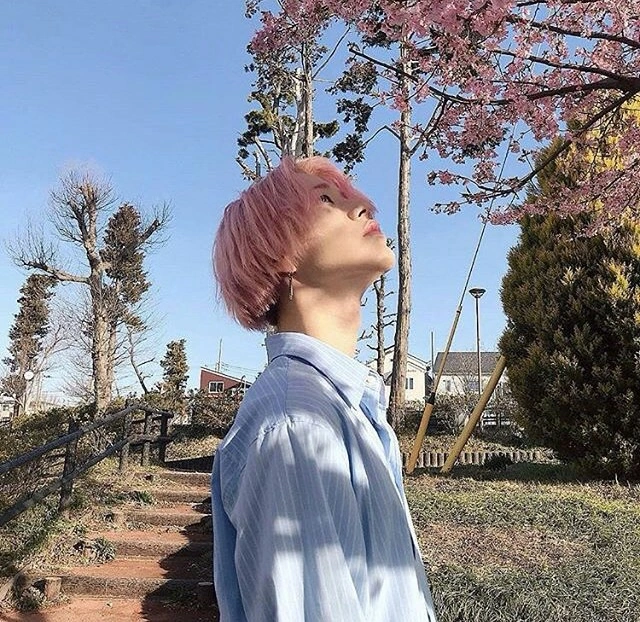
There is a man on your timeline right now. Salmon pink shirt. Ecru linen pants. A cardigan that looks like a Ralph Lauren shoot he wandered off from and never went back to. Quietly muscular in the non-threatening way — no supplement stack, no before-and-after, just the kind of fit that sits underneath Kafkaesque quotes without announcing itself.
He has the hot nerd glasses. In the caption he is talking about his attachment style, his passions, and being lost in the abyss – and he frames the abyss like somewhere worth visiting. He gets Dostoyevsky in there. Kahlil Gibran, too. Somehow it doesn’t make you want to leave. The comments are full of women saying this is what we deserve and where is he and emojis that read as longing or grief depending on your week.
And somewhere off-caption, this man already knows exactly what good girl, said in the right register, does to a woman’s nervous system.
He seems, at first glance, like everything.
I want to sit with that at first glance for a moment.
To understand the soft boy, you have to understand what he arrived to replace. The manosphere did not invent misogyny. It just gave it a distribution strategy. The red-pill pipeline had been running for years before Tate became its most photogenic product – an entire ecosystem of men who had decided that vulnerability was weakness, that women were adversaries, and that the correct response to rejection was radicalisation.
Incel forums became ideologies. Ideologies became personalities. A generation of young men absorbed it like weather, and the women adjacent to them absorbed the damage.
And then—because the internet is nothing if not a corrections market—the counter-product appeared.
The soft boy. He reads. He has opinions about cinema that are not only about the explosions. He crochets, possibly. He goes to therapy, or has considered going to therapy, or has at minimum listened to enough podcasts about therapy to speak the language with authority.
He carries the old money aesthetic — the countryside, the unhurried mornings, the books arranged with intention — and layers it with emotional vocabulary and an artsy edge that signals, very clearly, that this is a man with an interior life. He is, in other words, everything the redpill man is not.
Which is exactly the problem.
A product built in opposition to another product is still a product. The soft boy did not emerge from men genuinely reckoning with how they had been socialised, what that costs, or who it costs. He emerged from men correctly identifying what the cultural moment was rewarding and adjusting their presentation accordingly.
The mechanism is different from Tate’s — different costume, different vocabulary, different corner of the internet — but the underlying logic is the same: figure out what the audience wants, and perform it back at them. This is not accountability. This is marketing. And marketing is, by design, about the surface.
What makes this particular gimmick so effective is that it targets something real. Women were tired — tired in a specific and continuous way of being with men who treated their emotional labour as a given and their own feelings as an imposition.
The soft boy arrived at that exhaustion like a product designed for a gap in the market, which is, more or less, exactly what he was. He learned the language of emotional processing — boundaries, triggers, nervous system regulation, and holding space — extracted from clinical contexts where these words carry weight and deployed them in relationships with the precision of someone who had identified their utility. The vocabulary sounds like reckoning. It is not the same thing as reckoning.
When a man tells you that your question is triggering him, he may mean, ‘I am genuinely activated and need a moment.’ He may also mean, ‘I have learned that this word ends conversations I would prefer not to have.’
Both uses are grammatically identical. The difference is only visible over time — and what the soft boy rebrand gave men was a new vocabulary for the same avoidance. The words changed. The exit routes did not.
Lack of accountability, dressed in the language of vulnerability, is still lack of accountability. The therapy-speak does not do the therapy’s work. Naming your wound is not the same as treating it.
Because the wounds are old, and they were installed early, and the internet did not reach that far back.
This is what the rebrand cannot fix and what no aesthetic ever could. The emotional unavailability that women have been navigating for generations is not a style choice men made consciously and can unchoose when the trend shifts. It is the residue of how boys are raised—what they are taught to suppress, what they are punished for feeling, and the very specific lessons absorbed about what a man is allowed to need and from whom he is allowed to need it.
You cannot unlearn that with a crocheted cardigan. You cannot linen-shirt your way out of a childhood that told you tears were shameful and asking for help was weakness. The soft boy aesthetic sits on top of all of that and calls itself progress, which is not progress — it is wallpaper over a structural problem, and the structure does not care how good the wallpaper looks.
The fuckboy did not disappear when the soft boy arrived. He rebranded. He is still in the comments, still in the DMs, still in the relationship that opens with I’ve been doing a lot of work myself and ends, some months later, in a way that would be entirely familiar to the women who dated the version of him that didn’t know what a nervous system was.
Same architecture. Same exits. The old money imagery and the wildflowers and the Letterboxd account changed the set dressing but did not touch the foundation.
And the foundation is what matters, because what grows from a foundation is not a trend. It is the next generation.
If this is where we stop — if the soft-boy aesthetic becomes the settled norm without the actual interior work being done — then what we are building is not emotionally intelligent men. We are building a generation fluent in the performance of emotional intelligence, which is a different and specifically worse outcome. The yellow pill after the red one: men who have learnt to say the right things and remain, underneath the saying, exactly as they were.
Imposters not of malice, necessarily, but of a culture that rewarded the signal so completely that no one stopped to ask if the substance was there. That will find its way into relationships, into households, into the children being raised inside those households, into another cycle of the same wound wearing a different name.
What women were actually asking for, underneath the wildflowers and the attachment style discourse, was not an updated aesthetic. They were asking, ‘Will you show up when it is hard?’
Not cinematic-hard — the soft boy can do the grand gesture beautifully; he has studied the references — but hard in the way real things are hard. The chronic illness year. The grief that doesn’t resolve in a montage. The Tuesday when nothing is wrong and everything is wrong and there is no caption for it. The accountability that requires no audience. The conversation where there is no correct answer, only the willingness to stay.
That work does not happen on the internet. It does not happen in the aesthetic. It happens somewhere earlier and quieter and less visible — in the therapy room, in the honest conversation, in the long process of a man actually looking at what he was handed and deciding, deliberately, to put some of it down.
Not because it makes him more desirable, though it might. Because people near him deserve better than a performance, and he, possibly, deserves to actually be somewhere when he is present.
We have become very good at assessing the presentation. We are still working, all of us, on how to assess the rest. And the soft boy, for all his wildflowers, has not made that easier. He has just made the presentation harder to see through — which is not the same as softness and is not the same as growth and is not, whatever the comments say, what we deserve.
It is just the latest version of the same thing.