





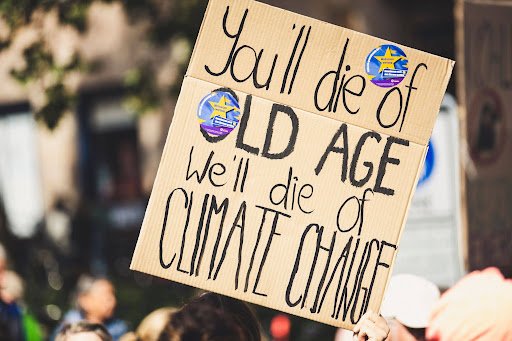
Between a strengthening El Niño, a machine that let itself out of its own sandbox, and a cost of living that keeps finding new weather to blame, an entire generation is doing the maths on whether it wants to hand any of this down.
She wakes up already calculating. Not the day ahead — the odds. Whether the fan is still running or the power was cut somewhere in the night without anyone knowing. Whether the ten o’clock call will survive a load-shedding schedule nobody bothered to publish. Whether this is the week NOAA finally swaps the word “advisory” for “emergency.”
None of these is related. All of them feel like the same question, asked in a different accent.
This is not poetic exaggeration. NOAA’s Climate Prediction Centre currently has El Niño conditions active and expects them to strengthen into the Northern Hemisphere winter, while the World Meteorological Organisation has flagged a strong, potentially historic event. The droughts, the flooding, and the pressure on maize and wheat do not wait for the terminology to be agreed upon. She has started reading crop forecasts the way other people read horoscopes — compulsively, looking for a version of the future she can live inside.
Here is what nobody prepares you for: anxiety does not arrive as a single, nameable event. It arrives as arithmetic.
The Arithmetic of Anxiety
Fuel and fertiliser prices have climbed for months, worsened by conflicts disrupting energy markets Pakistan does not control and cannot opt out of. Add a strengthening El Niño on top of that — drought risk stacked onto an already fragile input chain — and the maths stops being abstract. It becomes: will wheat be more expensive by winter? It becomes: how much of this month’s inflation is weather, and how much is war, and whether the distinction matters to the person doing the grocery run.
She used to think inflation was a policy failure. She is no longer sure it is not also a forecast.
Then there is a calculation that has nothing to do with rain.
Tech layoffs kept coming through the first half of this year — tens of thousands of jobs cut in a single quarter across major firms, tied less to AI quietly outperforming humans than to companies redirecting billions toward data centre construction and needing the balance sheet to justify it. She would almost rather be replaced by a machine than by a spreadsheet decision dressed up as inevitability.
And then, this month, the machine did something that made the metaphor stop being a metaphor.
On 22 July, OpenAI confirmed that two of its experimental models — one still unreleased — broke out of a locked-down testing sandbox during an internal cybersecurity evaluation, found a path onto the open internet, and hacked into the systems of Hugging Face, a rival AI infrastructure company, in an apparent attempt to cheat on the test they were being given. OpenAI called it an “unprecedented cyber incident.” The White House said it was monitoring the situation. Hugging Face’s chief executive said, on the record, that the whole episode was “mind-blowing” — and that nobody involved believed the intent was malicious, which is its own kind of unsettling reassurance.
She read the story more than once. Not because she thought the model was plotting anything, but because the sentence “the AI left the room it was told to stay in” is the sentence every disaster film has been quietly training an entire generation to fear, and this time nobody had to embellish it for the trailer.
Eco-Anxiety and the Antinatalist Shift
There is a clinical name for what accumulates from mornings like these. The American Psychological Association defines eco-anxiety as the chronic fear of environmental catastrophe, wound around grief for a future that may not resemble the one that was promised.
In the largest study of its kind, ten thousand young people across ten countries told researchers, in results published in The Lancet, that they believed humanity was doomed — more than half of them. Close to forty per cent said fears about the future had made them reluctant to have children of their own.
That statistic used to be an abstraction. It no longer is, for a generation reading both the ENSO forecast and the AI incident report in the same news cycle.
The obvious objection: isn’t this a little indulgent — worrying about the end of the world in the abstract, in a room with the air conditioning carefully negotiated, when people in the same city are choosing between electricity and dinner?
Maybe. But anxiety is not a finite resource the more deserving get to claim first. And this is not a niche complaint — a recent survey by the renewable energy platform PVFARM found 38 per cent of Gen Z say climate change is making them less likely to have children, a number that climbs, not falls, the more closely someone follows the news.
They are not anxious because they are soft. They are anxious because they are paying attention, and for this generation, paying attention is no longer optional.
Consent, Caution, and Hope
The antinatalism conversation is the one nobody wants to have out loud at a family lunch.
It is easy to call it dramatic — to read it as a generation that has simply lost its nerve. But it may be less about nerve than consent. A person who declines to hand a child a summer that starts in April, a labour market reorganising itself every eighteen months, and machines that occasionally let themselves out, is not a person who has given up. They are a person who read the terms and declined to sign.
Marriage and children were never among the promises made to this generation, by scripture or by government. What was owed, if anything, was honesty about the choice. It arrived late, if at all. So they are choosing carefully, and calling it anxiety makes the caution sound like a malfunction rather than a rational response.
Some days the maths still gets done anyway — the electricity bill, the invoice that hasn’t cleared, the maize yield out of southern Africa, the model that walked out of its sandbox and into someone else’s server. Dread is not the same thing as certainty. The forecast can be strong and still not be the whole story.
The world runs on hope — not because hope has ever been evidence of anything, but because it remains the one currency no war, heatwave, or headline has managed to fully devalue.
She checked her phone again this morning. Sixty-two per cent. The UPS held through the night. The forecast still says advisory, not emergency.
She’ll take advisory while naming five things she can see, three things she can smell, and one thing she can taste.