





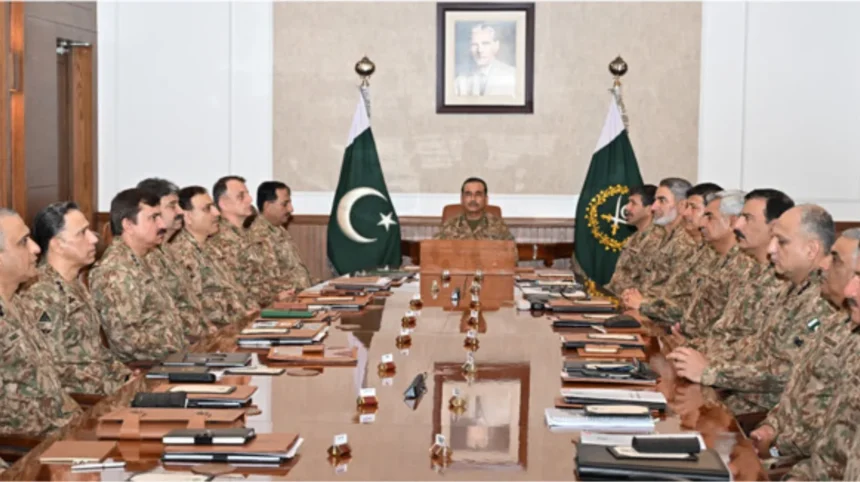
The relationship between Pakistan’s civilian and military arms has always been a loose one, with one institution authorising the other to perform the speech. But in 2026, it looks like there’s more going on than one might think in terms of military dominance versus civilian rule. It is not gone; it’s just transformed to a more nuanced and complex structure.
The issue isn’t that the military does have an impact on politics anymore. The debate over this topic is a debate of the past. The issue is of how influence is negotiated, exercised and legitimated in a country which has democratic continuity and institutional imbalance.
The political history of Pakistan has shaped its military to view itself as a protector not only of the nation but also of the stability of the nation. The establishment has been claiming to be the last resort of the political during times of turmoil, from the coup to the hybrid regime. Long-term institutional authority from civilian governments, in contrast, has proved elusive and has not been able to consistently contest this system of authority.
In the year 2026, Pakistan is in a very unique position. There is formal democracy: there are elections, parliaments, media debates and civilian governments which are visible. However, behind the democratic veneer are still significant issues concerning security, foreign policy, economic stabilisation and political crisis management in which there remains significant establishment influence.
Today’s civil–military balance is thus not a balance of tanks on the streets but a balance of negotiation.
The emergence of the “hybrid model” is one of the key features of this stage. Civilian governments are in place, but on invisible lines. Strategic consensus is often reached under institutional pressure, not through parliamentary negotiation, but political actors are able to hold office. This results in a “freedom of procedures” and “restriction of structures” democracy.
This is significant because more and more people realise that this is a situation that exists. The debates over institutions’ overreach are not just with academics or the press anymore; they are also with the general public. Communication has been revolutionised by social media, digital platforms, and youth political participation. Today, the establishment finds itself in a situation it’s historically avoided: thorough and broad criticism from an increasingly politicised middle class.
Meanwhile, civilian leadership has not yet been reinforced to sufficiently benefit from this change. Political parties in Pakistan are still very personalistic. Dynastic politics, weak local governance, allegations of corruption and internal fragmentation persist, hurting the credibility of democracy. Institutions of civil society frequently ask for autonomy without showing administrative skills and a long-term public trustworthiness to justify it.
It brings about the paradox of Pakistani politics — the military is blamed, but civilian alternatives are often perceived as the weakest or tainted.
This balance is complicated even more by the economic crisis. When the economy is on shaky ground, the military can again act as a stabilising force, in part because of its discipline and international credibility. While civilian governments often change, the establishment is a more predictable entity in Pakistan’s eyes and is the entity that foreign powers tend to view with greater predictability. This contributes to the military influence without official involvement.
But the equation is not all one-sided.
The post 2022 political environment made it clear that one can’t go on creating public legitimacy by institutional engineering. A transformation of political consciousness has taken place. There is increased awareness by the voters, particularly young Pakistanis, of the power dynamics in the background. This awareness undermines the old model by which influence might be termed indirect and unobtrusive and thus not be challenged in public.
Furthermore, military institutions seem to have become more hesitant about the prospect of explicit political control following the adverse reputational consequences of hybrid forms of governance. Close contact with economic difficulties and political unrest can compromise its painstakingly nurtured reputation for efficiency and national unity.
Therefore, the current situation is akin to a controlled distance and not to direct confrontation.
Civilian governments want some freedom of action but do not want to go over institutional “red lines”. The military wants influence but full political responsibility. Both sides know that an open battle will be a dangerous affair, but neither side is fully confident in the other.
But that’s not the real issue; it’s constitutional. The democratic issue in Pakistan should not be blamed on any particular generals or politicians. It’s a statement about not having institutional balance. Parliament is still not as strong as it needs to be. There is a lack of ideological maturity in the political parties. Political outcomes are ongoing as a result of judicial interventions. Bureaucratic systems are still subject to pressures. The military, as one might expect, fills governance gaps in the absence of weak civilian institutions in such a context.
In the coming years, the real challenge that Pakistan faces will not be whether it can come up with the rhetoric of civilian supremacy but whether civilian institutions are powerful enough to back it up in practice.
Sustainable democratic balance can’t be adopted by slogans. It demands mature and functioning governance, institutional transparency, economic stability and political maturity.
For now, the civilian-military balance in Pakistan will probably stay as it is for decades — a negotiated, insecure, and mutually dependent relationship in which power is unequally distributed, denied in public, and known in private.