





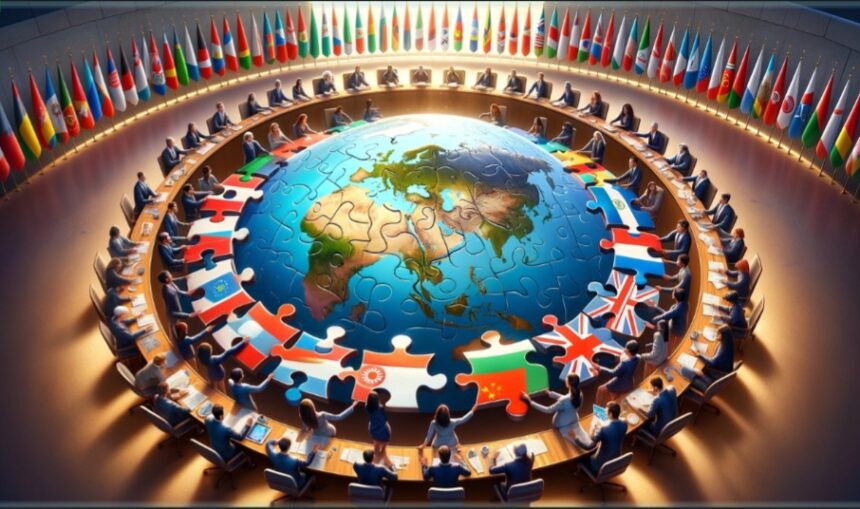
Power abhors a vacuum. After the fall of the British Empire, the United States took control of the world stage. Today, as American hegemony erodes, the failure of any state or institution to fill the resulting void has left the global system increasingly orphaned, leading to a crisis-ridden world.
From Pax Britannica to Pax Americana
Over the course of history, states contested for control of the trade routes, strategic resources and critical regions to exert and expand their influence. In doing so, they emerged as de facto guarantors of international order. From Pax Britannica to Pax Americana, one underlying feature remained constant; both were based on coercion and structural inequality. Whether it is Britain’s control over trade routes or the United States’ post-war rules-based order, stability was maintained through asymmetric power relations.
When equilibrium collapsed, it was mainly because the centre refused to pay the cost of maintaining order in the periphery, either in the form of security or development. The contemporary leadership crisis emerges not only from the structural weaknesses within the system but also from a recurring miscalculation of the inherently tenuous nature of the world order itself. For decades, the post-Cold War world order system projected the image of lasting U.S. dominance.
The reality is that all hegemonic systems eventually face the constraints of overextension, domestic fatigue, and competition. This is what the world is experiencing right now: the decline of the U.S. empire is crippling the world system.
The Waning of American Primacy
The pace at which the U.S. system is losing its ability to shape global outcomes, and the preparedness of alternative powers such as BRICS or China to capitalise on this shift, is unprecedented. Some scholars view the U.S. as a leviathan power, pointing to its unmatched military capabilities, extensive alliance networks, and global economic reach.
The U.S.’s assertiveness in reinterpreting the Monroe Doctrine and shifting strategic interests toward regions such as Latin America and Greenland has unleashed its hegemonic dominance. However, the situation is nothing but the reassertion of a declining power on the world stage.
The U.S. illusion of dominance has been eroded by prolonged conflicts, particularly in the Middle East. This has weakened the U.S. not only in the international system but also in domestic politics. People have lost their trust in U.S. foreign policy and are not willing to invest in wars.
The Absence of a Successor
Historically, a smooth transition from one power to another power helped maintain continuity in the international system and protected the world from major wars after the Second World War. The current problem is the inability of states to create a stable currency reserve system and sufficient military capacity, keeping the world in chaos. China is, no doubt, emerging as an economic power, but it still lacks the power and influence required to architect the global power structure.
Similarly, BRICS nations are making efforts to reduce reliance on the dollar by conducting transactions in local currencies but have not yet been able to challenge dollar dominance effectively. As a result, the world remains under fragmented American leadership even though trust has deteriorated.
The main reason behind all this is that no state is prioritising collective discipline over strategic hegemony. States are pursuing their own national interests while ignoring regional benefits and global public goods. At the same time, the international institutions have failed to develop a consensus among competing states, exposing their incapacity to manage crises effectively. Thus, the twenty-first century is marked by the decline of a superpower and the incapacity of states, coalitions or institutions to manage the international governance system.
The International System stands at a Crossroads
The unipolar world order is declining, and with no clear successor, the future of the global system remains highly uncertain. Different scholars predict different trajectories through which the current situation may unfold.
Scenario 1: Cooperative Multipolarity
One possible future is the emergence of a multipolar world order in which multiple states, such as China, Brazil, the European Union, and the U.S., collectively manage the international governance system. Each state balances the power of the other state, thereby creating a system of checks and balances within the international order itself. This structure can make international institutions more effective by giving a voice to stakeholders in the decision- making process rather than being controlled by a hegemon. Such a system would enhance the legitimacy of global governance and encourage collective efforts to resolve transnational issues.
Scenario 2: Competitive Multipolarity
The second most probable scenario is competitive coexistence of major global powers. Under this system, states will continue to cooperate and challenge each other’s power. China and the United States would remain the most influential states on the world stage, while other powers such as Brazil and Russia would continue to shape international affairs. Geopolitical divisions would be amplified among states. National and regional interests would be prioritised over collective public goods. The effectiveness of international institutions may be limited by strategic rivalries and competing interests. This kind of world system may succeed in maintaining stability by avoiding major confrontations, but it cannot provide a robust framework for addressing global issues.
Scenario3: G -Zero
G- Zero suggests a world order in which no single power is willing or capable of providing global leadership. This highly unpredictable international system would be characterised by symbolic institutions. States would prioritise their national interests even at the expense of global order. As a result, international cooperation would decline, and crises would be managed in an ad hoc rather than coordinated manner.
The world order is transitioning from unipolar to a fragmented world order. What we are witnessing is not a lack of power but the absence of a capable successor. No matter what the future holds, one thing is certain: the weakening of central authority. In a world grappling with crises, more than ever in history, the redistribution of power has left the world increasingly divided.