





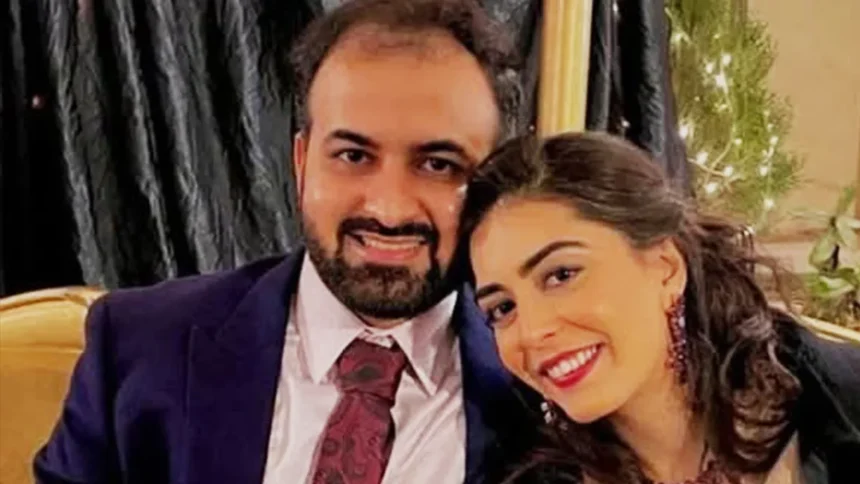
Human rights lawyers who used to fight for the rights of ordinary citizens with no financial supporters are now seeking justice for their own rights. It is unjust to sentence 17 years of imprisonment to individuals having no criminal background, who have never engaged in corruption, and have consistently given back to society, whether through pro bono cases, defending those accused of blasphemy, or supporting victims of sexual violence.
Their work always contributed to justice in society. Yet today they are confined in Adiala Jail for allegedly tweeting under the Anti-Terrorism Act and calling out authorities for their inadequate efforts. What was their crime? Demanding transparent government and questioning the unlawful conduct. On the other hand, those involved in corruption, with criminal charges pending against them, continue to hold positions of authority.
“Every voice raised for rights finds its way to a prison cell.
Every lawyer defending justice learns the language of jail walls.
Every politician who opposes authoritarianism ends up behind bars and even exiled.”
(…..)
The recent case shed light on serious concerns about the misalignment of Pakistani law with human rights standards involving Iman Mazari and her husband, Hadi Ali Chattha. Individuals reportedly harassed and intimidated and had faced reprisal after exposing controversial state policies on their ‘tweet’, which highlighted the increasing number of disappearances in Balochistan. Their post also criticised military officials, which drew further attention towards them. Both of them are human rights activists; Imaan Mazari is the daughter of PTI party member Shireen Mazari.
On 12 August 2025, the National Cybercrime Investigation Agency (NCCIA) filed a complaint under the Prevention of Electronic Crimes Act (PECA), which brought this to public attention. They confirmed that the post is “Associated with the terrorist groups in Balochistan, and her husband is accountable merely for reposting it”. In September 2025, an Islamabad court issued non-bailable warrants against the two, which is quite alarming. Imposing such severe restrictions at an earlier stage is rare. The apparent failure of judges to scrutinise the evidence thoroughly could amount to a “Miscarriage of Justice” within the judicial system.
On 23 January 2026, Islamabad police arrested Iman Mazari and her husband while they were en route from the Islamabad High Court (IHCBA) vehicle to the District Sessions Court The court, according to the information provided by the Human Rights Commission of Pakistan.
At the time, the president and secretary of the Islamabad High Court Bar accompanied them as the police took them into custody. The arrest occurred despite an order issued by The Islamabad High Court, on 21 January 2026, granted them temporary bail, an opportunity to present a complete defence. Subsequently, the police called upon the dormant and backdated FIRs against the two. One of these inactive cases, dating from Jul 2025, relates to an ongoing protest organised by the Baloch Yakjehti Committee in Islamabad, and in the given complaint, accused Mazari of assaulting a female constable, and Chattha was held accountable for firing at a police officer.
Even the Human Rights Commission of Pakistan has strongly condemned this act of violence, describing it as an unlawful arrest. The couple should be released immediately. “Arresting lawyers in the presence of the bar leadership and taking them to an undisclosed police station constitutes grave abuse of authority and contempt for due process”.
On January 24, the Sessions Judge of the Islamabad-West Criminal Court sentenced them. Both Imaan Mazari and Hadi Ali Chattha received a combined sentence of 17 years’ imprisonment and a fine of 36 million rupees each under sections 9, 10, and 26-A, which include glorification of an offence, cyber terrorism, and spreading misinformation, under Pakistan’s controversial Prevention of Electronic Crimes Act (PECA) 2016. Babu Ram Pant, Amnesty International’s Deputy Regional Director for South Asia, considers this case a blatant abuse of the justice system. He reacted to the cancellation of bail, saying that “Pakistani authorities must end the judicial harassment and coercive tactics used to silence dissent and intimidate those who defend human rights”.
Nevertheless, the Ministry of Interior of Pakistan defended the arrest by saying that “The couple was not arrested for criticising the authorities, nor is their arrest related to freedom of speech. It is connected to their ongoing legal case.” The ministry urged that the arrest should not be linked to political persecution.
Where Article 19 of the Constitution of Pakistan and International Law, and Article 19 of the ICCPR guarantees freedom of expression; the Anti-Terrorism Act 1997 has consistently been applied in ways that violate basic rights. The government initially enacted the Act to address serious violent crimes and imminent risks. Still, because of its vague or broad definitions, it has been applied to situations that do not involve actual terrorism. In numerous ways, the Anti-Terrorism Act is deeply flawed; it undermines constitutional protection, domestic legal protections, and international human rights standards.
The ATA provides unchecked and excessive powers to law enforcement institutions, which is particularly alarming in a country like Pakistan, where allegations of torture or extrajudicial killing resurface repeatedly. The government of Pakistan has established special Anti-Terrorism Courts for such cases, which do not provide the same procedural safeguards as an ordinary court, thereby significantly compromising the right to a fair trial.
As a matter of fact, the officials are using the ATA to shield themselves from scrutiny and accountability. Even if the person criticises the government or incorporates a political opinion, authorities may consider that behaviour as ‘terrorism’, which leaves little distinction between legitimate dissent and actual violent crime. The law also allows for the imposition of the death penalty in such cases. Consequently, this creates a hostile environment, discouraging lawyers or citizens from speaking out against the unjust authorities due to the risk of severe and extreme unfair measures. “This is a recipe for turning an innocent person into a suspect, and a suspect into a culprit, even a dead culprit. The law almost assumes guilt. It makes things as difficult for the accused as possible behind the fig leaf of due process.” Aziz Siddiqui, Human Rights Commission of Pakistan.
Such a case of an innocent facing jail time for merely speaking up is not the first isolated case of law-abiding citizens facing terrorism related sanctions; many more cases have gone unnoticed, with only a few getting media attention. One such case is that of Dr. Mahrang Baloch, a doctor by profession, a human rights defender, and a leader of the Baloch Yakjehti Committee, who has been imprisoned and serving her sentence for nearly one year. On March 22, 2025, the Police arrested her during a sit-in protest in Quetta. Later, the authorities registered an FIR against her, which includes charges of terrorism, rioting, sedition, and incitement to violence, as well as an allegation of taking the bodies of militants from a morgue.
However, she maintains she was merely protesting against the repeated disappearances in Balochistan, and the allegations against her remain unproven. She is currently serving her sentence at Hudda District Jail in Quetta. Her prominent team of lawyers has been fighting against the unlawful arrest of Mahrang.
A country in which its own citizens fear the consequences of speaking up cannot truly be considered a democratic state; rather, it will eventually begin to reflect an authoritarian regime. When individuals are afraid to convey their opinions for fear of being prosecuted under the Anti Terrorism Act, democracy will lose its importance.
A system in which citizens either remain silent or face harsh consequences does not align with the definition of transparent democracy. Instead, it highlights the crucial part that individuals in power dictate rules that become binding upon ordinary citizens, even if such rules operate an oppressive narrative. The issue remains unresolved, particularly in the absence of a fair trial and adherence to proper legal procedure. When the law appears to silence dissent rather than protect justice. When authorities exercise power without checks and balances, it undermines the essence and authenticity of our legal system.
The International Covenant on Civil and Political Rights (ICCPR) stated: “Lawyers should be able to perform their professional functions without intimidation, hindrance, harassment, or improper interference, and should not be prosecuted for actions taken in accordance with their professional duties or for the legitimate exercise of freedom of expression.”