





We face a new inflationary problem. Its origins are social and political, not economic or monetary. – Audrey Jones
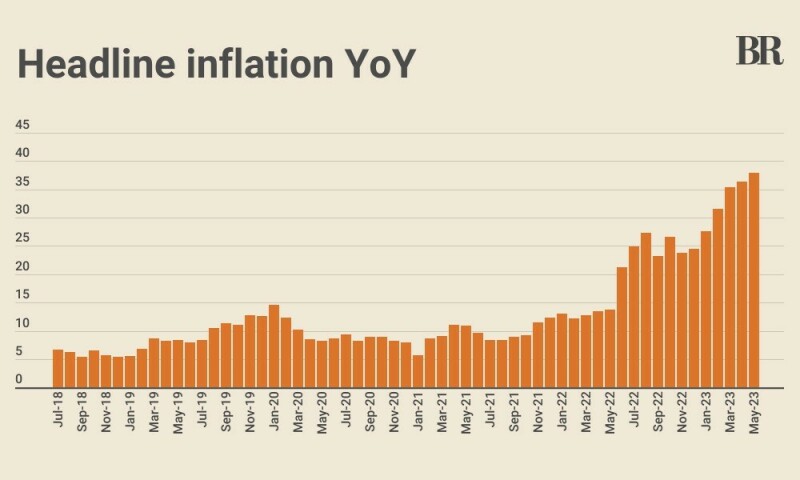
Reports of BTI 2026 show that Pakistan’s consumer price index skyrocketed from 2022-2023. By May 2023, headline consumer price inflation touched 38 percent, the highest on record in the country’s modern history. The ordinary necessities of life became unaffordable for millions in the country.
The State Bank of Pakistan had already elevated its benchmark policy rate to a record 22 percent and held it there for nearly a year. The surge, driven by subsidy removals, currency weakness, and global shocks, tested the government’s economic credibility. By the end of 2024, inflation had dropped to 4.1 percent, resulting in price stability. Inflation plunged from its peak toward 5 percent; however, the government still struggled to win over the public’s economic trust. Over 700,000 Pakistanis emigrated legally in 2024 in search of better prospects abroad.
This gap between the economic and emigration data depicts what sentiments do the citizens carry, and that is where economics ends and politics begins.
The price control in 2024 was not the government’s to take credit for; the fall in inflation was propelled largely by high base effects, monetary strains, IMF-mandated fiscal consolidations, and the normalisation of global commodity prices post-Ukraine shock. The SBP only began its first rate cut in four years in June 2024, reducing the policy rate by 150 base points to 20.5 percent, a signal that the worst had passed. Real interest rates had by then turned drastically positive, insinuating that while prices were finally receding, the cost of borrowing money for businesses and households remained punishing.
There is sheer juxtaposition at the heart of conservative stabilisation: the cure itself is a form of suffering. The IMF-backed program that arrested the slide toward default in 2023 required the government of Shahbaz Sharif to promptly raise fuel prices, nearly doubling them within a week and triggering a ripple effect of inflation across essential staples like groceries, electricity, and food.
The government provided price stability, but initially delivered the price spike, which ultimately made stability incumbent. This structurally reveals a fundamental weakness in Pakistan’s state capacity for economic management. Rather than building persistence against inflation, the country staggered into crisis and was rescued by external contingency.
When the SBP finally began decreasing rates, ultimately reaching 10.5 percent by December 2025, defying IMF guidance to preserve a dense stance, it felt less like confidence and more like political pressure relief disguised as monetary sovereignty.
Inflation is never politically neutral, as it dispenses pain unequally. The salaried middle class bore the abrupt losses as wages failed to keep pace with prices that accelerated by approximately 30 percent in FY2023 alone. Workers in informal sectors, who comprise the vast majority of Pakistan’s workforce, were deprived of wage indexation. Rural households dependent on subsidised agriculture inputs saw those subsidies trimmed as part of fiscal consolidation. Meanwhile, those with tangible assets, real estate, or dollar-denominated savings were significantly less susceptible. The current government is visibly trapped between the IMF on the external level and the nation on the domestic level.
The mistrust of 70 percent of people represents the wider distributional picture. Economic exhaustion suppresses political mobilisation, but it also produces a gradual, more perilous form of erosion: a quiet retreat from the idea that any government can deliver. Emigration is used as a political act of exit rather than raising a voice, and that is a referendum conducted on borders instead of a ballot box.
By May 2026, inflation had risen again to 11.7 percent, remaining well above the SBP’s 5-7 percent target range, driven partly by energy price pressures following West Asia conflict dynamics. With a general election scheduled, inflation is a make-or-break outcome for all parties. If prices stay low, incumbents may claim credit. If inflation flares up again, contenders will confiscate it. The incoming government, whatever its composition, will face the common dilemma: stimulate growth or tighten belts, knowing that any blunder will be blamed as negligence or elitism.
Overall, these reports highlight that the inflation saga emphasises a broader insight: economic management and political legitimacy are close-knit in Pakistan. High inflation uncovered the government’s vulnerabilities and jumbled political alliances; its later decline has given the current rulers some breathing room. However, unless growth picks up and incomes rise, the legacy of this cycle will linger. The coming months will tell whether the state can turn its inflation-fighting record into a lasting political strength, or the next global shock will reset the cycle all over again.