





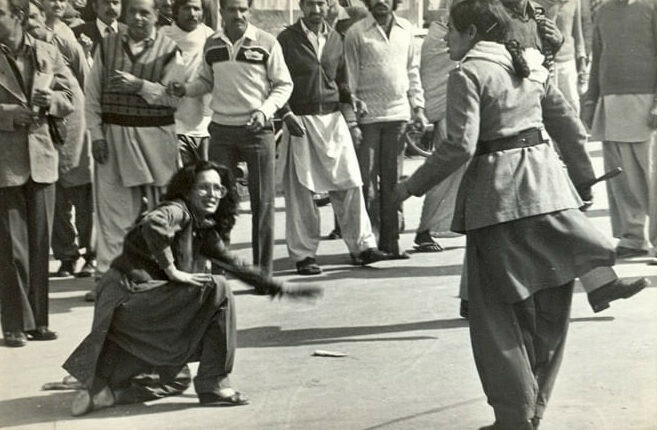
I used to believe history was something that happened to other people. It lived in textbooks, in dates I memorised for exams, and in the names of men whose faces stared from old photographs. It felt complete. Finished. Written. Then I started noticing what those textbooks left out. Not conspiracy theories. Not alternative facts. Just absences. The women who mobilised voters but never made it into political biographies. The grandmothers whose stories never got recorded. The protesters whose signs said things that will never appear in any official archive. I think about these absences constantly. And I’ve come to believe that the most profound reshaping of Pakistan’s national story today is being done not by politicians or generals but by its women – acting not as passive subjects of history but as its active archivists.
I think first of Fatima Jinnah. For most of my life, I knew her only as Madar-e-Millat, Mother of the Nation. A title of reverence, sure, but also a way of keeping her contained. The sister of the founder. A supporting character in someone else’s story. But when I started reading her speeches, I found someone else entirely. Fatima was a dental surgeon — the first woman in undivided India to earn that degree. She campaigned fiercely for women’s inclusion in the new state. She mobilised female voters when few thought women’s votes mattered. And in 1965, at 71 years old, she ran for president against General Ayub Khan. A military dictator. I feel a kind of awe when I think about this: a seventy-one-year-old woman campaigning across the country on a train called the ‘Freedom Special’. Men pulled emergency cords at every station just to hear her speak. Two hundred fifty thousand people gathered in Dhaka alone. She called Ayub a dictator. She argued that his surrender of river waters to India compromised national sovereignty. She gave voice to an opposition that had no other platform. She lost — the election was widely considered rigged — but she proved something I think we still need to remember: a woman could lead opposition against a military regime. That story isn’t in most textbooks. It took me years to find it.
Fatima isn’t alone in this recovery work, and I say this because I’ve spent months digging through archives myself. Begum Rana Liaquat Ali Khan founded the All Pakistan Women’s Association and played an integral role in settling migrants after Partition. She organised women into relief efforts, created economic opportunities, and built institutions that outlasted any government. Benazir Bhutto, for all the complexity of her legacy, was more than just the first woman prime minister of a Muslim country. She governed, negotiated, fell and rose again — a political actor whose full story is still being unpacked, still argued over, still written. I don’t think recovering these figures is about creating heroines. It’s about restoring nuance, sifting through what was saved, and questioning why some documents were preserved, and others were buried.
I feel this most acutely when I think about the Aurat March. Since 2018, women have gathered in Karachi, Lahore, and Islamabad, holding signs with slogans I’d never seen in public before. Mera Jism, Meri Marzi (My body, my choice). Apna Kharcha, Apna Control (My expenses, my control). Ghar ka Kaam, Sab ka Kaam (Housework is everyone’s work). I’ve watched videos of these marches late at night, trying to understand what draws women out despite the threats, despite the backlash, despite everything. The March manifesto demands structural change: implementation of labour laws, recognition of women’s unpaid contributions to the care economy, maternity leave, daycare centres, and justice for religious minorities and the transgender community. I think what moves me most is how ordinary these demands are. How basic. How long overdue it is.
The backlash was immediate, and I say this not because I read it — I saw it. Social media trolling. Death threats. Parliamentary resolutions condemning the march as un-Islamic. Doctored images designed to malign the movement. In the Khyber Pakhtunkhwa Assembly, a resolution was passed unanimously declaring the marchers’ demands un-Islamic and shameful. I read that resolution carefully, and I thought, ‘This too is history.’ This vote, this language, this moment — it documents what happens when women claim public space. Scholar Anjali Arondekar calls this an archive of the present. I think she’s right. Future historians won’t be able to say they didn’t know. Women are documenting it themselves, in real time. As one organiser put it, “No amount of backlash can take away what happens on that day. It fuels us for the entire year.” I believe her.
Before hashtags, before marches, there were other ways of preserving what official history ignored. I discovered Kishwar Naheed’s poem “We Sinful Women” in college, and I still remember the shock of recognition:
It is we sinful women who are not awed by the grandeur of those who wear gowns.
who don’t sell our lives, who don’t bow our heads, who don’t fold our hands together.
I felt, reading it, that someone had written words that had been waiting inside me all along. Literary scholars call this group ‘resistance’, ‘overt rebellion’, and ‘collective empowerment’. I just know it made me feel less alone. Bapsi Sidhwa’s Ice-Candy-Man weaves women’s experiences through the trauma of the Partition. Kamila Shamsie’s Burnt Shadows follows women across borders and generations. These writers don’t present women as victims — they show them as individuals struggling with hybrid identities shaped by colonial history and its aftermath. I think this matters more than we admit.
At a grassroots level, stories of Partition have been passed down not as political events but as sagas of loss and resilience. Histories absent from textbooks, preserved in kitchens, in lullabies, in the spaces between official record and lived experience. Organisations like the Simorgh Women’s Resource Centre have spent decades collecting oral histories from marginalised communities. Recording testimonies that would otherwise vanish. Turning private memory into public record. I think of this as archival work. It just doesn’t happen in archives.
The backlash against all this is revealing, and I say this because I’ve watched it unfold in real time. When women redefine heroes, document oppression, and claim public space with new stories, they challenge who has the authority to tell Pakistan’s story. Journalist Rimmel Mohydin put it sharply: “It is difficult to know where to place your feet when you find that the backs that you have been walking on are now standing up.” I contemplate this sentence often. When Fatima Jinnah’s 1951 radio address was censored by the Liaquat administration. When her manuscript, My Brother, was suppressed for 32 years for containing “anti-nationalist material.” These weren’t random acts. I feel certain of this. They were acknowledgements — proof that women’s voices matter enough to silence.
This archive can’t be burnt like dissidents’ books. It can’t be censored like Fatima Jinnah’s voice. It cannot be dismissed like the slogans of marching women. It lives in Simorgh’s oral histories. In Kishwar Naheed’s poetry. In the signs held high at marches, the Instagram posts documenting every threat, and the scholarship slowly excavating what was buried. It’s unshakeable, I think, because it’s built on lived truth.
Rewriting national history isn’t erasure — it’s completion. I believe this completely. The unshakeable archive isn’t a separatist project. It’s foundational. By insisting that half the population be remembered, this work doesn’t divide Pakistan. It finally makes it whole. It reframes feminism not as an imported ideology but as something simpler and more radical: telling the truth about who we really are.
The official histories will keep being written. But so will this other one. And as long as one woman keeps writing, keeps speaking, keeps refusing to disappear — Pakistan will never lose its past. I think about this every time I sit down to write. About Fatima Jinnah campaigning at 71. About Kishwar Naheed refusing to bow. About the woman holding a sign in Karachi while men shouted threats. About Begum Rana Liaquat Ali Khan organising relief when the state was still finding its feet. About Benazir Bhutto, whatever her failures and triumphs, she stood in rooms where no woman had stood before. About every grandmother whose story never made it into a textbook.
They’re why this archive exists. They’re why it matters. And as long as we keep writing, keep speaking, keep refusing to disappear — they can’t erase us.
The unshakeable archive is the cure. It is the truth that sets history free. And as long as one woman remembers, as long as one story is passed down, as long as one voice refuses to be silenced — Pakistan will never lose its past. And it will finally be ready for its future.