





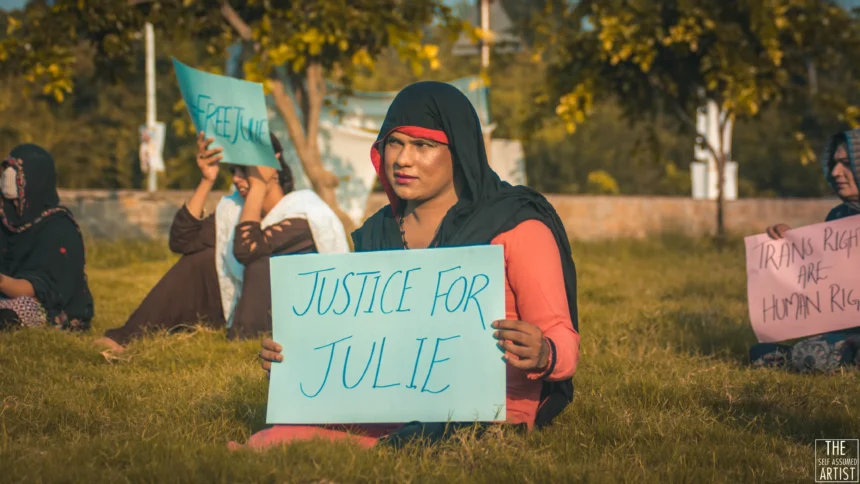
What does it mean to exist if your existence must first be approved?
I once heard someone say, “You can’t examine a soul under a microscope.”
When your state orders you to verify your identity through medical tests, it may appear as an attempt to bring clarity. In reality, it risks turning identity into something that must be proven, examined, and approved. On a surface level, it doesn’t seem or sound like a big deal, but it brings a disturbing threat to the Khwaja Sira community.
Who Are Khwaja Siras?
Khwaja Sira, referring to intersex, transgender, and others who identify themselves out of the biological norms. This might come off as a “new” or “westernised” concept; however, Khwaja Siras have existed for centuries. They are seen everywhere — on streets, at celebrations, in public spaces. Yet they are accepted nowhere — excluded from systems that define stability and dignity. Never recognised, never accepted.
Rights Of Khwaja Siras According To The Law
When Pakistan’s Transgender Persons (Protection of Rights) Act, 2018, allowed Khawaja Siras to self-identify their gender on CNICs without medical approval, it was hailed as a milestone for dignity and rights. Five years later, the 2023 Federal Shariat Court ruling has thrown that recognition into doubt, questioning self-identification and opening the door for medical boards. A community that finally gained legal visibility now faces uncertainty and the risk of being pushed back into the shadows.
What Does The “Medical Board” Proposal Suggest?
The proposal suggests that instead of self-identifying, a person would have to go before a panel — usually including doctors (medical examiners), sometimes psychologists, and in some discussions, even religious scholars. This board would then assess and decide whether someone’s gender identity is “valid”.
Reason For Proposing This Change
The Federal Shariat Court’s 2023 ruling raised concerns that self-identification without verification could be misused for several reasons that could cause disturbance to normal people. It may include;
- Changing genders to get more share of the inheritance.
- Men changing their genders in order to enter female restricted areas.
- Potential misuse in welfare, pensions, or programmes designed specifically for marginalised genders.
- Misidentification could theoretically be used to evade gender-specific obligations in family or civil law.
Moreover, the court is referring to it as implementing Islamic laws.
Though these points come off as very strong, the medical board proposal is taking away the fundamental rights from Khwaja Siras.
Concerns Raised For The Khwaja Sira Community
As per the suggested proposal, the CNIC issuance or updating could require medical approval.
A large part of the Khwaja Sira community doesn’t neatly fall into strict medical categories like male or female. Their identity is shaped by culture, community, and lived experience, not just biology. Therefore, if a medical board uses rigid criteria, a lot of them would be told that they don’t fit into any particular gender, due to which their CNIC wouldn’t be issued — taking away the right to jobs, voting, travel, bank accounts, or even education.
Alongside that, many Khwaja Siras live in poverty and lack formal education. So requiring hospital visits, official panels or repeated verification creates a system they may simply not be able to negotiate with.
From Islam’s Perspective
Historically, in the times of the Prophet Muhammad (PBUH), people we might today call ‘Khawaja Siras’ or gender-nonconforming individuals were recognised and integrated into society, though the context and terminology were different. The Islamic sources refer to ‘mukhannathun’ — men who displayed feminine behaviour or characteristics. They were acknowledged, protected, and integrated into society. Their identity was respected and their dignity remained intact.
Therefore, critics of this proposal argue that the ruling is not about religion per se but about state control over identity under the guise of religion. It creates barriers for the Khawaja Sira community that Islam itself never prescribed. Essentially, it weaponises religion to justify legal scrutiny of personal identity.
Controversy Of This Ruling
Although the court is right on its part, taking away the rights of a whole community just because you fear someone else might misuse the power is inhumane.
Instead of investing their time, energy and power in medical boards, the government should do a minor investigation on its part in order to know if someone is misusing the power. In case someone is caught doing such an act, huge penalties must be imposed on them in order to lower the risks of such cases. Islam doesn’t take any sort of right from the Khwaja Siras; those saying otherwise are biased against the community.
Preservation Of Their Rights
The debate is not about potential misuse — it is about whether the state has the right to decide who gets to exist. For the Khawaja Sira community, a CNIC is more than just a card — it is access to life itself. Every delay, every new hurdle, is a clear signal that legal recognition alone is fragile without societal acceptance and that dignity cannot be granted conditionally.