





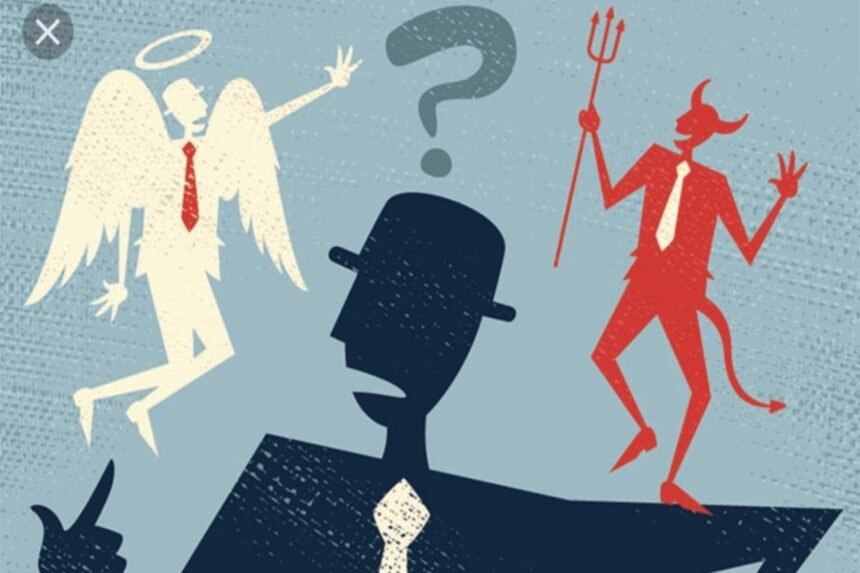
Honestly, it is not always the hero with a perfect personality and a bundle of good habits that inspires the reader; rather, it is a transgressive, yet more transparent character that catches the attention and hooks the eye — the villain. A hero enters to be a saviour and a rule-keeper, whereas a villain is someone who disrupts harmony and questions morality and its value as seen in our society. Strangely enough, we often remember the antagonist more clearly than the protagonist.
Nobody questions the standard idea of a hero and a villain, where we attempt to show the hero as someone beyond the set perimeter of perfection, and the villain as someone who is dangerous and destructive. By the very terms used for a villain, he represents who he truly is; whereas the hero puts on a facade, trying to be someone he ought to be. This happens when we suppress our emotions, desires, and dreams. Just because the antagonist refuses to walk according to the moral compass and follow societal directions, he is cast as a villain.
Perhaps we admire the villain not because he is evil, but because he can do what respectable characters cannot. He is there to expose hypocrisies, express desires without apology, and live without boundaries. This makes the villain more than just an antagonist — he holds a mirror to the world and reveals its true face. That is why he or she is hated and disliked: because no one is ever truly ready to face the truth.
You will remain a hero in everyone’s story as long as you choose to conform to their wishes and choices. You are doing what you are expected to do, and in this race, you eventually lose yourself.
A villain is far more relatable for readers because they spot within him something they have suppressed for societal standards — a dream, a desire, or a wish one cannot fulfil or express. Upon seeing a character who acts on these impulses, one feels seen.
To explain this biased admiration, there is a concept called the “Shadow” in psychology, introduced by Carl Jung. All the parts of ourselves that we are taught to hide or diminish from our personality become part of the Shadow.
How can our nature or traits leave our body and soul? They cannot.
Society expects one to be compliant, selfless, controlled, and so forth. There is a huge, never-ending list handed over to us at birth detailing how to act if we wish to see ourselves accepted in this society. What nobody tells us is that, regardless of what we do, people will still find a way to object to us.
Anyhow, despite all this effort in playing the “perfect person” game, one cannot deny that at the end of the day, a human being can possess anger, jealousy, ambition, a stubborn attitude, and a tinge of selfishness. When we are forced to snub these emotions and traits to act robot-like, they never truly leave us; instead, they become a part of our Shadow.
The Shadow explains the unacknowledged parts of ourselves. Correspondingly, the “Persona” — also introduced by Jung — addresses what people see and what we present to the world. It dictates how one should act, look, talk, and behave, leaving no room for free will.
Literature depicts the face of the Shadow without seeking boundaries or feeling bound by expectations to conform. It simply shows how a person living without bondage and restrictions exists.
Did I hear someone mention Macbeth? So what if he turned vicious and selfish when it came to the throne? Who despises power and authority? Once you possess it, there is always a danger posed at your door — like fear ringing above your head.
In Oscar Wilde’s The Picture of Dorian Gray, Dorian possesses a perfect persona: he is charming, young, beautiful, and apparently innocent. But on the inside resides corruption, a desire for pleasure, and a fear of losing beauty. Hence, he does not age, but his portrait lives through time and depicts the ugliness of his actions. The Shadow here is represented by the portrait, consuming everything Dorian never wanted the world to witness.
Similarly, Lihaaf by Ismat Chughtai reveals the unspeakable sexual desires of a woman and how she suffers from neglect. Begum Jan is a transgressive woman who, to the world, is the respectable wife of Nawab Sahib; yet her unfulfilled desires raise questions about womanhood and its traditional nobility.
Literature crosses the boundaries of morality and immorality to question who gets to design them. It creates characters such as criminals, manipulators, and sexual rebels simply to show the unseen parts of the human experience. Ultimately, it reveals the moral fragility of the order itself.