





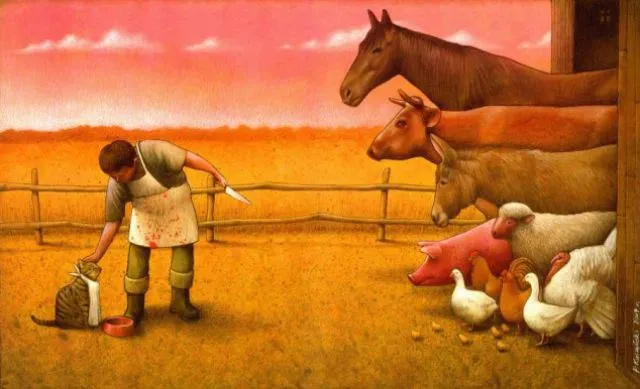
The Moral Status of Animals: Is Carnism a Philosophical Blind Spot?
Most people who consider themselves righteous — who revile cruelty, who donate to humanitarian causes, who believe that suffering matters — eat factory-farmed animals for most meals without giving it a second thought. They cannot be accused of hypocrisy, though. Rather, this phenomenon is more philosophically interesting: an ideology so pervasive in the fabric of daily life that it becomes invisible. Psychologist Melanie Joy coined it as: carnism.
Carnism is the belief system that conditions people to eat certain animals while finding the consumption of others morally repugnant. We eat lamb and recoil at the thought of eating a cat. We consume chickens by the billion and yet feel genuine affection for one in our gardens. There is no principled moral distinction at work here. Only cultural conditioning so deeply embedded it has been mistaken for nature. The question we must ask is: when we scrutinise this conditioning, does it hold up?
Who has Always Counted, and Who Has Not
The philosopher Peter Singer offered one of the most powerful frameworks for understanding moral progress: the expanding circle. The gist of it is that the history of ethics is the history of gradually recognising that more and more beings deserve moral compassion and consideration.
The circle began, in most human societies, with the individual and the immediate kin group. It expanded slowly, painstakingly, and against tremendous resistance to encompass the tribe, then the nation, and ultimately all of humanity. The abolition of slavery, the enfranchisement of women, and the recognition of children’s rights. Each of these moral revolutions was considered radical in its time, and each was resisted by those who insisted that the status quo was natural and correct.
Each expansion was unthinkable to those who had never questioned the current boundary, and apparent to those who had. The abolitionists were told they were being sentimental, that enslaved people were fundamentally inferior and thus undeserving of the moral consideration afforded to the white man, an oppression sanctioned by scripture and tradition. Sound familiar?
The question Singer and others now press is whether the circle has a logical terminus and whether with time and sufficient moral distance, the exclusion of sentient non-human animals will appear as self-evidently wrong as the exclusions that came before.
If a Creature Can Suffer, Is that Enough?
The central question is this: what grounds moral consideration? Different traditions give different answers. The Kantian view ties it to rational agency. The utilitarian tradition offers a more defensible criteria; sentience, the capacity to suffer and to experience wellbeing. For example, pigs have been shown to possess sophisticated emotional lives, chickens demonstrate measurable anxiety, cows have been observed mourning the loss of companions. The consensus on animal sentience has been unifiably hardened since the Cambridge Declaration on Consciousness affirmed that animals possess the neurological component necessary for conscious states.
So if suffering matters morally then the suffering of billions of animals in factory farms demands a justification that goes beyond tradition, taste or convenience. Tom Regan takes the argument further by asserting that animals who are ‘subjects of a life’ — who have perception, memory and and welfare that matters to them — possess inherent value and therefore a right not to be used merely as means to an end. A logical extension of the framework we already apply to humans.
What the Defenders of Carnism Have to Offer
The case against carnism must engage with its strongest objections, the strongest of which argues that practiced with genuine care, the farmer-animal relationship involves a kind of reciprocity: animals receive protection, shelter; humans receive food. The problem arises when we take into account industrial farming.
Others invoke the natural order. Claiming that predation is a natural feature of the biosphere and humans are animals with ecological roles. But this argument collapses when confronted with the fact that non-human predators lack moral agency and thus free from moral responsibilities. While we can be held responsible. We are not wolves. We are beings who can reason about our choices.
Hence, there is a reasonale probability that future generations will regard the mass industrial suffering of animals with the same horror we now feel toward the great atrocities of human history. The current arrangement of billions of sentient creatures confined, mutilated and killed under conditions of tremendous suffering, for the reason that we enjoy the taste and prefer not to thing about it. This is not an ethical position. Its an ethical absence, a blind spot at the centre of a culture that calls itself moral.
Why is stomping on a cockroach easy but not a butterfly