





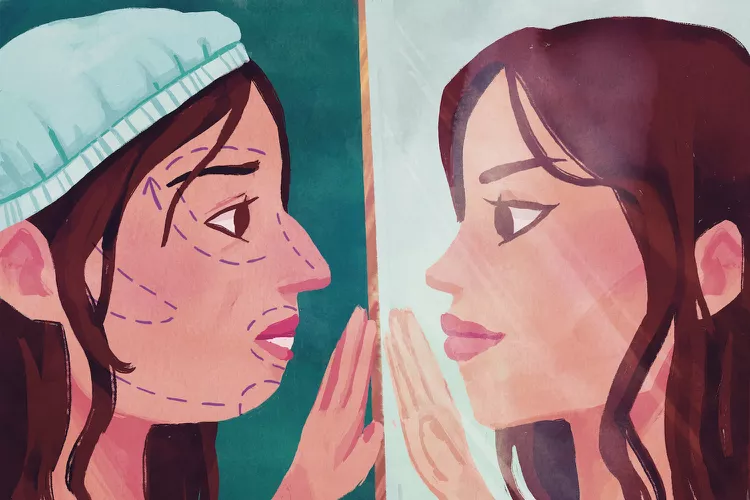
It is becoming increasingly possible to change what we look like, and with each passing year, those possibilities grow more expansive and more ordinary at the same time.
Cosmetic procedures that once seemed exceptional have now become part of everyday life. A reshaped nose, a sharper jawline, and smoother skin are now common interventions and choices that sit comfortably within the realm of the attainable. Alongside these surface-level changes, medicine has advanced in ways that extend far deeper. Organs can be replaced, limbs can be supported or enhanced, and researchers are exploring technologies that may one day integrate the human body with machines, blurring the distinction between the biological and the artificial.
Overall, these shifts highlight a change that is easy to miss because it happens so slowly. The body is no longer just something we live in. We can modify, fine-tune, and in some ways, redesign it. This change raises a question that feels both ancient and suddenly more urgent. If we alter ourselves gradually, what still stays the same?
Philosophers have long wrestled with this problem. The Ship of Theseus thought experiment challenges us to envision a vessel undergoing a gradual replacement of its wooden planks. Over time, every original component is removed and substituted. The question that follows is deceptively simple. Is it still the same ship?
For centuries, this puzzle was comfortably housed in the realm of abstraction. It served as a way to explore identity, continuity, and the nature of objects. Today, however, it feels less like an intellectual exercise and more like a description of the conditions we’re beginning to live in.
Modern culture frequently presents physical transformation as progress. Cosmetic enhancements promise increased confidence and self-alignment. Medical procedures offer longer, healthier lives. Emerging technologies suggest optimisation and control. Beneath these promises lies a consistent idea: the self is not fixed and can be improved.
There is, of course, truth in these claims. The ability to heal and restore the body is one of medicine’s most important achievements. Yet, the broader shift from healing to continuous modification introduces a quieter and more complex uncertainty. When change becomes constant, maintaining continuity becomes harder to define.
We often believe that identity is rooted in the body and that our physical appearance defines who we are. However, this idea begins to break down when we think about how much the body can change without affecting our sense of self. People age, recover from illness, and change their looks, sometimes quite drastically, yet they still see themselves as the same person.
If the body cannot fully explain identity, then memory appears to be a more convincing candidate. We often view ourselves as the sum of our experiences and the stories we tell about who we are. But memory is also unstable. It fades, shifts, and is constantly reinterpreted. The narrative of the self is never fixed; it is subtly revised over time, often without our awareness. If identity isn’t entirely rooted in the body or memory, then what maintains its coherence?
The Ship of Theseus doesn’t solve this question as much as it reveals its difficulty. Each change, whether it’s a cosmetic procedure, medical intervention, or technological enhancement, seems manageable on its own. It doesn’t seem to threaten the continuity of the self. However, these changes don’t happen in isolation. They build up. And because they happen gradually, they rarely feel like a transformation at the moment.
This stage marks the point where the modern condition starts to differ from the past. Change has always been part of human life, but it is no longer just something that happens to us. It’s increasingly something we control. We can choose what to change, keep, and improve.
This capacity is often considered a form of empowerment, and in many ways it is. It allows individuals to match their external appearance with their internal sense of identity and to have some control over the conditions of their embodiment. At the same time, it raises a question that is much harder to answer: if the self can be constantly changed, what anchors it?
The challenge is that identity is not a single, stable thing. It’s a relationship between the body, memory, perception, and experience. Changing one part doesn’t necessarily break that relationship. But changing many parts over time can make it harder to see where continuity is.
This argument does not imply that transformation is inherently problematic. Human beings have always evolved, both physically and culturally. What differs today is the scale, speed, and intentionality of that evolution.
In this context, the Ship of Theseus becomes less about objects and more a framework for reflecting on ourselves. At what point does modification turn into transformation, and when does transformation start to alter how we perceive identity itself? These questions do not have simple answers. They resist clear boundaries and definitive conclusions. Yet, they are becoming harder to ignore.
The more control we gain over the body, the more we reflect on what it means. We define who we are and what we can do. The body may be increasingly editable, but the self remains more elusive. It cannot be reduced to a single feature or function, nor can it be easily preserved in its original form.
Perhaps this dilemma is the central tension of our moment. If everything about us can change, the challenge is to understand what “the same” means. And that question, unlike the body, resists easy reconstruction.