


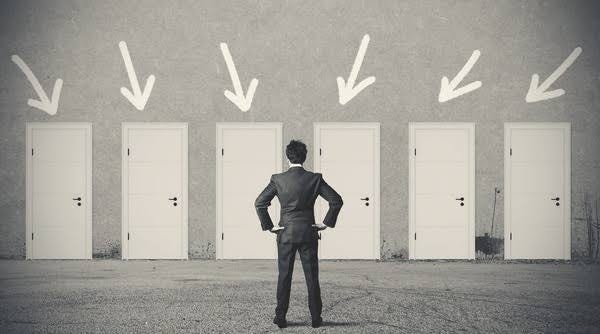
The notion that we have free will is comforting. It lets us feel like we’re not merely controlled by our environment. We are the sculptor, not the sculpted. We construct our own lives, tastes, and preferences. Today, with more options available for every facet of life, we feel more empowered than ever. But the constraints shaping our thoughts have not been removed; they have just evolved. Algorithms, modern societal expectations and unconscious biases draw invisible boundaries that quietly lead us to a destination we think we chose all on our own. But did we make a decision, or did we succumb to all that happens before it?
Algorithms: Predictors or Decision Makers?
You open up Instagram, and a feed full of relatable reels appears. When you head over to Netflix, the algorithm recommends exactly which TV shows you’ll like. If a system can reliably predict what you are likely to watch, it’s not just about how accurate the algorithm is; it signals that our choices are pre-made. By the time you press play, thousands of options have been silently filtered out for you, and you are presented with a narrow set of specific content. It’s branded as ‘customisation,’ but it actually shrinks the decision radius. Our engagement metrics drive our algorithms, yes, but the algorithms drive our viewing habits too. We’re not fully conscious consumers, and when you’re on your 15th reel, it’s hard to know if it was your thumb or the app that got you there.
The Roots Laid by Social Conditioning
Despite the pervasive presence of technology, the influence of culture is far more determinative of what we choose to do. Families instill their values in children, as does religion. Country and economic class dictate what kind of education or career to aspire to. Language differences inform our biases towards people. Our every preference can be traced back in some way to those early years. Sociologist Pierre Bourdieu explained this in his concept of habitus — the idea that our “spontaneous” choices are shaped by internalised social structures that become second nature to us. This means that actions come as a reflex rather than from conscious calculation. Even our instincts are heavily architected, the thing we usually take full credit for.
Cognitive Biases: Our Blind Spots
Outside influences are only one piece of the puzzle. We also behave based on built-in mental tendencies. For instance, in a salary negotiation an inexperienced candidate might demand a low figure because the recruiter opens with a lower number. That’s anchoring bias (the lower opening number being the “anchor” or comparison point); however, our reaction to it is what worsens the problem. Instead of acknowledging the blind spot, we claim the choice as our own and rationalise it. In this case, the lowballed candidate would say he purposefully lowered his bar to not lose the opportunity. Psychologists call this approach “confabulation”, where a person creates a story for a choice they didn’t consciously make. Neuroscientist Benjamin Libet’s famous experiments on human consciousness in the 1980s pushed this concept further. He showed that the brain gave movement commands several hundred milliseconds before a conscious awareness of the command. Though his methods were scrutinised, the implication endured: by the time we believe we are choosing, an unconscious part of us may have already decided.
Freedom: A Marketing Tool
While intellectuals debate the idea of free will, entire industries and countries use it to achieve their goals. Consumer capitalism drives up spending by attaching it to an expression of an individual’s identity. The brands you buy reflect the kind of life you live and the image you project to others. But if the consumer senses a forced demand creation rather than a natural alignment with the brand, buying things no longer satisfies their wants. Similarly, the self-help industry, whose life coaches and motivational speakers rake in millions of dollars, capitalises on a person believing that one decision is all that holds them back from turning their lives around. Even governments propagate the idea of freedom to ensure their citizens retain confidence in their agency and in their elected officials. Ironically, in all these systems our belief in free will is what prevents us from seeing our cages.
The Implications of the Illusion
If free will is not an uncontested fact, the consequences are far-reaching. Consider criminal justice, where one camp believes in full responsibility while the other asks for consideration of the life circumstances that led the defendant to the courtroom. Also, think about addiction policy where the addict is either thought of as a moral failure or a vulnerable person trapped in a disease. Philosophers like Daniel Dennett believe that neither extreme can be declared accurate because a choice is made from the interplay of conscious thought and a deterministic universe. He explains that though an absolute, undetermined choice might not exist, humans still have the capacity for rational deliberation and self-regulation. But this nuance raises concerns. Particularly in a court, if the brain is not an independent decision-maker, what is a judge’s sentence really punishing?
What We Can Control
The purpose of questioning free will is not to sink into helplessness or to absolve ourselves of any responsibility. It is to recognise and work within the limitations of our consciousness. It means practising “metacognition,” which involves being an observer of our own psyche. Spotting when a bias surfaces helps us make decisions more objectively. Being aware of our social conditioning means we see how it impacts our choices. The more we understand our impulses, the less we are ruled by them. But it requires a consistent curiosity towards why we act the way we do. Slogans would have us believe that we are all born free. But real agency comes from a painstaking commitment, not from a sense of entitlement.
Today, we have more choices than ever before. But the real question is what silently makes those choices for us before we even arrive at them. Being truly free is not about how many options we have. It’s about understanding what shapes the very free will we select those options with. But we seldom examine our constraints, and so the illusion carries on.