





Let’s be real, you wake up and reach for your phone before your brain has fully woken up. Don’t try denying it. A thumb scrolls, eyes half-open, and suddenly you’re watching someone else’s morning routine. Their bed is made. Their skin is glowing. Their life looks suspiciously calm. Somewhere between the third reel and the fifth story, your own room feels messier, your morning heavier.
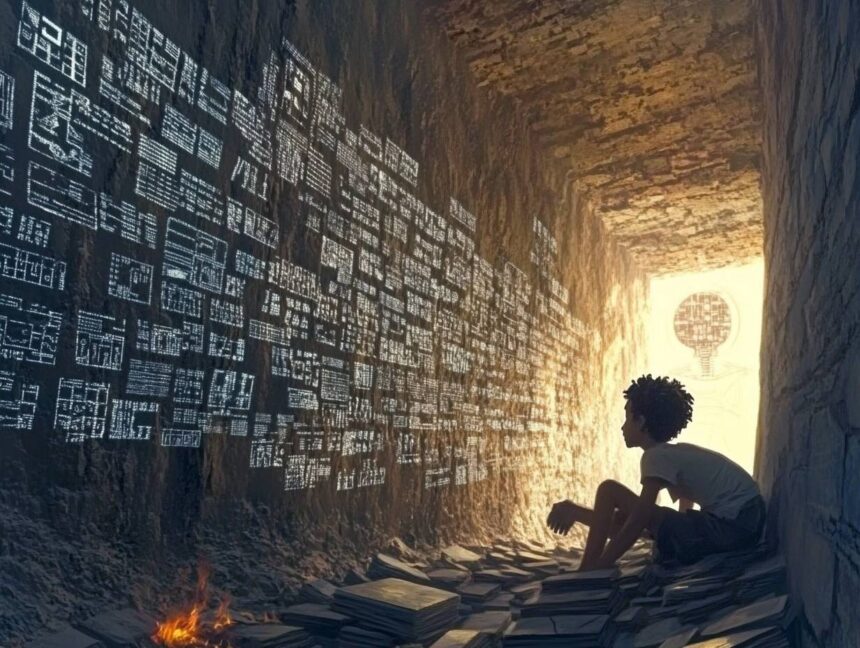
Plato would’ve recognised this instantly. In his allegory of the cave, prisoners are chained, forced to stare at shadows projected on a wall. They argue about those shadows. They believe those shadows are the world. They don’t even realise the actual things exist behind those shadows, let alone the fact that there is a whole world of reality beyond the cave. Replace the fire with a phone screen and the shadows with curated content, and a 2,000-year-old philosophical teaching becomes all too familiar.
Social media is our cave, and the algorithm is very good at keeping us seated as well.
Every post we see is filtered, edited, timed, and framed. Even the “raw” content is curated to look uncurated. We both know this. We say it out loud. But still, we look at our behind-the-scenes footage compared to everyone else’s highlighted reels. We observe the aesthetic lives of strangers while lounging around in our sweatpants and T-shirts, confused about why we feel like we are lagging behind in a race that’s never been officially called.
The most dangerous part isn’t that social media lies. It’s that it tells believable half-truths.
Yes, that person is on vacation. Yes, that creator did wake up at 5 a.m. and went to the gym and yes, that couple does look in love in that photo. What we don’t see is the argument before the picture, the exhaustion behind the routine, the loneliness after the camera turns off. Plato’s shadows weren’t fake at all. They were just incomplete. And that incompleteness is what trapped people.
TikTok is addictive for the same reason the cave was convincing. It doesn’t just show shadows. It shows the best ones. The algorithm learns what holds your attention and feeds it back to you on a loop. Beauty, productivity, wealth, drama, relatability packaged into 30 seconds. You’re not just scrolling, but also being trained. Trained to stay, to compare and trained to believe that fulfilment is always just one video away.
But when you finally look up, you realise that hours have passed.
Mental health doesn’t collapse all at once in the cave. It erodes slowly and slowly. You start measuring your worth in likes, your productivity in aesthetics, and your happiness in how postable it feels. Real life becomes something that is solely supposed to be documented rather than experienced. Moments don’t feel complete unless they’re shared on Instagram. Silence feels uncomfortable. Boredom feels like pure failure.
Plato warned that if a prisoner were dragged out of the cave, the light would hurt them. Their eyes would resist reality. They would want to go back to the shadows because at least they made sense. Wait, doesn’t that part feel especially familiar?
Digital detox sounds nice in theory. In reality, it’s rather uncomfortable. You pick up your phone and realise there’s nothing to scroll. You sit with your thoughts instead of muting them with noise. You notice anxiety you didn’t know you were numbing. Leaving the cave is not aesthetic. It’s awkward. It’s boring. It’s quiet. But it’s also where real connection begins.
Outside the cave, conversations don’t come with filters. Laughter isn’t timed for engagement. Joy exists without being documented. You start remembering what it feels like to be present instead of perceived. To live moments that don’t need proof. To be human without an audience.
Also, just by the way, this isn’t a call to delete every app and disappear into the woods. Plato didn’t say the shadows should be destroyed. He warned against mistaking them for reality. Social media isn’t evil. But it sure is powerful. And power without awareness, well, traps easily.
The real question isn’t whether Instagram or TikTok is bad for us. It’s whether we’re letting a screen define what we think life should look like. Whether we’re still capable of turning around. Whether we’re brave enough to sit with unfiltered reality, even when it isn’t flashy.
Because the scariest part of Plato’s cave wasn’t the chains, but rather how comfortable everyone became wearing them. (Damn, that was dark.)
And maybe the most radical thing you can do today isn’t to post something meaningful, but to live something that never makes it to the screen at all.