





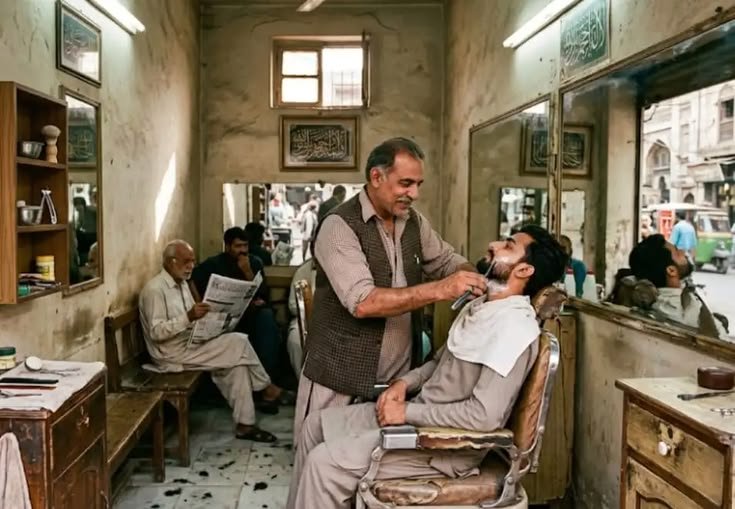
The chime above a barber-shop door is a threshold I seldom cross without feeling a bit like an unwitting eavesdropper.
Some of my earliest memories are of my father and his barber. Every fortnight, the man came to our house with his case of elaborately crafted grooming equipment and established a workspace in a peaceful corner of the lawn.
My father would sit in the chair, a cloth fastened snugly around his collar, while I watched from behind the veranda pillars, at a respectful distance. At the time, I didn’t know what was going on. I just knew that when the barber arrived, there was a small world of private masculine communion between the two men that I was not invited into. They talked while cut hair gathered on the cloth, while dark dye was combed back through my father’s hair until he mirrored the sharp portrait of Allama Iqbal on the cover of The Reconstruction, and while I waited for the chair to be folded, the lawn to be swept, and the visitor to take his leave.
Later, reading Ghulam Abbas’s short story “Fancy Hair Cutting Saloon” acted as a watershed for me because that domestic scene suddenly resolved into a broader social pattern. The barbershop in his story is not the harmless, utilitarian shop I had imagined, but rather a microcosmic representation of society and human behavior. The characters of the four barbers and the munshi represent greed and class aspirations, where the mundane act of grooming collides with greater questions of morality, vanity, and social climbing. The very name “Fancy Hair Cutting Saloon” carries the promise of transformation as one enters as one person and expects to leave looking like another.
Still, the local barbershop club has remained one of those places which are definitely outside of a woman’s world. I have passed hundreds of barber shops without going in. Growing up, I tracked their glass fronts through the car window on the commute to and from school. I would watch their interiors flicker past with rows of mirrors catching the yellow beams of tube lights and walls plastered with faded, sun-curled posters of Zayn Malik, David Beckham, Hrithik Roshan, and Virat Kohli. It was a peculiar pantheon of male aspiration, pinned up above red plastic chairs where grey-haired, open-pored, hollow-cheeked men waited their turn.
That waiting, and then surrendering to the chair, has an enforced, physical vulnerability. Customers can’t stand up at the middle of a trim and they can’t suddenly turn their head back when a straight razor is pressed against their neck or when there is lather of biting bleach on their face and neck. The barber is standing close enough to talk, and he is busy enough so that he doesn’t seem like a threat when asking idle questions.
Silence rarely survives. Men talk about anything to avoid this uncomfortable intimacy or physical proximity: politics, cricket matches, receding hairlines, herbal totkas, philosophy or whatever it is that men’s minds think of. Thus the barber, known as ‘naai’ or ‘hajaam’ by the people, has always held a separate status throughout South Asia. He’s a tradesman, of course, but also an informal archivist of ordinary life. He grooms young men for their weddings, then gives their sons their first trims, and is often among the final visitors summoned to trim a dying patriarch’s beard.
Across rural punjab, the barber’s social role is even more deeply rooted. In rural areas, barbers also serve as chefs or khansamas on special occasions, cooking food on a large scale for extended family members during weddings and funerals. Another interesting facet is the custom of saipi, associated with town barbers and other workers, in which landed gentry, after their crop harvests, give a good bulk of their crop to their barbers in exchange for services until the next harvest.
To be a Lahori is to run on sheer audacity, and the city’s barbers have long turned that nerve into something comically meaningful. During the late colonial period, A.N. John ran a salon on Mall Road, catering mainly to British bureaucrats and Anglo-Indian elites. The cultural historians Ian Talbot and Tahir Kamran note that many patrons assumed the master barber was an Englishman because of the name. He was not. Under this pseudonym, Amar Nath John was a local craftsman who had trained in England and returned home armed with the precise techniques his rulers associated with refined society. The salon was an exquisite, carnivalesque inversion with the imperial master sitting entirely passive beneath native hands.
On the other side of the city is the roadside barber, who has only a mirror, a chair, and the colour of the street. Public health reports warn about these curb stalls from time to time, due to the transmission of hepatitis through unsterilized blades and shared wash basins. The risk is real and immediate. But still people sit down. One of the reasons is cost. Part of it is convenience. And there’s a part of it that has to be familiarity. The new, fancy grooming lounges struggle to create that sense of familiarity. They can set up coffee machines, leather upholstery, television screens, and dub them an experience. The local barber maintains his clientele by building relational capital, a base of trust that cannot be replicated by decoration or luxury. Years of physical proximity, discretion and shared community make up the local barbers’ base of trust.