





During a recent workshop I facilitated, I shared a perspective that continues to shape how I understand and respond to children’s behavior.
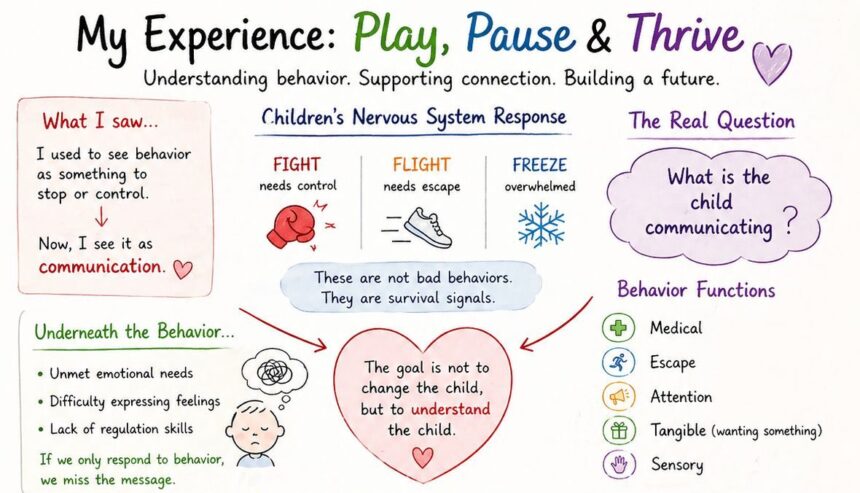
Through the Play, Pause, and Thrive framework, I invited participants to reconsider what we often label as “challenging behavior.” Instead of viewing it as defiance, I presented it as communication—an expression of underlying needs that may not yet have words.
We explored how quickly adults can move toward control—trying to stop or manage behavior—when, in reality, many children are operating from a place of fight, flight, or freeze. In those moments, behavior is not intentional misbehavior; it is a reflection of the nervous system responding to stress, overwhelm, or unmet needs.
A key shift I emphasized in the workshop was moving from the question:
“How do I stop this behavior?”
to
“What is this child trying to communicate?”
This reframing allows us to better understand the function behind behavior—whether it is driven by a need for escape, attention, sensory input, or emotional support. I highlighted the importance of adult responsiveness, encouraging a shift from control to understanding through connection, co-regulation, and intentional teaching.
Using play as a foundation, pausing to regulate ourselves, and responding with purpose, we create the conditions where children feel safe enough to develop new skills. I also acknowledged that this process is not immediate—often, behaviors may intensify before improvement is seen. However, this is part of the learning process, not a setback.
Ultimately, my goal in sharing this framework is to support a shift in practice—from managing behavior to understanding it—so that children are not simply coping, but are supported in truly thriving.