





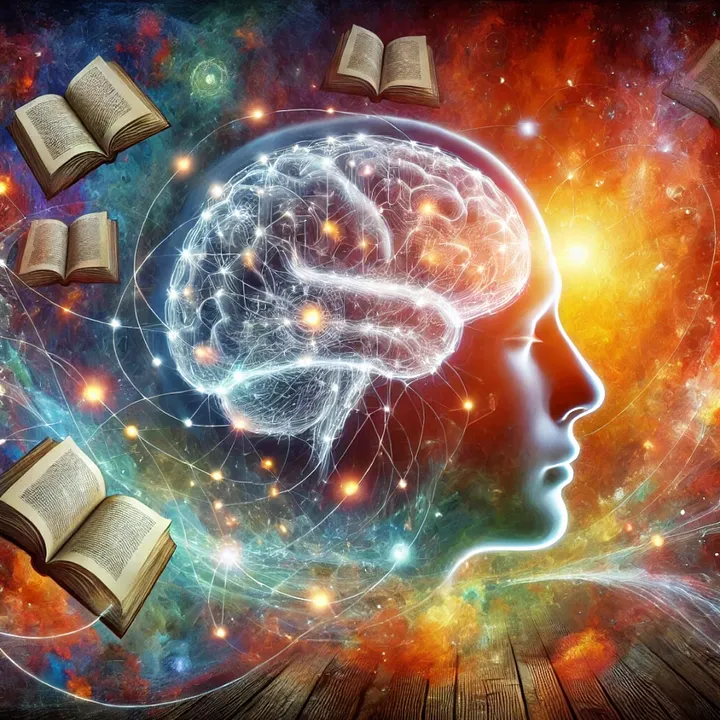
For a long time in history, a book has been understood as possessing an inherent, fixed meaning that we must decode. It has been claimed to have a meaning that we must understand, oftentimes a meaning which people believe to have been intended by the author, but a text is not a signifier for some meaning. A book’s meaning, as we understand it, is always reconstructed. Reading has been treated as a receptive act, as a passive encounter between the reader and a text with a fixed meaning, but neuroscience has now unsettled this assumption. The brain does not decode language; instead, it actively rebuilds scenes and a person’s emotions with its own neural architecture. A “text” is only enacted in the mind.
The ongoing neuroscientific research on narrative processing has shown that reading activates areas in the brain that are associated with perception and experience. When a reader encounters a description, be it a description of movement or sensory experience, the brain tends to reproduce the same feeling partially. It is not interpreted in some symbolic sense, but instead, a person’s brain actually recreates the text they’re interacting with. Such a phenomenon is described as “neural mirroring,” which suggests that reading collapses the distinction that exists between a created representation and the experience of the reader upon encountering a text.
This has profound implications for the way we think about meaning. If it is true that each reader’s brain simulates a text differently because every person subjectively experiences it, then it is impossible to claim that two readings could ever be identical or even similar. It’s fascinating how the same sentence is capable of generating distinct patterns of activation in the brain that are dependent on memory and the relevant context. This is what cognitive theory calls a “situation model.” Though with caution, we can claim now that reading is a form of neurohermeneutics because we can entertain the idea that biological interpretation precedes cultural or linguistic forms of interpretation. Thus, if not only strange, it is also highly disconcerting to imagine that the meaning of a text is not dictated by some hidden meaning but is instead constructed within the reader.
The philosopher Jacques Rancière offers an oblique insight where he argues that aesthetics determines what can be seen, thought, or felt, and he calls this the “distribution of the sensible.” In this sense, reading is equivalent to entering a field of perception. Such a process isn’t neutral because research shows that narratives actively shape perception, emotion and even decision-making. While it is true that stories guide attention and foreground certain elements, it is still the brain that follows these cues to construct a coherent world, even when reality is far more complex. Thus, immersion is also a form of direction.
The power of a narrative then does not lie in what it says but instead lies in the ramifying way it organises experience within a reader’s mind. Things like imagery and pacing aren’t merely decorative features, but rather they modulate neural engagement greatly. A well-constructed sentence is therefore the epitome of cautiously orchestrated cognition. This is the point where the boundary between the reader and the text collapses, and the book is now treated as a set of instructions instead of a fixed object where each reading produces a different version of it, distributed across individual minds. As peculiar as it may sound, there is ultimately no stable single text and only multiple neural instantiations of it.
This idea is in line with the broader work that has been done in cognitive narratology, which argues that stories arise from and operate through fundamental brain processes. Narrative is continuous with how the mind organises experience itself, and reading feels natural because it mirrors the way the brain already functions. Yet, this also introduces a constraint because if narratives align with neural tendencies, then they can reinforce them as well. Simplified structures and familiar patterns are produced more efficiently, and therefore they become more dominant, and the aesthetic of reading begins to favour whatever is cognitively easier to process instead of what feels more structurally unfamiliar.
This is the reason that contemporary reading environments increasingly privilege immediacy, such as shorter forms and more direct emotional cues, because text adapts to the brain’s preferences just as the brain adapts to texts, which makes such a relationship reciprocal. To understand what reading is in neuroaesthetic terms is to then see it as an event instead of an object. The meaning of a text is not something that we encounter and read into; it is something we create by reading through the text that, inasmuch as it is a text, refers to nothing except itself. The meaning of a text comes from the patterns of activity it produces within our brains.
The implication here is subtle, but it is still highly significant to consider that interpretation is what we construct of something in our minds. To read critically is to then become aware of this constructive process so that we may recognise not only what we are being shown but also the way our cognition is being shaped in the process, because after all, the death of the book is where the brain begins.