





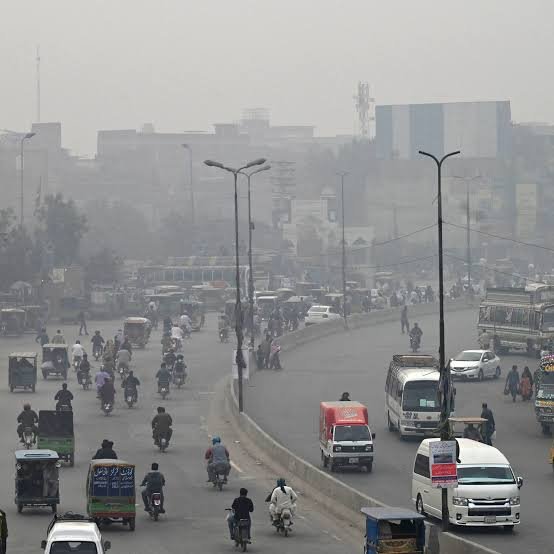
Air pollution levels in Lahore have continued to rise, placing the provincial capital second on the list of the world’s most polluted cities, with an overall Air Quality Index (AQI) reading of 273, according to City 42.
Several neighbourhoods recorded significantly higher pollution levels, with Iqbal Town reporting the worst air quality at an AQI of 414, classified as hazardous.
Other heavily affected areas included Lahore Cantonment, where the AQI reached 331, Paragon City at 324 and Gulberg II at 300.
Pollution readings were also elevated along Burki Road at 290, Chaman Park at 279, Model Town at 271, Bedian Road at 258 and DHA Phase 5 at 247.
Health experts have urged residents to take precautions against prolonged exposure to polluted air, advising people to avoid unnecessary outdoor activities and wear protective masks when leaving their homes.
Meanwhile, the Pakistan Meteorological Department forecast dry weather in Lahore, with the current temperature recorded at 23°C. The city’s maximum temperature is expected to reach 30°C, while the minimum could fall to 16°C.
Humidity was recorded at 66%, with winds blowing at approximately 2 kilometres per hour.
Elsewhere in Pakistan, the weather department predicted rainfall in parts of upper Khyber Pakhtunkhwa, Azad Kashmir, Gilgit-Baltistan and Balochistan, with snowfall expected in mountainous regions.
In Khyber Pakhtunkhwa, rain accompanied by strong winds and thunderstorms is forecast for Peshawar, Kohat, Dir, Chitral, Swat, Mansehra, Kohistan, Kurram and Bajaur.
Parts of Gilgit-Baltistan and Azad Kashmir may also receive rain, while higher-altitude areas are expected to experience snowfall.
Most districts of Punjab are likely to remain dry, although light rain is forecast for Murree, Galiyat, Dera Ghazi Khan, Taunsa, Bhakkar, Layyah, Khushab, Sargodha and surrounding areas.
According to the Meteorological Department, dry conditions will prevail across much of Pakistan’s plains, while several northern and mountainous regions could experience rain and snow.