





Tesla CEO Elon Musk has unveiled a new version of the long-awaited Roadster sports car, demonstrating technology that he claims could eventually allow the vehicle to fly.
The two-seater electric sports car was presented on Thursday, October 15, at a SpaceX test facility in Waco, Texas, where Musk showcased a series of unusual manoeuvres involving high-pressure air propulsion.
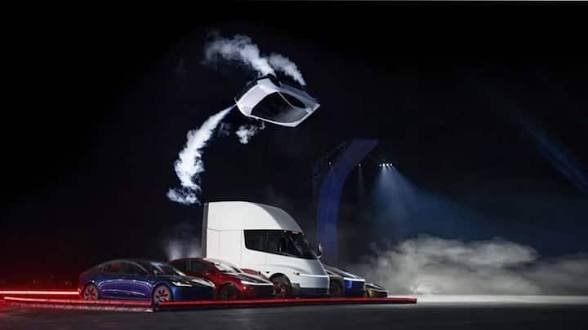
During the demonstration, the driverless Roadster climbed a steep ramp using suction technology beneath the vehicle, briefly remained suspended upside down and then flipped through the air before landing with the assistance of air jets.
Musk explained that the demonstration was conducted without anyone inside the vehicle for safety reasons.
“Success is not guaranteed,” he told the audience. “I mean that. It’ll probably work, but if it doesn’t work, we’re at a safe distance.”
The Roadster subsequently performed another stunt, using its propulsion system to jump over several Tesla vehicles parked alongside one another.
Musk also demonstrated the car’s acceleration capabilities, claiming it could reach 60 miles per hour in less than one second, aided by air jets positioned at the rear.
According to Musk, the vehicle incorporates 10 propulsion nozzles powered by what he described as “ultra high-pressure air tanks”, designed to provide additional thrust both on the road and during airborne manoeuvres.
He attributed the technology to cooperation between Tesla and SpaceX, describing it as “the results of what happens when you have a collaboration with the world’s best car company and the world’s best rocket company.”
Addressing spectators, Musk said the live demonstration was intended to show that the vehicle’s capabilities were genuine rather than computer-generated.
“We need an audience to prove that it’s not AI or SI. So you guys can tell people you saw it with your eyes, because what you see with your eyes, you will not believe,” he said.
Tesla plans to begin production of the new Roadster in 2028, although the company’s previous vehicle development schedules have frequently experienced delays.
Despite the dramatic presentation, important questions remain about whether the production model will be capable of sustained flight.
Thursday’s demonstration showed the Roadster performing short airborne movements and controlled jumps, but did not establish that it could travel significant distances through the air.
The vehicle’s claimed acceleration, propulsion system and potential flying capabilities will therefore require further testing before their practical performance can be confirmed.
For now, Musk’s presentation offers a glimpse of Tesla’s ambitions for the next-generation Roadster, with commercial production still approximately two years away.