





“What would you expect if you taped and hung a banana on your drawing room wall? A mess or art?” Now take a step back into a New York museum, where a banana was once taped to a white wall. Would you think someone had mistakenly forgotten their lunch? I stood stunned for minutes when I discovered that the piece was worth $6.2 million — far more than my father’s annual income. Would you also feel the same? The banana is still a banana, but something must be different. Is it the fruit itself, or the perception? The same banana qualified as both art and lunch.
I think beauty is always in the eyes of the spectator. But what about judgment? It carries centuries of culture and expectations. In many moments, when we stare at a realistic portrait, we naturally pronounce, “Wow, amazing!” Yet we dismiss a painting of a square on a blank canvas as “nonsense.” Thereupon, we expose the hidden taste that has shaped our sense of beauty.
Do you think the debate about contemporary art is whether something like a banana taped to a wall deserves to be called art? It never was. It is fundamentally a question of authority. Who is given the power to define what constitutes good art and deserves appreciation? Whose declaration decides what hangs in museums? Who tags what sells for millions? And who critiques what must be left to gather dust in oblivion? Is it you or me? You may also have observed that one canvas often becomes a cultural treasure, while many other pieces remain unseen and unloved. This brings us back to the key issue: authority
Then, think for yourself: what is beauty? It may be a breathtaking sunset or a perfect technique. But is it always found in perfection? Consider why Pablo Picasso kicked off the old rules, or why Henri Matisse painted with colours that do not even exist in real life. This is because the world has never been painted solely in black and white. One artist’s masterpiece may be another’s absurdity.
In my search for the definition of beauty, I realised that philosophers have been arguing over the concept for centuries. Everyone holds a different perception. Plato saw beauty as an objective ideal, whereas Immanuel Kant took a different stance, suggesting that beauty is a matter of the observer’s judgment and emotions. History tends to resonate more with Kant’s philosophy, as evidenced by the refined patterns of Islamic art, the simplicity of Japanese design, the realistic portraits of the Renaissance, and the vibrant colours of African masks — a wonderful array of diverse visions of beauty.
If beauty were truly universal, every culture would admire the same designs. Do you think every observer would perceive the same painting as ideal? If that were true, what would become of creativity and individuality? If there were no individual perception, what would make one person look at a Picasso painting and feel completely captivated, while another sees only a jumble of twisted faces? After much reflection, I am still unable to pin down the idea of beauty as either completely subjective or entirely objective. To me, it is a dialogue between the world and our perceptions. If you travel across the globe, you will surely realise that beauty does not look the same everywhere.
It changes with perception and does not carry the same passport for an Italian cathedral and the Blue Mosque. Every civilisation has drafted its own handbook of beauty and art. Many prize minimalism, others realism, and some abstraction. The West has long celebrated realism — the ability to recreate the world in precise detail, as seen in Leonardo da Vinci’s masterpieces. On the flip side, Islamic art appreciates beauty through geometric precision and colourful calligraphy, while Japanese art offers a completely different perspective, locating beauty in imperfection and simplicity (wabi-sabi).
Art has never had a single native language; it has always been formed by culture, religion, history, and geography. Why, then, should the art of one culture set the standard for all creative expression? Imagine if contemporary art were brushed aside simply because it does not resemble the Mona Lisa!
What, then, would become of creativity? We need to question who moulds our artistic appreciation and creative interpretations.
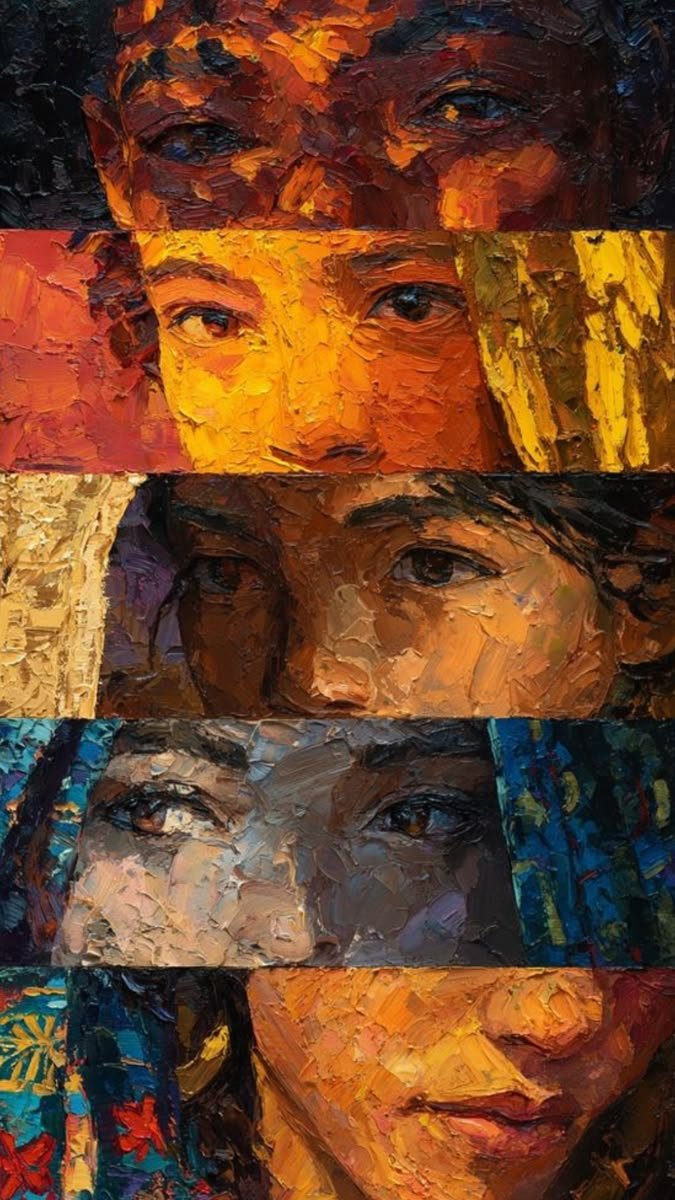
Why does everyone perceive art differently? Is it about the viewer’s gaze? As one person gazes at a beach painting, they might be transported back to a carefree summer evening from their childhood, while someone else might feel a pang of grief. The same artwork can stir up confusion or beauty depending on who is watching. One viewer may utter, “My five-year-old child could do that,” while standing before a painting of a red apple, whereas another stands contemplating its deeper meaning. The artwork remains unchanged, yet it evokes a distinct reaction in each person.
Art serves as a bridge between artist and spectator. Is beauty always confined to a canvas? Certainly not. We rarely approach a painting as a blank slate; we view it carrying our beliefs, histories, cultures, and biases. That is why our appreciation is rooted in memory and experience. A war survivor may perceive sorrow in a barren tree, while another views nothing more than empty branches. Does art reside in the object itself? Do we merely look at art, or do we see it through ourselves? Is there a definitive answer? Perhaps not, and that is precisely why the debate over contemporary art remains so intensely contested.
Contemporary art is not merely about perfect techniques, realistic portraits, or scenery that can now be effortlessly captured by a camera. Modern art represents what cameras still cannot capture in an AI-driven world: inner chaos, raw emotions, and pure imagination. It does not seek to please you with aesthetic perfection; it wants you to argue, reflect, and question.
So, do you still think that banana was worth millions just to gain confirmation from everyone on whether it constitutes art? It never was. What seemed absurd yesterday is often recorded as a masterpiece today, and today’s experiments may become tomorrow’s timeless classics. Artistic boundaries have been constantly redrawn over the centuries. Somewhere between banana art and the Mona Lisa, beauty has crossed from the weird to the wonderful. Hence, contemporary art blooms in the space between confusion and curiosity.
Perhaps every act of seeing is itself an art form. Beauty enters through the eyes, but it only truly begins when one dares to look beyond what is already familiar. One final question remains: if every act of seeing is an art, who is the real artist? Is it the creator, or the viewer whose gaze provides meaning? To me, art is an ongoing conversation between the artist, the audience, and the world.