





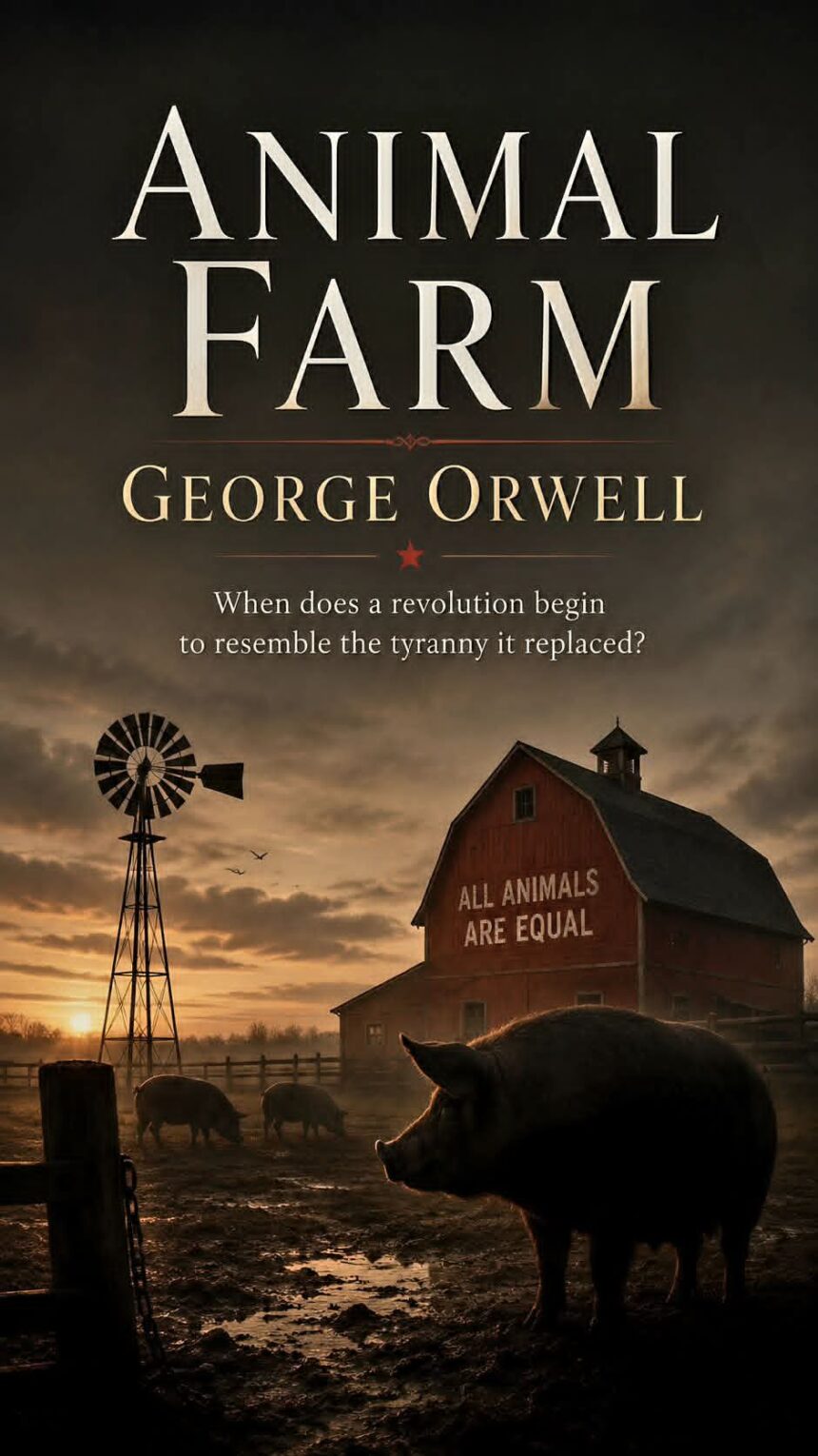
At first glance, Animal Farm looks like a simple fable. There is a farm, a cruel farmer, a group of tired animals, and a dream of freedom. The animals rise against Mr. Jones because they are hungry, overworked, and humiliated. They want a world where no creature is exploited by another. Their dream is beautiful: all animals will be equal, all will work for the common good, and the farm will finally belong to those who labour on it.
But George Orwell’s genius lies in how quietly he turns this hopeful beginning into a tragedy. The animals do not lose their freedom in one sudden moment. They lose it slowly, line by line, commandment by commandment, lie by lie. The pigs do not arrive as monsters. They arrive as leaders, thinkers, organizers. They speak the language of justice. They promise equality. They claim to know what is best for everyone. And that is exactly where the danger begins.
The most frightening thing about Animal Farm is not that power corrupts. That idea is old. The frightening thing is that corruption often comes wearing the mask of service. Napoleon does not say, “I want to become a tyrant.” He says everything is being done for the good of the farm. Squealer does not say, “I am lying to you.” He says the animals have misunderstood. Every abuse is explained. Every betrayal is justified. Every memory is corrected. The truth is not destroyed with violence alone; it is first softened, twisted, and repeated until the weak begin to doubt their own eyes.
This is why Boxer is one of the most heartbreaking figures in the novel. He is strong, loyal, and sincere. His answer to every difficulty is, “I will work harder.” He represents the honest people who carry revolutions on their backs but rarely enjoy their fruits. Boxer does not understand political tricks. He trusts the cause. He trusts the leaders. He gives everything he has, and when he is no longer useful, he is sold. His tragedy is not only personal; it is historical. It is the tragedy of the faithful worker betrayed by the very system he helped build.
The farm changes, but the language remains noble. That is Orwell’s sharpest warning. Words like freedom, equality, sacrifice, and loyalty can become tools of control when people stop questioning those who use them. The commandments on the wall are changed because the animals cannot read well, cannot remember clearly, or are too exhausted to resist. In this world, ignorance is not innocent. It becomes dangerous. A society that cannot read its own laws is easily ruled by those who rewrite them.
The famous line “All animals are equal, but some animals are more equal than others” is absurd, but it is also terrifyingly accurate. It shows how tyranny often survives through contradiction. The rulers do not need truth to make sense. They only need enough power to make nonsense official. By the end, the pigs walk on two legs, drink alcohol, sleep in beds, trade with humans, and behave exactly like the masters they once condemned. The revolution has completed its darkest circle: the oppressed have not become free; their new rulers have become indistinguishable from the old ones.
What makes Animal Farm so powerful is its simplicity. Orwell does not hide behind difficult language. The sentences are clear. The story moves quickly. The characters are animals, yet the meaning is deeply human. A child can follow the plot, but an adult can spend a lifetime thinking about its warning. That is the rare beauty of the book: it is easy to read but impossible to forget.
In the end, Animal Farm is not only about one revolution or one country. It is about every place where power asks for blind trust. It is about every society where leaders change the truth and call it progress. It is about every ordinary person who works, suffers, hopes, and is told to be patient while others enjoy the rewards.
Orwell’s farm is small, but its shadow is enormous. It reminds us that freedom is not protected by slogans. Equality is not guaranteed by promises. Justice is not preserved by leaders who cannot be questioned. A revolution may begin with noble dreams, but if truth dies, memory fades, and power goes unchecked, the animals may one day look from pig to man, and from man to pig, and discover that they can no longer tell the difference.
Its my favourite Novel.