





“For if a lover’s face survives emblazoned on your heart, the world is still your home.”
This quote is from one of my all-time favourite books, “My Name Is Red,” by the Turkish author Orhan Pamuk — and if there were a book that I would recommend to anyone and everyone, it would be this one without a beat.
My Name is Red, a philosophical thriller that blends art, history, meaning, love, life and death together in itself. Set in late 16th-century Istanbul, during the reign of Sultan Murad III, we see a group of miniature artists grappling with the questions of personal style in their works, pondering over what it means to have personal style — and if it really is a blasphemy against God’s perspective.
The book talks about miniature artists of 16th-century Istanbul and how they are fully devoted and dedicated to their craft.
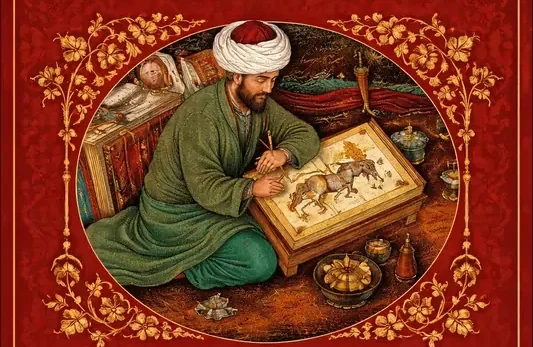
They do not create new paintings but imitate the old masters. If drawing a horse is needed, it would always be drawn the same way — one foreleg raised. If drawing faces is concerned, the faces won’t have any characteristic that distinguishes them from the rest. They argue:
“Only God can create; humans can only replicate.”
The dedication to their craft is so potent that the dream of every artist by the end of their life is to go blind, whether it be through lying or pricking a needle when needed.
The book dives straight into the rich and intricate world of miniature artists with the first chapter titled “I am a corpse,” which establishes to us, the readers, the death of Elegant Effendi, one of the miniature artists who was working on a secret book commissioned by the Sultan. The book is accused of being secretly drawn using the controversial European, Venetian style, which goes against the notions of Islamic art or the way of the old masters of Herat.
Amid the mysterious death of Elegant Effendi, Black, our protagonist, enters. He was exiled by his uncle for falling in love with his young and beautiful daughter, Shekure.
His uncle, Enishte Effendi, instantly gives him the mission of finding the murderer, which in turn will get him to win the hand of his beloved Shekure, who is now stuck in a religious limbo after her husband went to war, never to return.
Through and through the novel, Orhan Pamuk has a sensory style of writing, which really absorbs us in the world of art and philosophy. We get to read descriptions of scents and colours in words, the grandeur of the art of miniatures.
Alongside the main plot, we encounter multiple essays on painting, style and signature. Chapters dedicated to inanimate objects like a counterfeit coin, the colour red, and death make reading the book more fun. We also get chapters like “I, Satan,” which makes the book a winner for me.
The main theme of the book, according to me, is a debate on style. It discusses the differences between the art of Eastern masters and the blasphemous perspectives of Venetian artists. We get to see the artists pondering over how individual style is a deviation from Satan, making the artist compete with God’s creation. It argues that personal style isn’t an achievement but proof of arrogance against God.
As for the characters, I found them incredibly human and flawed, incredibly rich in their inner worlds that envelop us. It felt to me rather difficult to judge and categorise their evil as evil and their good as good when I knew the reason behind their actions and the ‘why’ behind their evil.
But throughout the book, the debate on style and signature often gets repetitive — and as the book progresses, I found myself more involved with the devotion of the artists instead of finding out who the murderer is.
But to really bring it down, one of the characters that resonated with me the most was Shekure, who is an intellectual and a beautiful woman who uses her beauty and her brains to navigate the slippery situation of being widowed but having no proof of it — using her intellect and beauty to get herself freedom in the midst of a world set for men.
We don’t see her being even once kind to the men around her or her fate. I found her struggles similar to those of many. She is so layered, so complex… so human, and just when we, as readers, would think we know her, bam. We don’t.
One of the lines that I have annotated and highlighted in the book, my favourite one, is:
“When you are a woman, you don’t feel like the devil.”
All in all, My Name is Red isn’t a light read, nor a book you would read once in a fortnight and forget. It’s a book that draws you in, asking you to contemplate whilst giving you permission to feel like you’re one of the characters.
It’s a rare book where we as readers see the fourth wall breaking with every passing chapter. We experience how real humans have secrets and how perspectives change from personality to personality, person to person.
It mimics to me the feeling of an intricately illustrated manuscript flecked with gold leaf, with accents of a deep and rich blue lapis lazuli set on the pages. It is a book that drew me in and left me with questions long after it ended.
It is a book I would keep re-reading till the day I die, and each re-read would unlock a different perspective for me in a different way.