





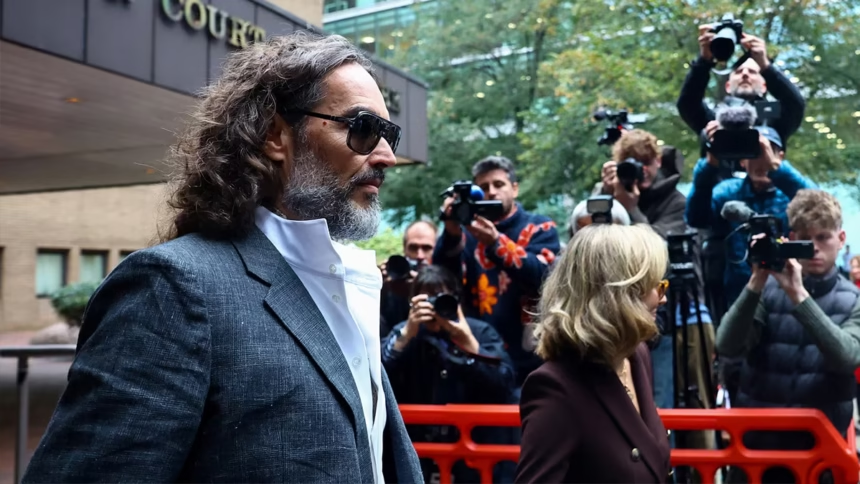
Woman A woman accusing British comedian and actor Russell Brand of sexual misconduct told a London court on Friday that he attempted to pull her into a toilet cubicle at her workplace in 2001, describing a sudden change in his behaviour during the encounter.
The woman, the second of six complainants giving evidence in Brand’s trial, told Southwark Crown Court that the alleged incident occurred while she was working at MTV Europe in London.
Brand, 51, faces three counts of rape, three counts of sexual assault and one count of indecent assault involving six women over a period spanning 1999 to 2009.
The former television presenter, who was previously married to American singer Katy Perry, denies the allegations. Following his arrest, he told police that he had never engaged in sexual activity without consent.
According to the complainant, her interaction with Brand began with a friendly exchange about his clothing. She said they had engaged in light-hearted conversation after she complimented his T-shirt.
However, she alleged that his behaviour changed when she accompanied him to show him where the toilets were located.
She described Brand as initially friendly before becoming “a wild-eyed maniac trying to pull me into the toilet”.
“He grabbed me by the arm and started to pull me and said ‘come on, come in with me’,” she told the court.
“He started to plead almost, ‘go on, go on, come in’.”
The woman said Brand had gripped her arm firmly, but she managed to pull herself free.
“I said to him ‘what are you doing, are you mad, let me go’,” she testified.
She told the jury that Brand eventually stopped attempting to persuade her and entered the toilets alone. The entire encounter lasted approximately 20 seconds, according to her account.
The complainant said she did not report the incident to her employer at the time because she believed it would be her word against Brand’s.
She later contacted police after watching a 2023 documentary containing allegations against the comedian.
Defence Challenges Complainant’s Interpretation
During cross-examination, Brand’s lawyer, Ian Winter, questioned whether the woman’s understanding of the encounter had changed after viewing the documentary.
Winter suggested that Brand had asked her to enter the toilet for sexual activity but stopped when she refused.
He characterised the alleged encounter as a “very short-lived, very minor incident where he tried to get you into the lavatory and you refused and he left it there”.
The defence’s account was presented as a challenge to the complainant’s evidence, rather than an established finding about what occurred.
Presiding judge Joel Bennathan told jurors on Thursday that all six complainants, whose identities are protected by lifelong anonymity under British law, had approached authorities following the documentary’s release.
The trial is expected to continue for approximately six weeks, with further evidence to be heard before the jury reaches a verdict.
Brand has pleaded not guilty, and the allegations remain unproven.