





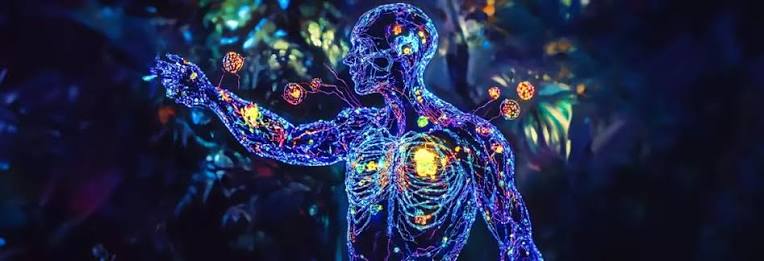
To understand the basic idea of transhumanism, imagine yourself perhaps 1,000 years in the future. You wake up and your organs are artificially made, your memories are stored in some sort of computer network, your limbs are entirely robotic, and you have perhaps escaped the idea of death being inevitable. The idea of defeating death might sound like science fiction right now, but what if I told you that this could become reality? Transhumanism essentially advocates the use of modern technology to overcome the biological limitations of human beings. In very simple terms, it means replacing every body part that becomes dysfunctional with technology.
We are all trying to expand our lifespan in one way or another. Some of us try to remain fit by exercising or going to the gym. Others take medicines that may help them live longer by keeping their bodily functions regulated.
This phenomenon has many potential benefits, as it could eliminate major health issues and cure a number of life-threatening diseases that are currently thought to be incurable. All such problems could, in theory, be eliminated through technological advancements. This brings us to the Paradox of Theseus and the question of when we stop being human.
The concept of the Paradox of Theseus is this: imagine the Ship of Theseus, whose pieces are gradually discarded and replaced with new ones until none of the original parts remain. If someone gathered all the discarded pieces and reassembled them into another ship, which one would truly be the Ship of Theseus? The one with none of its original parts remaining, or the one reconstructed from all the original pieces?
This question has no definitive answer, but the paradox aligns perfectly with the concept of transhumanism. If humans were to replace all of their organs, would they still remain human? We are all familiar with the concept of artificial limbs, and if someone has an artificial limb, they are obviously still the same person. The concept of transhumanism is far greater than that. It does not merely involve replacing one or two organs; it envisions a stage where every part of a human is replaced, from limbs to vital organs, to the point where even consciousness becomes digital.
At that point, one begins to wonder whether identity is connected to physical features and biological composition or to consciousness and thought. Would you still be you if your memories were stored in a computer?
Another aspect of this situation is that, in a capitalist society, not everyone would be able to afford immortality. The world could become a monopoly in which centuries-old elites control society while remaining immortal. What would become of humanity in such a world is something we should seriously consider. Perhaps the most important question to ask ourselves is whether the mortality of life is what makes it worth living.
Everything that is temporary or destined to end often holds more value than something eternal. Life is so precious to us because we know it will one day come to an end. If that were no longer the case, would we still cherish living as some of us do now, or would life lose its meaning? We enjoy the rain because we know it will stop and the sun will eventually come out. We appreciate the changing seasons because we know they will not last forever. It is human nature that, although we value durability when buying products, we often treasure in nature the very things that are fleeting.
Then again, if we cherish mortal life this much, perhaps we would cherish an immortal life even more because it could bring a new meaning to existence. Maybe something else would become more valuable. In many religious conceptions of the afterlife, we are fascinated by the idea of eternal life, so why should it be different here? Even so, I think many of us would still prefer death eventually, because eternal life on Earth does not necessarily mean a life free from suffering. If the miseries of living remain, not many of us would truly wish to live forever.
Although the idea of transhumanism is fascinating in theory, as it offers the possibility of defeating death and living forever — a dream humanity has pursued for centuries — it also forces us to reflect on the nature of human identity, social justice, and perhaps life itself. Whether the meaning of life is connected to its mortality is a question that transhumanism inevitably raises. Before pursuing any form of immortality, we must first determine what it truly means to be human.
Very well composed and essentially fluent, loved it.