





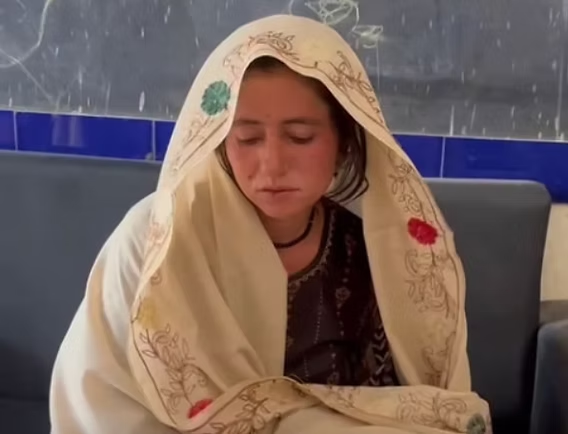
“I know I will be killed.”
She was right.
Gulaan Bharo, a 25-year-old woman and a mother of two, fled her home after fearing for her life at the hands of her abusive husband. After enduring domestic violence for years and attempted murder, she ran to the nearest police station in the Sukkur district of Sindh. She named the people responsible for the abuse and attack. She told the police that she would be killed if she were sent back. She requested to be sent to a Dar-ul-Aman shelter.
The state heard her but sent her back anyway. Gulaan Bharo was murdered within days. This is not a story about honour killing as a culture. It is about the institutions that made it possible.
As reported, Gulaan, with cuts and scratches from walking through bushes and thorns in the dark at 1 a.m. and crossing the Sindh River on foot, reached the police station near Rohri Railway Station in Sukkur District. She reported her injuries to the police and named her husband, Moula Bux Bharo, who tried to kill her. She asked for help. She asked for protection.
Instead of filing an FIR, the police filed a written application and brought her before the court, seemingly to arrange her protective transfer to the Darul Aman shelter home in Sukkur. What should have ensured her safety turned into her return from the place she escaped when her father, Imdad Bharo, placed his turban at her feet — a traditional trick used to emotionally pressurise someone — in court. He asked for her return home to save his honour and guaranteed her protection in writing, which the court accepted. Gulaan signed the document, which proved to be her death warrant.
Before leaving, she told the press, “I know I will be killed. But I am going to sacrifice myself for my father’s honour.”
The court resolved the matter without ordering a welfare inquiry, arranging shelter or issuing a protection order. Her husband had declared her ‘kari’ — a label for which a woman is punished to death, often handed down at the man’s discretion in tribal areas during jirga/panchayat proceedings. Gulaan Bharo’s prediction of her own death came true just days after her return. On 2 May 2026, her husband and her paternal uncle buried her alive. They killed her with a Kalashnikov rifle.
The police did not act with discretion. They broke the law. According to section 154 of the Code of Criminal Procedure (CrPC) of 1898, the police are obliged to register an FIR when the offence is cognisable. Attempted murder is a cognisable offence under section 324 of the Pakistan Penal Code 1860, which expressly covers attempts to kill, including those committed in the name of honour. Not only did Gulaan name her attacker, she also showed the police the injuries and marks on her face and body inflicted by her husband. This should have triggered the registration of an FIR instead of writing an application. This was clearly an illegal act under the law.
Notably, Section 11 of the Sindh Domestic Violence (Prevention and Protection) Act, 2013, mandates the magistrate to issue a protection order when domestic violence has prima facie taken place. Gulaan appeared in court. She had injuries. The culprit was named and identified. All the conditions for invoking section 11 had been met. Yet the court failed to issue any order, instead allowing Gulaan to leave with her father on insufficient surety. A father’s emotional coercion is not a welfare inquiry. Custom is not jurisdiction. The institutions were aware of this distinction, yet still chose not to fulfil their duty.
The case of Gulaan Bharo is not an isolated incident, but rather another tragic example of a woman losing her life at the hands of the very people who were supposed to protect her.
In April 2026, another innocent life was lost in the name of honour killing. Rubina Chandio, also known as Khalida, was brutally killed by her tribe in a jirga decision on the allegations of karo kari (tainted) and buried without religious rites, and her body was disturbingly dug up by stray dogs.
These are just some of the reported cases. Thousands more go unreported due to weak institutional implementation and law enforcement. These are the consequences of decisions made by individuals who are not in lawful authority.
The police station took in the victim. Although they saw her injuries and knew the attacker’s name, they decided to proceed with a mere application instead of lodging the FIR that was mandated. The court viewed the father placing a turban at his daughter’s feet as an act of emotional coercion to protect his honour and followed this custom without ensuring Gulaan’s safety. Imdad Bharo offered a guarantee, but he could not protect his own daughter. Moala Bux Bharo was a brazen killer and abusive husband who took Gulaan’s life.
This is a judicial failure with another case number that will be lost among thousands of similar files.
Gulaan Bharo did everything she could to ask for help. She had names, she had evidence and she had hope in the system. She ran to it for help. She left the court with a statement, a signed document, and a message for the press. The paper trail exists, and these acts can be tried, charged and answered for.
The real question is whether anyone will follow it.