





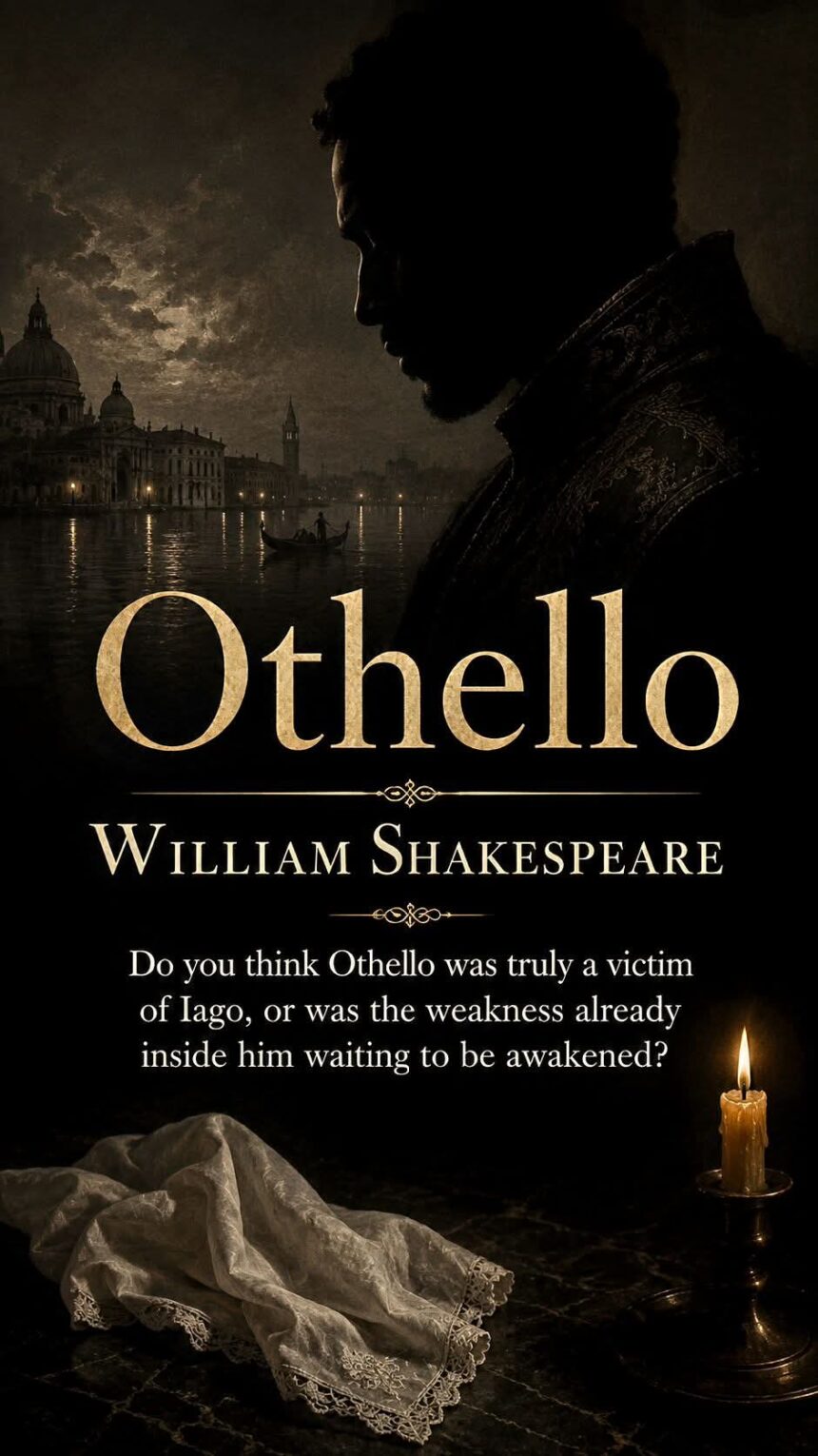
There are tragedies in literature where a kingdom falls, where armies clash, where crowns are lost and blood fills the stage. But Othello is more frightening because its real battlefield is not a palace, a battlefield, or a court. Its battlefield is the human mind.
Shakespeare’s Othello is the story of a powerful man who can face enemies in war, but cannot survive the enemy whispered into his heart. It is not simply a play about jealousy. It is about trust, insecurity, manipulation, love, race, honour, and the terrifying speed with which doubt can destroy a life.
Othello begins as a heroic figure. He is a respected general in Venice, a man who has earned his place through courage and service. He is not born into the world of Venetian privilege; he enters it through merit. He has fought battles, survived dangers, and won admiration. Even his language at the beginning of the play is calm, noble, and dignified. He does not need to shout to prove his greatness.
And then there is Desdemona.
Their love seems almost miraculous. She loves him not for wealth, youth, or social comfort, but for the stories of his life. He has travelled, suffered, fought, and endured, and she listens with wonder. Othello says she loved him for the dangers he had passed, and he loved her because she pitied them. It is one of Shakespeare’s most beautiful descriptions of love: two souls meeting through sympathy.
But the beauty of this love is also its weakness. Othello’s marriage to Desdemona is unusual in the society around them. He is older, foreign, and black in a white Venetian world. Desdemona is young, noble, and admired. Their relationship challenges social expectations. Even before Iago begins his work, the world is already prepared to doubt them.
And then Iago enters like a shadow.
Iago is one of the most chilling villains in literature because he does not destroy Othello with a sword. He destroys him with suggestions. He rarely says anything directly. He plants small doubts, then lets Othello water them with imagination. He understands that the most dangerous lies are not shouted; they are whispered.
He knows exactly where to wound Othello. He does not begin by saying, “Desdemona is unfaithful.” Instead, he pretends reluctance. He pretends honesty. He gives half-sentences, pauses, warnings, and sighs. This makes him more dangerous than an open enemy. An open enemy can be fought. A false friend is invited inside the soul.
The tragedy of Othello is that he trusts the wrong person and doubts the right one.
Desdemona is innocent, loyal, and loving. Yet Othello begins to see her through Iago’s poisoned imagination. The woman who once seemed pure becomes suspicious. Her kindness becomes evidence. Her pleading becomes guilt. Her handkerchief becomes proof. Shakespeare shows us something deeply disturbing: once jealousy takes control, even innocence can look like crime.
That is why Othello remains so powerful. It understands the psychology of jealousy with frightening accuracy. Jealousy does not merely ask questions; it invents answers. It does not wait for truth; it creates its own truth. It turns love into surveillance, affection into suspicion, and memory into a courtroom.
Othello’s downfall is painful because he is not naturally evil. He is not like Macbeth, who chooses ambition and murder. Othello is a noble man infected by a destructive belief. His tragedy is that he wants certainty in a world where love requires trust. He wants proof, but the proof is manufactured. He wants justice, but his justice is built on lies.
The handkerchief becomes one of the most powerful symbols in the play. It is a small object, almost ordinary, yet it carries enormous emotional weight. To Desdemona, it is a token of love. To Othello, once corrupted by suspicion, it becomes evidence of betrayal. Shakespeare shows how objects do not always have meaning by themselves; we load them with our fears.
Desdemona’s tragedy is equally heartbreaking. She cannot understand the darkness growing inside Othello because she has not created it. She keeps loving him even as he becomes cruel. Her innocence is not weakness; it is the tragic purity of someone who cannot imagine the full ugliness of deception. She believes love should be enough to defend her. But in Othello’s corrupted mind, love itself has become the reason for violence.
And then comes the ending – one of the most devastating endings in all of Shakespeare.
When the truth is finally revealed, it comes too late. Othello sees what he has done, and the greatness that once made him heroic becomes unbearable to him. He understands that he has murdered the person who loved him most. He has not defended honour; he has destroyed innocence. He has not punished betrayal; he has committed the ultimate betrayal.
His final moments are filled with terrible self-recognition. That is the essence of tragedy: the hero understands the truth only after the damage can no longer be undone.
But perhaps the most haunting thing about Othello is that Iago’s motives remain disturbingly slippery. He gives reasons – jealousy, resentment, suspicion – but none fully explain the depth of his evil. He seems to enjoy destruction for its own sake. He is terrifying because he represents a kind of human cruelty that does not need a grand purpose. Some people ruin lives not because they gain a kingdom, but because they cannot bear another person’s happiness.
That is why the play still feels modern. We still live in a world where reputations are destroyed by whispers, where relationships collapse because of suspicion, where insecure people are easily manipulated, and where false friends can be more dangerous than declared enemies.
Othello is not only about a jealous husband. It is about how fragile trust can be. It is about how quickly love can be poisoned when insecurity meets manipulation. It is about the terrible human habit of believing the worst when fear speaks louder than truth.
Shakespeare gives us a hero who conquers armies but loses the war inside himself. And that is what makes Othello unforgettable. His tragedy reminds us that the most dangerous enemy is not always the one standing before us.
Sometimes it is the voice we allow into our mind.
And sometimes, once that voice begins to speak, even love may not be strong enough to silence it.