




An ideology such as feminism, which has evolved into a mass socio-political movement, benefits from the convenience of its message. Although now a global phenomenon, it originated in the West. Hence, its dominant language of portrayal is English. The advocacy of feminism primarily in English has adverse effects in an Urdu-speaking nation because it creates an accessibility and understanding gap for the vast majority.
Mass media (social media, TV, radio, newspapers, magazines, books, etc.), protests, press conferences, journalism, and seminars are some of the ways new beliefs are introduced in societies. As long as they reach the intended audience, all those media are able to tackle social, political, economic, and religious issues by raising awareness, asking questions to hold those responsible accountable, and bringing forward feasible solutions. That is how the fight for gender equality and female rights, and against harmful gender-based restrictions and traditions, violence, and discrimination, is fought in the modern era. However, the initiation of such doctrines is mostly by highly literate people who persistently choose English as their language of expression. This is caused by several reasons and, consequently, creates several issues.
Despite decolonisation, we are unable to recognise the linguistic impact of Western imperialism on us. Urdu is our national language, and English is our official one. But our commitment to perfecting the latter is stronger. People take pride in speaking fluent, accented English and focus more on that than the idea behind it. This national deprivation costs those who need education more than attraction. Native Urdu speakers writing poetry and prose in English also reflects our level of comfort in self-expression through a foreign language rather than our mother tongue. Urdu is simply too powerful for emotional expression, almost revolutionary. Nonetheless, this potent literary strength is the requirement to create a better world for women. Activist communities exist throughout the world, and a common language amongst them creates a well-structured network for all of them. Due to a need to belong to a larger community and get recognition from it, feminists may use English to advocate for women’s rights movements. Although not inherently an ‘elitist’ practice, its consequences can reflect such principles.
According to The Times, about 40% of Pakistan’s population, or 100-120 million people, do not speak or understand English fluently. For this reason, the choice of language for promoting an unfamiliar ideology in this country should be obvious. Use a language that reaches more ears.
When feminism is promoted mainly in English instead of Urdu, it creates a disparity in understanding and implementation. Underprivileged areas, where more women face gender-based abuse, have easier access to Urdu media. If victims do not realise they are being violated, they cannot seek help. Perpetrators will go unchallenged, and the cycle of exploitation will continue. Many resistant and insecure individuals view anything Western as a threat to religion and culture. Extremists label feminism as blasphemy and an innovation in Islam. If these principles were presented in Urdu, they would seem less foreign. Pakistani society might accept them more readily.
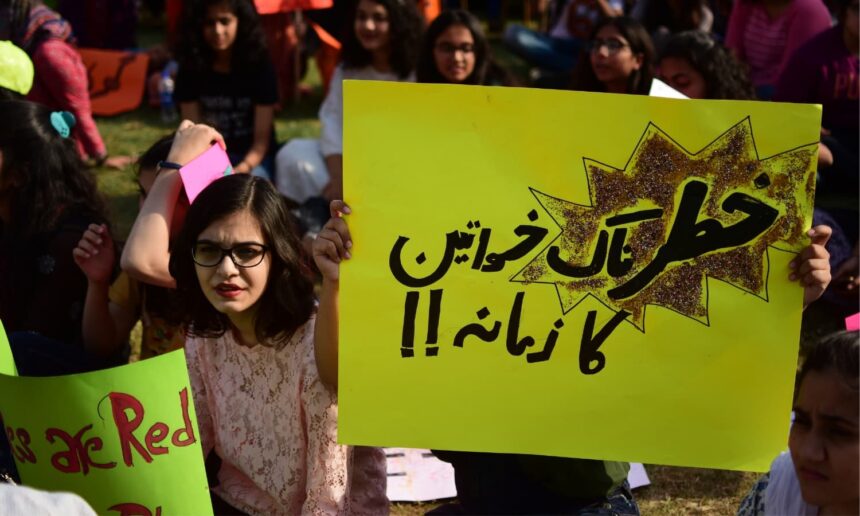
Today, feminism in Pakistan is mainly represented by a nationwide demonstrative group called ‘Aurat March.’ This group began in 2018 in major cities. It protests against state and non-state bodies to demand women’s safety, equality, justice, and autonomy. Its slogans are bilingual and often include culturally relevant posters, such as ‘Jab Tak Aurat Tang Rahegi, Jang Rahegi, aur Jang Rahegi.’ However, elite and English-fluent people mostly participate, as working-class women find it difficult to participate — fearing the risk of violence at home, loss of employment, and the social stigma associated with the March’s ‘westernised’ propaganda. The protests are held only in major cities, and social media campaigns are in English. As a result, the message fails to reach and influence the majority of the country, and nearly half the population feels detached.
Saadat Hasan Manto, a renowned Urdu author, talked about women’s roles in society from entirely different perspectives. He was remarkably comfortable using pure Urdu to discredit the objectification of women — that was done either through a sexual lens or a laborious one. His short stories, such as Khol Do, Mozel, Mera Naam Radha Hai, Hatak, and Thanda Gosht, represented the raw humanity of women. They encompassed unique feminist themes, including complex emotions, narratives, dignity, trauma, and struggles faced by women in modern society. While he was labelled ‘vulgar’ and an outcast to sophisticated society, his work in Urdu literature was accessible and enjoyable for the common man and hence left a deeper impact on the crevices of society than any prose or poetry in English. Artists like Ismat Chugtai and Fehmida Riaz also challenged patriarchal taboos that suppress women. They all set standards for future writers and poets to pledge to fight patriarchy in Urdu.
The advocates of feminism shoulder the responsibility to make it accessible to people of all backgrounds. And in order to attain such accessibility, Urdu must be utilised as the primary language on all platforms and counter the English language gap that hinders society from benefiting from revolutionary ideas. Inclusive education is the way to foster change, and any further delay in this transition will harm the people more. Otherwise, we can only wonder whether such activism aims to reach the masses who need it or keep them excluded.
love love love this