





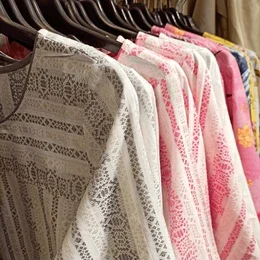
The first thing you learn at a dawat in Karachi is not the host’s name. It is the brands.
You clock them in before the greetings. Before the chai reaches you. A Sana Safinaz here, an Elan there — the careful neutrality of someone in a brand with a questionable, over-the-top aesthetic who isn’t sure yet whether she’s arrived or is still arriving. And the unbranded ones — lawn, yes, but not the right lawn — are already being quietly filed away.
It is not a party. It is an audit.
I want to be careful here because it would be easy to write this as though I were above it.
I’m not. Or I wasn’t. There was a version of me who gawked at a ‘designer’ store one April, squinting at a price tag with too many digits and holding fabric up to the light and watching the light come clean through it.
I bought it anyway.
I held translucent fabric in my hands during the hottest month of the year. That too, in a country where summer is not a season but a condition of existence that begins in April and does not have the decency to leave until October, and thought, ‘Yes, this is the one.’
What I did not think about, standing in the air-conditioned exhibition store that bore no resemblance to the August afternoon I would actually be wearing this in, was the chemise.
The lining – the additional layer of fabric I’d need to purchase separately and have stitched separately to wear underneath the suit that was theoretically designed for breathability — so I could be modest in my seven-thousand-rupee lawn that cost a few hundred more to make wearable.
The lawn that was supposed to save me from the heat was, structurally, asking me to add more clothing. I have thought about this many times since.
The lawn itself has always been practical. A light, breathable cotton suited to heat that announces itself without warning and overstays without apology. For decades, it was simply what you wore in summer.
Then the designers arrived. Then the over-the-top campaigns. Then the annual launches are treated with the coverage of film releases, queued for with the urgency of concerts, and dissected in WhatsApp groups before the clothes hit the store.
At some point, the lawn season stopped being about fabric. The hierarchy runs roughly as follows, though it shifts by neighbourhood and by exactly how much someone’s mother-in-law is watching.
At the top: the established luxury houses. Sana Safinaz, Elan, Zainab Chhotani. To wear these is to signal not just money but the right kind of money — old enough to be tasteful, new enough to be current.
These are the brands people drop by name in conversation, casually, the way you only mention something when you assume the other person already knows it.
Below them: the aspirational mid-tier. Good brands, worn by women, make a considered argument for their position. The argument is usually accepted. Usually.
Below that: the unbranded lawn. Functionally identical in heat. Socially, a different country.
Khaadi deserves its own moment, because Khaadi is the story of the whole thing in miniature.
It began as something genuinely democratic — accessible, decent fabric at prices that didn’t require you to do the maths before entering the store. For a while it worked. It was the brand that let a broad band of women opt in without the dawat tax.
Then came Khaadi Khaas. ‘Khaas’ means ‘special.’ What it means in practice is a premium line for those who found the original Khaadi too crowded with people like us. The price point moved, the embellishments multiplied, and the message — delivered without anyone saying anything out loud — was straightforward enough: there is Khaadi, and then there is Khaadi for women who would prefer not to be mistaken for Khaadi customers.
The brand built on accessibility quietly installed a velvet rope inside its store. Nobody announced it. Nobody had to. What it tells you is how the system keeps itself going — not through exclusion imposed from outside but through aspiration manufactured from within. You are never locked out. You are simply shown a better room, at a price, and left to decide what you think you’re worth.
The scarcity is a product too. The top-tier brands sell out with a speed that feels miraculous until you understand that the miracle is engineered. Limited runs paired with well-timed drops. Waitlists that may or may not be entirely real. The controlled panic is the point — the sense that if you do not act in this specific window, something irreparable has happened.
What this produces, reliably, is the booked-and-sold economy. Women with capital and the social fluency to move early, buy in bulk at launch, then sell to the women who missed it — in black, above retail, with the composure of someone who knows they are not selling fabric. They are selling access. The chance to still have the right thing. Not to be the woman who didn’t get it in time.
The brands know. It extends the mythology. The woman selling knows the buyer knows the markup is unjust, and the buyer pays it anyway because last season’s print carries its own cost — the cost of sitting at a table full of women who have been reading the room since before the chai arrived and being read.
An entire informal economy, running on the anxiety of belonging. It is, if nothing else, efficient.
Then there is the stitching problem, which I raise with the energy of someone who has personally buried three lawn suits and would like a small ceremony for the grief.
The panels first. The higher the price of the fabric, the more the designer has apparently decided that a plain kurta is beneath the customer. So: lace inserts. Panels at strange angles. Buttons arranged on a placket that serves no purpose except to make the tailor call you twice. Tassels — attached to things that have no business having tassels, alongside organza dupattas that are a pain on their own.
You take all of this to your darzi, who looks at the plethora of attachments the way a person looks at a map of a country he did not know existed. He nods. You both know he is doing his best with material designed by someone who has never met a sewing machine, socially.
Three fittings later, one panel is sitting eight millimetres left of where it should be, the tassels are already fraying, and the lace at the hem has been attached with the optimism of someone who has never encountered a spin cycle. You wear it twice. The second time, a seam goes at the shoulder during a family lunch. But you must finish the biryani first. Because priorities.
And if you think the unstitched lawn is bad, we have not even opened the chapter on pret.
Pret arrives already stitched, sparing you the darzi entirely, and it is priced with the confidence of something that has earned it. It is sold on the premise that what you are paying for is quality. Craft. The ease of a thing already done properly.
What you are actually paying for is the tag.
The stitching on pret is not stitching made to last. It is stitching made to look good on a hanger or in a campaign photograph in the approximately three weeks between purchase and the first proper wash.
After that, the hem goes. Then the side seams start making decisions. The fabric — which cost an arm and a leg and made you briefly consider the medical necessity of having two kidneys — begins to pill, to pull, to make itself smaller than the body it was cut for.
You paid for belonging. You received a garment that is already on its way out.
Here is the part that doesn’t get said. As the price has gone up, the fabric has gone down — in quantity, weight, and coverage. The dupatta, once a proper sheet of cotton draped with intent, has been replaced across the upper tiers with chiffon you can read through, organza that catches light beautifully and covers nothing, or some net-like threadbare fabric that floats away the moment you step into a fan.
The necklines have dropped. The backs have cutouts. The sleeves suggest coverage without providing it. The culottes come with organza tiers that offer the leg to the gathering with equal generosity as the breeze.
None of this is the problem of the women wearing it. The problem is the price tag attached to a suit that covers less than what your nani wore on a Tuesday in 1987 to run her errands.
Her Firdaus lawn jora asked nothing of anyone. A gaudy floral qameez, loud enough to be seen from across the street, stitched onto a plain shalwar in whatever colour came closest to matching. Cotton dupatta, opaque, monotone, and heavy enough to stay on her head because it had the weight to stay.
The whole thing cost the equivalent of nothing and was worn until it faded, then worn some more. It breathed, it covered, and it survived the wash and came back looking roughly the same.
The women who understand this Jenga of societal pressure best are rarely the ones at the top. They’re the ones just below it, working its geometry with a fluency that comes from having had to learn it consciously rather than absorb it. They know which brands read as taste and which ones read as trying.
They know that over-dressing at the wrong gathering can be more damaging than under-dressing. They know the whole project is legibility — being read correctly by the right people in the right room.
That’s a form of intelligence. The problem is that its intelligence is yoked entirely to a system designed to keep moving. The finish line shifts every season, by design. The launch creates the longing. The sellout manufactures the scarcity. The black market fills the gap. More exclusive options appear to remind you that even when you think you’ve arrived, there is always somewhere more arrived to be. And the women below the top keep studying, keep adjusting, keep spending — not because they are foolish, but because the system has made the alternative feel like disappearing.
I own eleven kurtas in solid colours. It may seem a little self-indulgent to the minimalists, but I have never, in my adult life, been cooler. Not metaphorically. I mean this as a temperature reading. Proper cotton, the kind with weight and opacity that does not require a second layer underneath to prevent me from accidentally revealing my existence to the world.
Churidars that fit my actual body because I chose them for my body, not for what the silhouette signals across a room. Monotone dupattas that do not fight the rest of the outfit for attention, which means I spend zero minutes of any gathering adjusting them. My darzi and I have a good relationship. It is founded on the fact that I have never once handed him a panel-inflicted nightmare.
Walking away from the lawn caste system was not a single decision. It was a slow accumulation — small jabs to the self-esteem, fittings that resolved nothing, a seam or two that gave up in public, the particular exhaustion of social arithmetics of how the brand that was right last season and slightly wrong this time.
The watching is the part nobody names. You’re reading the room, and the room is reading you, and both of you are doing it with the efficiency of people who have been doing it since before they knew that’s what it was called.
I got tired. Not of the money, though the money was real. Tired of the labour of it. The constant orientation toward a system that had no intention of staying still.
My plain churidar makes no argument. It is not trying to signal a tax bracket or a social aspiration or any of the complicated feelings I have about the women who raised me and the women who married into my family and the women I find myself trying to read at a lunch I will have entirely forgotten by Tuesday.
It is a kurta. It fits. It breathes in June, which is what it was always supposed to do.
I paid three thousand rupees for it in total. It has been washed seven times. The seams are still exactly where I need them.
I understand every woman standing in that store with too many months left and not boatloads of money, buying the fabric anyway. She is buying the feeling, however briefly, of having gotten the password right. I was her. I know what she is hoping for when she hands over the card.
But the password changes every season — by design, on purpose, as a business model — and the only way I found to stop being wrong about it was to stop needing to be right.
My plain cotton kurta does not get me into every room.
It turns out I needed fewer rooms than I thought.