





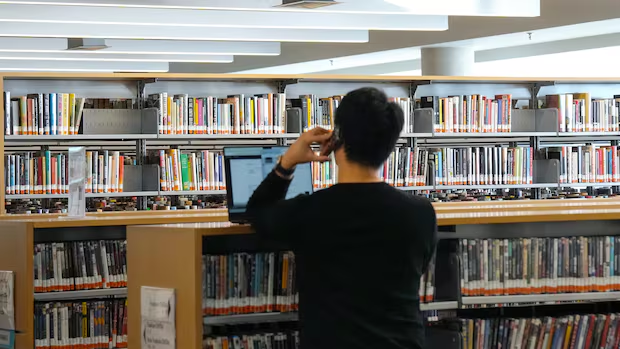
A public library is the only place where we can seek refuge in its endearing silence. Or perhaps this is how it used to be. Today, the silence speaks of something far more upsetting — the decline of a free, egalitarian space for civic engagement and fostering social development.
One of the reasons the silent decline of public libraries is largely unnoticed is that their presence and importance are usually overlooked. We often perceive libraries solely as buildings that offer a wide range of resources. But if we zoom out our lens, we will be able to see it as a social institution — one which provides not just access to knowledge but also a sense of belonging in a society that claims to promote and support inclusivity.
With the absence of libraries, the inequality crisis becomes more visible. Access to learning has become paywalled — treating knowledge as a matter of affordability. Those who can spend money can get their hands on the most exclusive editions, and those who cannot are left with disappointment and frustration. Education was once a public necessity — now it has become a commodity. The educational gap between the privileged and underprivileged has widened because access has been tied to income. Libraries offer equal opportunity across all socioeconomic classes, but our neglect as a society has resulted in a lost opportunity for social advancement by those deprived of basic needs.
Looking beyond the realm of books, public libraries offer social cohesion. For a socially sound civil society, we need to be more tolerant and more respectful of different opinions, which can be achieved in the welcoming atmosphere of a public library, where we can have debates, share ideas and opinions. Because other public spaces have become transactional, where our presence is commercialised. Conditions such as paying, consuming, and having an in and out time are attached to just sitting in a quiet place.
Restoration of public libraries will not be enough without encouraging people to actively use them. Festivals, talks by authors, and community discussions are some events that will help revive people’s interest in going. Because even today, there is a large population that is fond of books, eager to learn and interact with people of the same interests. Socialisation should extend beyond just entertainment and food. Engaging intellectually will enlighten people — creating a better-informed society that can make decisions on its own, some even being capable of real and transformative change.
Encouragement is also important because ease of access to online resources has decreased people’s tendency to visit libraries. The fact that, though digitalisation offers convenience, it cannot replace the shared communal experience provided by libraries should be emphasised. With the increasing decline of public libraries, where learning is collective rather than personal, our community’s sense of intellectual identity will start to erode.
Although many public libraries still exist in Pakistan, they remain underfunded, underfacilitated, and largely neglected. Our neighbouring country, India, is investing in making the country’s largest and most modern library in the state of Gujarat, whereas our country’s financial constraints and policy priorities have shelved such initiatives. The outcome of this is a cultural deficit.
It will take time, but we as a society need to step up. By taking a strong initiative followed by small steps towards commitment — such as events, frequent visits and investments — we can bring back our libraries. They are struggling today, but if given the attention they need, libraries can fill the inequality gap and help us prosper as a nation.