



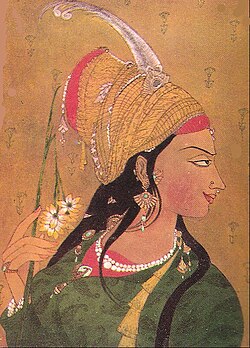
The tomb of Anarkali lies in Lahore as a mystery of fiction and history. Constructed by Emperor Jahangir for his beloved, “Anarkali,” or simply Sharif-un-Nissa, the tomb is a testimony of love and how myth and reality often become inseparable. Told widely and surviving on oral storytelling, a version of the legend was finally penned down by Imtiaz Ali Taj in 1932 for his drama with the same name, ‘Anarkali.’ This act immortalised an incident by interweaving tales with reality and adding to its mystery.
What really occurred may have been lost to time; however, a few facts can be traced and applied to paint a clear picture. Indeed, historians have tried to trace the origins of such a woman who, despite her significance, wasn’t even mentioned in Jahangir’s autobiography, Tuzk-i-Jahangiri.
The most significant version of the legend follows the drama of Imtiaz Ali Taj. At the beginning of any copy, he mentions that the drama is a work of fiction and should not be taken literally. The reader inevitably pictures the tomb, wondering about the connections between the two.
The play paints a royal picture of the Mughal Court; each act opens with an intricate description of the atmosphere, pointing down to even the small details. Vividly, one can imagine the glory and glamour of the Mughals. Emperor Akbar, his son Saleem (Jahangir), Nadra Begum (Anarkali) and Dilaram form the central characters.
Saleem falls helplessly in love with the new and young dancer named Nadra, despite being an heir to the throne. Dilaram, jealous of the relationship as she too loves Saleem, influences Akbar to form hate against the young lovers, which ends with the brutal murder of Nadra or Anarkali as Saleem falls into insanity. The tragedy ends with regretful Akbar and Dilaram, and an heirless, uncertain future for India.
While Taj’s version adds to the mystery, other accounts of the incident exist as well, some of which try to separate fact from myth and others that dive deeper into the latter. The first recorded account of this legend comes not from an Indian but a British man named William Finch. Finch travelled to Lahore from 1608 to 1611, during the reign of Jahangir himself, and mentioned Anarkali in his travelogue. According to him, she was one of Akbar’s wives and the mother of Danyal Shah. Akbar accused Jahangir of engaging in an illicit and incestuous relationship with his step-mother-in-law, resulting in her being entombed alive within the walls of Lahore Fort. Later, Jahangir had the tomb constructed.
Other confirmations of Anarkali can be found in historical accounts such as the Tehreek-i-Lahore by Syed Abdul Lateef that follow the general myth of an illegitimate love leading to burial and later the tomb.
However, historian Abdullah Chughtai and the Tehreek-i-Lahore, represented by Kanhanya Laal, take different approaches. Chughtai argues that the tomb in reality is of Jahangir’s wife, named Saheb Jamal, and that the mystification and attention from the story of Anarkali have distorted this fact. Meanwhile, Laal mentions that Saleem and Anarkali were indeed lovers, but she died naturally while he was away in Decan. Later, he had the tomb built to honour her memory.
Most popular versions of the incident present a rather colonial perspective, heavily influenced by European sources, especially in Taj’s version. The binary presentation of protagonists and antagonists is also common in colonial writings, where a clear distinction between “good” and “bad” exists. In a study of “The Zoo” by Tariq Rehman, it is argued that in post-colonial fiction, “the concepts of superiority and inferiority, cultured and savage, educated and illiterate, developed and underdeveloped, sensible and sensuous and the like are closely and ideologically associated with the concept of colonial representation of less developed and privileged peoples of the third world.” Though Anarkali as a story has existed alongside and before colonialism, the influences are evident in how the story is narrated now.
On the other hand, the direct European narration has also had its effects. For example, Finch’s account showcases an orientalist perspective of the Mughals. One marked by the “exotic” happenings inside the lives of the rulers of Hindustan, seemingly to illustrate the native as an “other”, less civilised or more immoral being. The narrative by Finch is different and presents the love affair as illegitimate even to the readers who usually sympathise with the young lovers. Edward Said argues that the West maintains a certain image of the East as mysterious and uncivilised, while the former is civilised and rational. Finch, arguably, upholds this too.
Despite the confirmations and their validity, it is clear that a love story existed because of the tomb. However, the question that remains is why the mention of the tomb is absent from Mughal records. This incident may, in fact, have been a minor court incident, not out of the ordinary, accounting for the lack of primary records attesting to it. This tale can be viewed from a different perspective, addressing questions of power, authority, and discipline.
In all the different versions, we see that the Mughal emperor had absolute power, where the lives of those even within the court were not spared. What could have been avoided ended as a murderess tragedy. The emperor wields authority, and he may take extreme measures to uphold his hegemony.
The Mughal rulers saw themselves as divinely ordained to rule people, in this case, Hindustan or the Mughal Empire. For this, they maintained an air of superiority over common subjects, going as far as not using their real names and instead using multiple titles such as Jahangir or Shah Jahan. Anarkali, a commoner, to fall in love with a prince and heir to the empire, in a sense, puts into question the divinity of the royals, for if married, a commoner would become the queen of the empire.
It cannot be ignored how patriarchal structures maintained the Mughal rule and its sovereignty in these tales. The lack of evidence on the first hand insists that this story is a legend, not reality. A deeper look may conclude that the entitlement and shrinking of women during monarchical rule may also be the cause. Though not mentioned by Jahangir himself, Abraham Eraly references Abul Fazl, the court historian of Akbar, on an incident where Saleem was caught trying to meet one of his father’s wives. Furthermore, the status of women within the empire was secondary, and in the tales, women are often the victim in the form of Anarkali or a jealous villain in the case of Dilaram in Taj’s version, instead of a well-rounded character with both flaws and positives.
Though impossible to know the full reality behind this legend, it has contributed to the genre of doomed, star-crossed love affairs born out of innocent love that doesn’t discriminate between class boundaries. It is, moreover, noteworthy how presumably street gossip can turn into folklore that survives generations. The intrigue behind Anarkali is that it offers a personal look into the lives within the Mughal rule, whether real or not. Here, it can be concluded that history’s deep political and emotional nature is fully on display as the tale circles around different events from the perspective of race, class, power and even gender.
Works Cited
Bari, Faisal. “Legend: Anarkali: myth, mystery and history – Newspaper – DAWN.COM.” Dawn, 11 February 2012, https://www.dawn.com/news/694833/legend-anarkali-myth-mystery-and-history. Accessed 28 February 2026.
Butt, Aamir. “Anarkali: Fact or Fiction?” The Nation, 18 March 2016, https://www.nation.com.pk/18-Mar-2016/anarkali-fact-or-fiction. Accessed 28 February 2026.
Foster, William, editor. Early Travels In India, 1583-1619 (1921). Kessinger Publishing, 2008.
Lashari, Mubarak Ali, et al. “Binary Opposition and Colonial Hegemony: Structural and Post-structural Study of Tariq Rahman’s “The Zoo.”” International Research Journal of Arts & Humanities [IRJAH], vol. Vol. 47, no. 47, 2019, p. 8. University of Sindh, https://sujo.usindh.edu.pk/index.php/IRJAH/article/view/62.
Said, Edward W. Orientalism. Knopf Doubleday Publishing Group, 1994.
Sharma, Bhawna. “Mughal Theory of Kingship and Perception of Sovereignty.” International Journal of Innovative Research in Technology, vol. 11, no. 8, 2025, p. 7. University of Jammu, https://ijirt.org/publishedpaper/IJIRT172390_PAPER.pdf.