





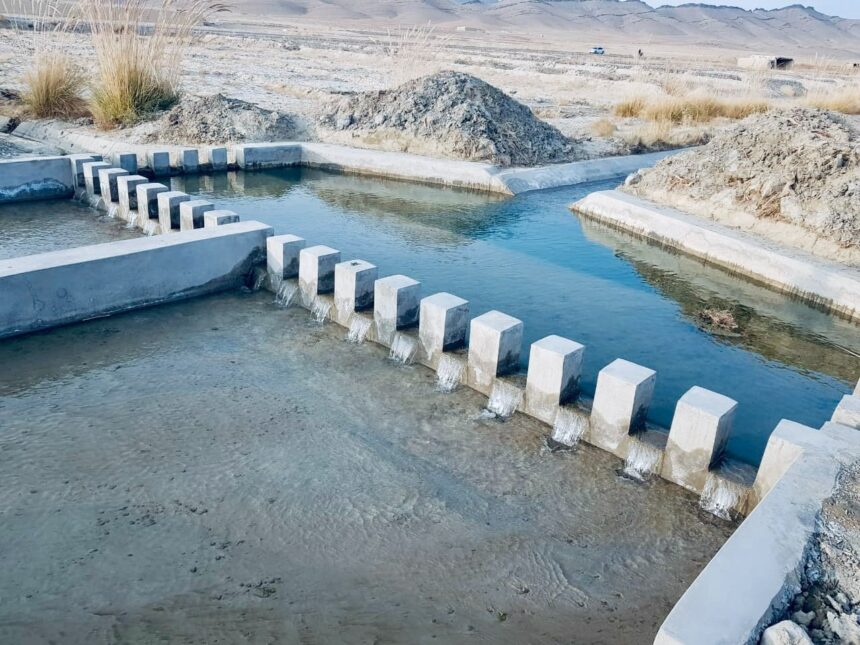
Water has always been a luxury in the dry and rugged countries of southwestern Pakistan. Inhabitants of the dry land of Balochistan invented a remarkable technique to supply water in their villages and farms, which had to be located at a depth of several metres underground, more than a millennium ago. This ancient system, the Karez System, was used to sustain thousands of people with an uninterrupted and sustainable supply of water. However, these underground channels are now fading away, and one of the most intelligent water technologies in Pakistan is becoming a lost history.
The Karez System is an underground system of tunnels that transfers water found in the natural aquifers in the mountain ranges to the fields and settlements that are located several kilometres distant. The system relies on gravity to direct the groundwater to a set of tunnels in a sloping manner instead of pumping water directly out of wells. These tunnels join a series of vertical shafts through which a worker is allowed to excavate, repair, and ventilate the tunnels. The land seems to be pocked with small holes, which are circular as seen through the eyes of the air, but there is a silent underground stream below the ground.
The history of Karez technology is very deep. The system is thought to have originated in ancient Persia and, since then, conquered Central and South Asia centuries ago. The system gained particular significance in Balochistan in Pakistan, where rainfall is low and rivers are few. In cities like Quetta, Mastung and Ziarat, communities were so dependent on these underground channels to cultivate crops and support day-to-day lives.
Karez construction was not that simple. It needed qualified labourers who were familiar with the terrain and the underground movement of groundwater under the mountains. To begin with, they would find a good source of water in high places. Then, with simple equipment and proper measurements, they excavated a slightly sloping tunnel which was capable of going several kilometres. Vertical shafts were developed at intervals to excavate soil and give room to make a repair. They also used these shafts to supply oxygen to the workers in the construction.
The Karez system is so brilliant in terms of its simplicity and long life. The water movement is also natural, as it moves through underground tunnels, keeping it cool and not evaporating, which is a significant quality in hot desert environments. The system also eliminates over-extraction of groundwater since it will only give the natural amount of water supplied by the aquifer. By doing so, the Karez was a sustainable and balanced form of irrigation well before the modern-day notion of sustainability.
The social and agricultural life of Balochistan was formed over centuries under the influence of the Karez System. The outlets of these underground channels were often constructed into villages around which fresh water surfaced. Farmers used the water to irrigate orchards of grapes, apples, and pomegranates, as well as fields of wheat and vegetables. Local communities had the responsibility of distributing water, and, as a result, they were governed by traditional regulations that evenly allocated water to the farmers.
Nevertheless, the Karez System is in decline despite its historical significance over the past several decades. This decline is largely due to the adoption of the use of electric and diesel-powered tube wells. These contemporary wells have the ability to extract much groundwater within a short time, which might be convenient in the short run. Nevertheless, overpumping has reduced the groundwater levels in most places. The groundwater table is declining; thus, the underground tunnels of the Karez System become mostly useless as they tend to dry up.
Climate change has exacerbated the problem. Water has even become more scarce in Balochistan due to the reduced rainfall and long droughts. The region has seen several traditional Karezes being collapsed or abandoned as communities do not have the resources to fix them. As well, the process of cleaning and strengthening the structures of these tunnels is both expensive and time-consuming.
Loss of traditional knowledge is another problem. Previously, the knowledge required to build and maintain Karezes was passed on between generations by professional builders. This is because today, fewer young people are learning the techniques, with many of them travelling to cities in search of modern jobs and lifestyles. In the absence of this information, it is even harder to restore destroyed systems.
However, there are professionals and local people who are trying to restore the Karez system. Conservation bodies and water management organisations have been able to see the merits of these ancient underground rivers. Through fixing the old tunnels and conserving the groundwater resources, they are hoping that they can restore the available water to the rural population. The reinstitution of the Karez system may also assist the communities to adjust to the changes in the climate by offering them an environmentally friendly and dependable water source. Many years before technology was introduced to society, individuals in Balochistan came up with a solution that would not exceed the boundaries of the environment and satisfy society. The rivers were flowing under the earth and keeping alive generations in one of the driest regions of Pakistan.
Nowadays, when the world is experiencing increasing water scarcity, long-lost knowledge of the Karez system can be learnt. It demonstrates that sometimes complex machines are not the way to achieve sustainable solutions but a thorough knowledge of the land and the natural resources there. The conservation and rejuvenation of these old channels may see to it that the undiscovered rivers under Baluchistan flow even after many years.