





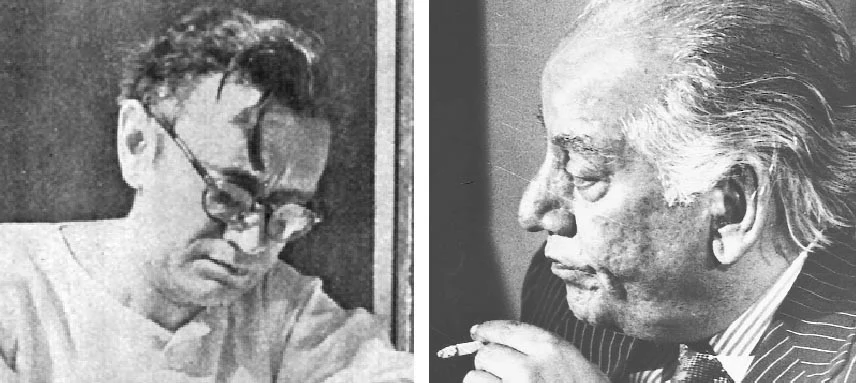
In some ways, literature reaches a stage when the writer ceases to be a man and becomes a myth. They become symbols on their faces, a mark of suffering on their aesthetic, a word on their performance. No one reads them anymore; they are the version history they created. Finally, the poet gets lost in the legend in his/her name.
It happened to Faiz Ahmed Faiz, Saadat Hasan Manto, and Sylvia Plath, three writers from very different cultural backgrounds, yet connected by the same cultural destiny. All increased in size beyond their literature. Both were broken down into something that was familiar to the public to recycle time and time again. The revolutionary. The madman. The tragic woman. Their humanity was eclipsed, and their mythology took over.
Today, Faiz is present in every place and nowhere. His poetry can be heard in the protest slogans used to march down the street; in the university movements; in the melancholy captions that accompany the passing of the days; in candle-lit conversations of revolution. He has emerged as a symbol of beautiful resistance, soft-spoken rebellion, in lyrical elegance. His verses have been passed down generation to generation as symbols of hope and rebellion.
In the midst of this romanticisation, however, the complexity of Faiz gets lost.
Faiz was not just a poet of missingness but also a poet of revolution. He was a strong political voice, shaped by prison, exile, labour movements, and the strident failure of postcolonial nationalism. However, modern viewers tend to “colour” him into a mere background. The smoke of cigarettes and the Urdu couplets that are soft, sad and intellectual by Faiz are easier to digest than the ideological seriousness of his work.
His poetry is cited as emotional fodder, and the structures of power that he critiqued throughout his life are ignored. Resistance itself is made into an art. The revolutionary poet becomes an ornament of the culture.
The reduction that Manto undergoes is another kind of reduction.
His name is synonymous with destruction. Nearly all the discussions that revolve around him come back to the obscenity trials, alcoholism, mental collapse and Partition. He is remembered as the writer who exposed society’s hypocrisy and lost his sanity. The tragedy of Manto has always been at risk of ruining the marvellous accuracy of his craft over the years.
He is sometimes described as having “spilt the pain” on paper. However, Manto wasn’t rambling when he wrote. He was disciplined, purposeful, and precise. He knew how to edit his stories because he knew how to keep them to a minimum. He was well aware that silence could inflict a wound, deeper than description. He had a good sense for when to leave a reader gasping for breath.
But the audience goes on and on about the self-destructive genius more than the storyteller’s brilliance.
This is especially true in South Asian literature, where an artist’s suffering is perceived as authenticity. Manto is made into the prototype of the doomed intellectual, annihilated by society’s rejection of truth. His addiction becomes a part of his mysticism rather than being accepted as a true sign of human deterioration.
The myth expands to the size of a man.
Then there’s Sylvia Plath, one of, if not the most mythologised, writers of the modern era.
Few writers have been so ensnared in the story of their own demise. Plath’s poetry is always interpreted through the lens of her suicide, as though each of her poems were a foreshadowing of that event. Her literary genius is continually eclipsed by public fascination with her suffering.
She has emerged as the icon of the sad woman rather than a writer.
This diminishment takes away Plath’s intellectual complexities. She wasn’t just a sad or weak woman; she was an ambitious, technically savvy, darkly humorous, deeply conscious woman, and a woman who knew how overarching and suffocating the systems that oppress women are. Her writing delved into rage, identity, motherhood, performance, and power with chilling intensity.
But in popular culture, the image of the tragic woman is far more appealing than that of the disciplined artist.
Most especially, the Internet has made Plath a sort of aesthetic category. Young women exchange their bits of work, along with pictures of loneliness and emotional decay, and engage in a culture that romanticises female suffering but overlooks the systems that create it. Pain becomes fashionable. Breakdown becomes beautiful.
This time, the legend takes over the writer.
Faiz, Manto and Plath do not have tragedy in common alone; they have in common a desire for simplicity in society. Crowds want characters they can recognise in the story: the revolutionary poet, the drunken truth-teller, the suicidal genius. Complexity unsettles people. Contradiction demands effort. Easier to carry myths than real human beings.
There’s something profoundly weird about literary culture and how they exist on broken artists. The more one suffers, the more authentic it is. The more they are tormented, the more sacred they are. We start to consider pain as part of the requirements for genius.
However, to focus writers solely on their wounds is to demean their work.
A writer’s biography ought to add to an understanding of the literature, not to a prison. Faiz wasn’t just resisting; he was fighting back. Manto was more than “ruin”. Plath was much more than despaired. But where they come from, cultural memory has always boiled them down to archetypes, and hidden from them the contradictions which animated them.
The worst thing readers do is presume that they know a writer because they know the legend of him.
When the poet is the poem, the man or woman gradually is lost. And literature is robbed of its most important fact: that great sentences are written by, by, and by weak, frail, complicated people who are trying to be understood.