



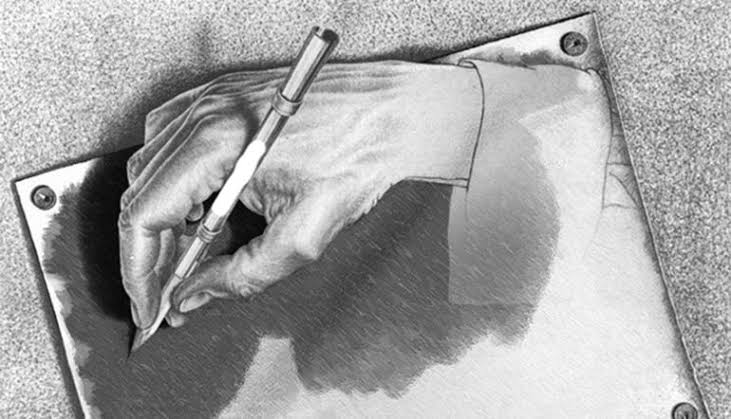
Writing about our problems is easier if we pretend that they belong to someone else — some fictional being detached from ourselves. Perhaps reading about our struggles is also easier when we see a fictional character portray them, rather than being forced to hold a mirror to our faces and confront our weaknesses, our insecurities, and those deep core fears that we are not entirely comfortable accepting or admitting to.
Is it not agonisingly difficult to hold our heads high when faced with our true selves? Is this not the reason that people endure identity crises and existential dread? The image we have constructed of ourselves in our minds does not necessarily reflect the truth, and it is an ordeal to see ourselves stripped of the glamour, allure, and charm to which our brains had latched on. Would the moon not be disappointed to realise that it is merely a huge rock?
And thus, I believe that people have begun to gravitate towards autofiction, both in reading and writing. Autofiction is a literary genre that blends autobiography and fiction. It occurs when authors write an overtly fictional story whilst weaving in scraps of truth, leaving one apparently indistinguishable from the other. It blurs the lines between fiction and reality, and perhaps that is for the better.
In such narratives, it is possible to find comfort and consolation for our solitary loneliness without being entirely vulnerable to the jabs of reality. Perhaps it is even possible to find solace in characters who are not you, yet conjure up enough similarity to give rise to a sense of camaraderie and affection. We find parts of ourselves tucked between pages and keep them there, lest they escape the words and haunt us in the mirror.
Osamu Dazai, in his book No Longer Human, described such a treacherous life for his protagonist and poured so much of his own experience into him that scholars and readers still debate the autobiographical nature of the book decades later. Is the solemn main character, Yozo Oba, Dazai himself, or is he akin to an imaginary friend in whom Dazai sought comfort?
In Junji Ito’s manga adaptation of the book, Ito interpreted the content as parallel to, yet distinct from, Dazai’s real life. At the end of the manga, Ito draws both Yozo Oba and Dazai as they meet in prison and become friends. The character and the author finally come together through a third-person lens.
This moment is obviously not present in the original work and represents an interpretation by Ito himself. Yet I do not entirely disagree: Dazai could never maintain his relationships with real people and was thoroughly depressed — who better to understand him than a person of his own making? A person whose mind and experiences he hand-crafted himself; a person whose thoughts were completely open to him and changeable by him.
Sylvia Plath hid pieces of herself between the lines of The Bell Jar, and years later, Ocean Vuong dipped a pen in his own blood to write On Earth We’re Briefly Gorgeous. Autofiction has remained a powerful genre throughout literary history, precisely because the reality of the author’s genuine emotions serves as nourishment for a fictional story.
It allows readers to scavenge through paragraphs in hopes of catching a glimpse of something real. And because it is real, it resonates. When one detects an emotion with which they are all too familiar within an autofictional novel, perhaps it dulls the pain of existence or, at the very least, serves as proof that the mountain of sorrow is not ours alone to bear.
We can display our bruises and scars without having to parade in complete nakedness. By painting our wounds onto our characters, we let them wander into the masses and show the world what hurt us, all without having to leave the comfort of our front door.
Considering all this, I am not surprised that autofiction garners so many readers and devoted fans around the world. If nothing else connects humans, at least our shared feelings do. If people cannot find connections in real life, they will seek them elsewhere — and in this case, that search leads to books.