





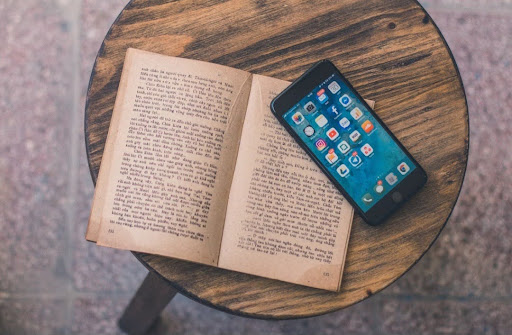
There’s a particular guilt that lives inside my drawer, underneath a half-finished notebook and my phone charger. It is a novel I started three weeks ago, its spine uncracked, pages unfolded, and a bookmark still on page thirty-five. Page thirty-three is exactly where I left it three weeks ago. I had to finish it, and I still mean to. But every evening, before I can reach for my book, I have scrolled through twenty posts, ten carousels, five reels, and a thread post that led me to nowhere. And by the time I remember my book, my brain has already forgotten how to be slow and be present in a moment.
Well, I am not writing this to confess about my leisure time. Rather, it is an observation that raises a question: Is literature facing a crisis of attention and not just readership? We are living in a strange contradiction: more people than ever are talking about books these days. BookTok and Bookstagram have millions of followers and devoted readers; literary aesthetics trend on almost every platform, and bookshelf decor in every home has become a kind of art form. But sitting down to read an actual novel without reaching for your phone is considered to be the most difficult task today.
The Numbers Are Not Comfortable
Research by Dr Gloria Mark (2023) found that in 2004, the average attention span on digital devices was around 150 seconds. By 2012, the number had dropped to 75 seconds. And by 2024, it had fallen to a staggering 47 seconds.
Now, think of what a novel asks of you in contrast: an uninterrupted silence, the presence of mind and body at once, and the willingness to sit in someone else’s life without a notification pop-up and a scroll. Additionally, the reading time of an individual is decreasing rapidly with each passing year. There were years when reading leisure time peaked at above 30 minutes per day. However, it fell to less than 10 minutes within a few years, and the decline is directly related to rising screen time.
What The Algorithm Trains Us For
The problem is not concerned with the attention problem at all. The problem is structural. Every platform (Instagram, Facebook, TikTok, Substack) is designed to train our brains to think that accepting the breakthrough scrolling for bare-minimum tasks is essential. Every platform is designed meticulously to break our attention span into pieces, and yet we are trained to expect outcomes and the next thing immediately one after another. As the novel doesn’t give us the next thing, the next twist immediately, we turn to our phones, and the hours pass in the blink of an eye.
Since we are so accustomed to scrolling and skimming, many people now struggle with close reading of lengthy texts, which ultimately leads to failed literary analysis. The screen in front of us trains us to expect the quick burst of information rather than a preserved narrative. There’s a screen in front of me right now, but it doesn’t expect me to scroll through unlimited posts because the framed narrative isn’t asking me to do so. Hence, this is not a moral failing, but a learned behaviour and can be unlearned easily if only we name it perfectly.
The Paradox Of BookMedia (Bookstagrams and BookToks)
There is something hopeful yet ironic about the fact that the same short-form digital culture eroding our attention span hypes up certain book sales and is responsible for a genuine resurgence in sales. Bookmedia (the constellation of reading communities on TikTok, Instagram, and beyond) runs on commands—books that can be described through feeling and identity in seconds—and rewards instant emotional clarity. Such books that travel the fastest are those with a hook you can explain in fifty words: enemies-to-lovers trope, revenge-based genres, family ties, and devastating endings.
Bookmedia is full of slogans that corrupt the minds of new readers when they accidentally decide to read a novel. And this is not the problem. People are reading and enjoying their journeys. The problem arises when these books match the algorithm we have been trained for years to match the pace. And these novels do exactly that. Bookmedia has shown the audience that reading is no longer only private but also commercial and performative. The slower the novel, the more difficult it becomes to find an audience, because it asks us to find a quiet place and sit in it for hours, thinking about uncertainty. The place where no certainty or spoilers can ever find a place.
Similarly, the concern is not that we read less. But prolonged exposure to shallow digital media, reliance on AI, and multitasking have contributed to shorter attention spans in younger generations. If you allow me to tell you a secret, I would ask you to spare a month for a better reading and comprehension of a long novel (1000+ pages) and observe the difference it makes to your brain, as it demands the exact opposite of brain-rot.
What We Stand To Lose
Therefore, the novel has always been a technology of slowness. It was built to do something no other form of information can do— embracing the quality of presence. The trend of literary reading still follows our daily lives, but with minimal gestures toward real moments. We are giving so little of ourselves to literature, philosophy, culture, and history, and receiving so little of what they have to offer in return. Hence, the novel is not dying. The saddest part is that our brains are dying from brain-rot and endless scrolling, leading to the death of our relationship with creative ideas. This relationship is not changing with guilt over not consuming enough knowledge, but with attention, which, fittingly, was asked of us.
Work Cited
Mark, G. (2023). Attention Span: A groundbreaking way to restore balance, happiness and productivity. Hanover Square Press.