





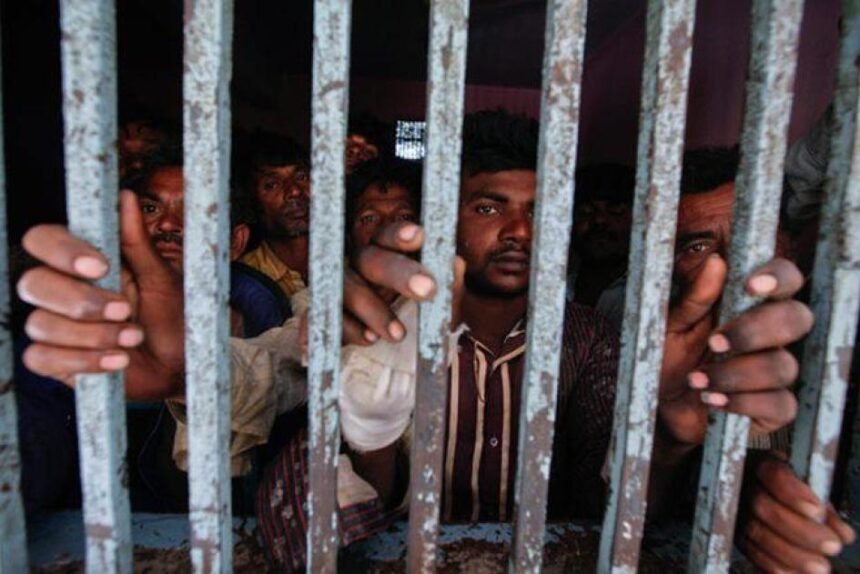
There is a peculiar irony in a state promising to be more generous with bail when its courts settled the question of how generous to be three decades ago. The Supreme Court held that for offences punishable with less than ten years, “the grant of bail is a rule and refusal an exception.” Pakistani courts have spent 30 years operating under that instruction, yet the Islamabad Declaration on Prison Reforms on 2nd July 2026 pledged, among other things, to expand access to bail and non-custodial alternatives, painting a picture of rare political consensus. The underlying concern, that Pakistan’s prisons are overcrowded and clogged with under-trial prisoners, is genuine and commendable, but there is less clarity in why the remedy pledged is more of something the system already hands out with little resistance.
The architecture on paper, and its practical collapse
The starting point is not in dispute. The Code of Criminal Procedure draws the operative distinction: offences punishable with death, life imprisonment or ten years are non-bailable as a matter of category, but even there, courts retain the power to grant bail where the case calls for further inquiry into guilt, a threshold that has been read generously for decades. Add to this the doctrine of parity, which frees an accused simply because a co-accused was freed first, and a separate line of cases granting bail on the basis of statutory delay alone. On paper this reads as a careful balance between liberty and the interest of justice, and yet in practice the outcome is vastly adverse.
Nowhere is the imbalance sharper than at the pre-arrest stage, which essentially exists to protect the genuinely persecuted accused from malicious prosecution before an FIR can be weaponised against him, and that purpose is sound. But its practical effect, in the ordinary run of cases, is to hand an accused advance notice of the very investigation meant to build a case against him, together with weeks or months of liberty in which to act on that notice. The accused who steps out of a police station or a courtroom on interim pre-arrest bail is not a passive beneficiary of due process, but for the duration of that bail, he is in a position to reach the complainant, the witnesses, and in some cases the evidence itself, and the state has almost no operational apparatus to stop him.
This is not solely a Punjab problem. Sindh legislated first, in 2013. Balochistan followed in 2016. Khyber Pakhtunkhwa came last, in 2021. Four provinces, four statutes, and the same failure in each: laws that exist on paper and nowhere else. Sindh’s own implementing rules were still unfinished in 2024, over a decade after the Act passed. A February 2022 Senate briefing put actual witness protection caseloads at roughly 1,000 in Punjab, 374 in Sindh, 100 in Khyber Pakhtunkhwa, and 19 in Islamabad, numbers too small to matter against the scale of criminal litigation in any of these provinces, and Balochistan’s law, the briefing noted, had not been implemented at all.
The gap between threat and remedy
Article 164 of the Qanun-e-Shahadat Order empowers courts to admit evidence produced through modern devices and has been interpreted to permit testimony by video link where appropriate. Set against this is the older mechanism under sections 503 and 506 of the CrPC, which allow a witness who cannot attend court to be examined instead through a formal judicial commission, requiring the commission to be executed, the resulting deposition returned to the trial court, and the proceedings adjourned in the meantime for however long the process takes. The relationship between Article 164 and the commission procedure remains underdeveloped in Pakistani jurisprudence, and until that is resolved, a witness’s practical ability to testify without facing his intimidator in person depends less on the protective intent of the law than on which of the two competing procedures the trial court applies
Meanwhile the standard for undoing the damage once it has begun is set deliberately high. Cancellation of bail under section 497(5) of the Code generally requires misuse of the concession already granted, not mere apprehension of future misuse, meaning courts will rarely act on a credible fear that a witness is about to be intimidated, and will act only once intimidation, disappearance or retraction has already occurred. This makes every grant of bail, pre-arrest or post-arrest, an irreversible gamble. If the accused behaves, nothing is lost. If he does not, the harm to the prosecution’s case is usually done by the time a cancellation application is filed, heard and decided, and no subsequent order restores a witness’s nerve or an alibi’s plausibility once either has been compromised. Courts routinely treat this asymmetry as somebody else’s problem, an enforcement failure rather than a reason to be more careful about the initial grant. It is, in fact, the entire point.
Blaming the wrong stage of the process
Part of why further inquiry has become such a well-worn escape hatch is that it is not being misused so much as accurately applied to genuinely poor police work. Investigation in the ordinary criminal case in Pakistan is frequently under-resourced, procedurally careless, and completed under time pressure that produces exactly the kind of gaps further inquiry was designed to catch: recoveries improperly witnessed, statements recorded well after the fact, chain of custody broken before a challan is even submitted. Judges granting bail on further inquiry in these cases are not being unusually generous, simply because a Judge is bound by the files and evidence provided to the court, and thus when they are looking at a police file that genuinely does not support the charge as framed, they cannot deny a privilege granted by the Code.
This is the harder truth sitting underneath the loose bail critique, and it changes where the fix belongs. If the police file is the reason bail is difficult to resist, then treating the resulting bail grant as the disease is a category error, and expanding access to bail to relieve prison overcrowding compounds that error twice over. It uses a liberty mechanism to paper over an investigative and infrastructural failure, without any corresponding investment in the police capacity that produced the failure in the first place. Using bail policy to solve what is, at root, a resourcing and training crisis inside the investigation and prosecution machinery is not reform. It is a dangerous over-correction, one that will not reduce the underlying rate of poor investigation and will instead normalise it as an acceptable justification for release, case after case, indefinitely.
The damage is evidentiary, as well as just human. Section 27 of the Qanun-e-Shahadat Order allows police to rely on an accused’s disclosure statements made in custody, particularly those that lead to the recovery of a weapon, stolen property, or a body. That provision relies upon, and only works because, custody itself produces the disclosure. A hasty bail release removes the leverage and neutralises the evidence before it can be recovered.
What follows is a slower, quieter version of the same tampering problem described above, except directed at objects and records rather than people. An accused back in the community has every opportunity to interfere with a crime scene not yet fully documented, to relocate or destroy recoverable property, and to coordinate an account with co-accused who have not yet been separately examined. Evidence that was recoverable during the first days of custody, when an accused’s location and disclosures could still be tracked and verified, is frequently unrecoverable weeks later, once bail has been granted, and the forensic footprint of the case has been compromised. The chain of custody is shattered before evidence can be formally exhibited, and by the time the trial reaches the stage where that evidence would matter, the file simply contains less than it once did.
The Declaration’s misdirected remedy
This looseness is not uniform. The same courts that grant bail and further inquiry with little friction in ordinary matters left lawyer Imaan Mazari-Hazir’s sentence-suspension plea pending for months, a reminder that leniency tightens considerably once a case carries political weight. Viewed against this backdrop, the Declaration’s principal commitment, to widen access to bail and non-custodial alternatives, misdiagnoses the problem it seeks to solve, though not uniformly. The Declaration’s separate commitment to probation and parole for women, children and individuals detained for minor, poverty-related offences is a genuinely different proposition from expanding bail in the ordinary criminal docket, and deserves to be read on its own terms rather than folded into this critique. That population, poor and unrepresented, held for want of a lawyer able to move a bail application at all, is exactly who a reform agenda should be protecting. But it is not the population responsible for the case backlog, the tampering problem, or the credibility crisis in bail jurisprudence described above. For that, the issue was never a lack of access. It was an investigative and prosecutorial infrastructure too weak to survive an accused’s release, paired with a judiciary unwilling to treat that weakness as a reason for caution. Expanding the avenues for bail in the ordinary criminal docket, while leaving both of those defects untouched, does not relieve pressure on the system. It adds another lane to a road already congested with cases that were released too easily, quietly tampered with, and left to collapse before trial.
Speed to verdict, not ease of release
The solution to overcrowded jails is to move cases already in the system to a final verdict faster, so that the bail decision no longer functions as a de facto end to proceedings, rather than letting suspects out even earlier. Here the more useful lever is section 344 of the Code of Criminal Procedure, which governs the postponement and adjournment of proceedings. Pakistani trial courts routinely permit long strings of adjournments, sought by defence and prosecution alike, for reasons that would not survive serious scrutiny, and every adjournment granted to an accused already on bail is another month in which witnesses can be reached and evidence can go quietly missing. Courts should clamp down on mechanical, frivolous adjournments as a matter of institutional discipline, not judicial courtesy, and should treat an unexplained request for postponement in a case involving a bailed accused with real suspicion rather than routine indulgence.
The Islamabad Declaration is right that Pakistan’s prisons are in crisis. But the premise embedded in the reform agenda that treats expanded bail access as the fix, without confronting why bail already functions as an exit from the criminal process rather than an interim measure within it, will not empty the prisons of the wrongly detained. It will simply give the loosely reasoned bail order a wider mandate, and a longer runway for the damage that follows it. This is not an argument against reform. It is an argument that the reform, as framed, is aimed at the wrong end of the problem. The true metric of judicial efficiency is the acceleration of the final trial verdict, not the leniency of the initial bail order, and until Pakistan’s courts internalise that distinction, no declaration signed at the Supreme Court will change what happens the moment the prison gates open.