





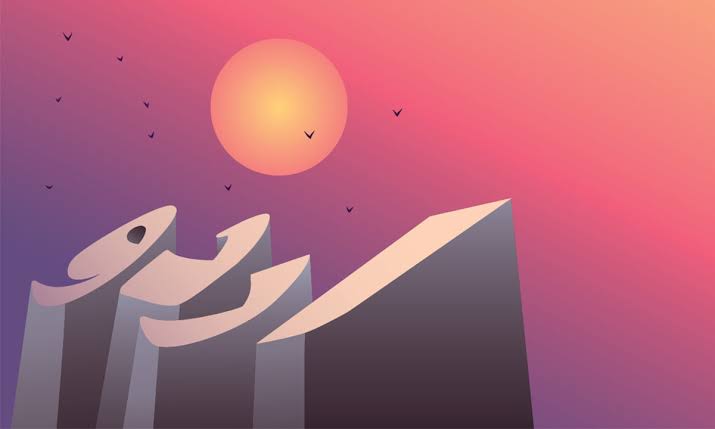
Going from Urdu being celebrated with the most articulate conversations and vocabulary used in drawing rooms, mushairas, libraries and the slowly fading pages to just an archival asset. Urdu has been a home to many expressions; it was used to write handwritten letters to your beloved, scented with memories on one hand and travelled through the dusky voices of poets through the radio on the other hand. For many younger audiences with a short attention span, the language and its beauty were merely part of the algorithm instead of a living language so celebrated in the past. And it now feels like an heirloom passed on to us with shaky hands by our ancestors, hoping we will be able to safekeep the beauty of it with the same admiration and respect as they did.
But then something out of the blue happened.
The internet.
Mostly blamed for taking away creativity became the biggest source of revival for the language.
Across pages and digital archives, the Urdu language has found a new platform and a unique set of audiences: younger, global and more emotionally invested in finding depth.
And this revival this time around is not just endorsed through institutions but also through screens.
For decades Urdu has been retreating from public spheres and conversations. For example, if viewing it from a post-partition point of view, it has declined in India despite the roots being deeply embedded in the northern side of the country. While on the other hand, in Pakistan it has remained the national language, but there has been a preference for English over Urdu due to international competition. In addition to this, amongst the diaspora communities abroad, no matter how connected they are to the language, there is still difficulty faced in reading the script.
This caused a strange balance: the language loved by all but understood by a few.
And this is where the digital evolution comes into play.
Unlike the traditional literary spaces, the internet does not restrict its viewers; for example, a teenager in Canada is out there listening to Ghalib through a subtitled reel. While a university student is reciting Faiz over the internet, or maybe a few of them are learning calligraphy.
Urdu itself inherently holds a charm that barely anyone can ignore, with its themes ranging from longing to separation or memory to dignity; one is bound to feel some sort of emotional resonation. And social media amplified it.
With the fast-paced sharing on digital platforms, a single couplet can reach a mass audience in a few seconds, which suits the purpose. As ghazals, nazams and shers are revived through this modern adaptation.
But it runs deeper than this; people online have become rather shallow and hold no constructive conversation, so to fill this void, young people have turned to this language to feel any sense of belonging and understanding.
But again, the irony remains of how fast-paced these platforms are, whereas the language itself demands to be thoroughly enjoyed. The emotional richness of certain words cannot be translated in any other way or form; for example, “hijar,” “vasal,” and “khamoshi” carry centuries of cultural resonance, and any translation can’t do them justice.
But at the same time, digital platforms have made writings and classics accessible across borders and allow people to discover them individually, and they are not confined to just South Asia. As the internet has blurred those traditional lines and now allows users to use and understand the language apart from the canonical poets taught in classrooms. Hence, this flexibility and adaptability are two of the main reasons behind its long-term survival.
The revival has now hence manifested into a rare hybrid form of both classical writings mixed with digital intimacy, which was assumed to flatten the language; it is now the ultimate cause behind the language’s evolution.