





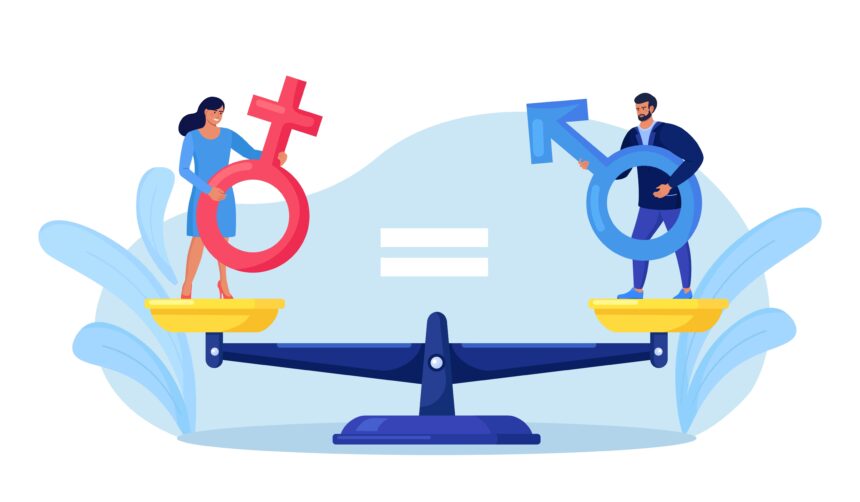
Equality has been the epicentre of many debates in Pakistani society for many years — many of these debates circle around the ideas of ‘What exactly is equality defined as?’ and ‘Does this definition of equality align with the morals and values of our society?’
Often, these debates conclude with the creation of various parties that have polarised views. Some believe that the fact women are allowed to work should be enough, as in previous times, women attaining education was also a huge feat, as traditionally it was considered that a woman belongs in the house and a man belongs outside the house.
This is not just a ‘Pakistani concept’ but also one that has been voiced by Western sociologists such as George Murdock and Talcott Parsons, who believed their families only function properly when roles between the man and woman are divided on the basis of their gender, as their gender defines the sort of strengths they possess.
For women, this strength lay in their maternal instincts, and for men, the strength was encrypted in their physical strengths, which made them better fit for the outside world and the adverse situations it brought with it. However, recent times have brought about a shift in such thinking. Now, the conversation is more about the fact that equality does not imply that women are declaring that they are physically comparable to men, but rather it is about the fact that men and women should receive equal opportunities politically, socially and economically. Therefore, now, even though women are allowed to work, more opportunities are being created for them deliberately through the following initiatives, such as the Benazir Income Support Program and Punjab Women Empowerment Initiatives (Mazhar). Though these programmes have not satisfied many women, as these programmes and jobs do not cater to the many other responsibilities on women’s shoulders, and often their male counterparts are not trained or brought up to assist their female counterparts. Thus, the debate on equality being beyond the idea of women being employed kicks in.
Coined by sociologists Arlie Hochschild and Anne Machung, in their 1989 book ‘The Second Shift: Working Parents and the Revolution at Home,’ coined the term ‘second shift,’ which encapsulates the idea that often a lot of women return home from work, only to be welcomed by a pile of domestic tasks which burdens them and could demotivate them from pursuing formal employment as well. This debate gains more momentum because often, men are not seen assisting women in such tasks.
Contextualising this to Pakistan’s context specifically exemplifies the issue, as our society has rigid ideas of what a real man should be like. Some characteristics associated with such a man are those of anger and hyper-independence, but this independence falters when it comes to tasks such as preparing their food, ironing their clothes, etc. As those tasks are assumed to make them less of a man. What this does is that all of these tasks are transferred onto women, and in a way, they are dehumanised, as it is believed that as a woman, it is only natural for them to bear all duties and not complain.
Usually when they complain, they are met with the criticism that they should not have vouched for formal employment in the first place. This burden worsens when we consider the third shift (bains) many women take up in society. This third shift consists of the emotional duties they have to perform towards their children, the elderly and their husband.
Talcott Parsons proposed the idea of the ‘Warm Bath Theory,’ which added further depth to the concept of a third shift developed by the sociologists Jean Duncombe and Dennis Marsden. In his ‘Warm Bath Theory’ (‘Talcott Parsons and the Family’), Parsons suggests that women are supposed to provide their family comfort and peace by welcoming them warmly after they have returned from school or work. The idea links with the fact that because women are mothers, it is generally thought that they are equipped to make others feel at ease. While this idea inherently has no flaws, in one way, it further emphasises a woman’s natural traits. Yet, at the same time, using biology to justify structural inequalities is slightly problematic. Even if men are not naturally equipped to take care of the household and its members, they can try — the goal is not perfection but just to make women feel less isolated and to assure them that they have someone looking after them as well.
Furthermore, another aspect of this debate is that women should work if they want to; thus, the idea of women having to seek consent to work should be deemed invalid. Often, women are made to take permission for such tasks because it is thought that they do not possess enough cultural capital to understand the way they should behave in society. As long as such schools of thought persist, society will remain stagnant, as an essential part of cerebral equality is providing women with the privilege to make their choices, the same privilege that men have. Perhaps, if women are given more authority over the kinds of decisions they can make, then the problem of double and triple shifts would also dissolve, as they would be happier.