





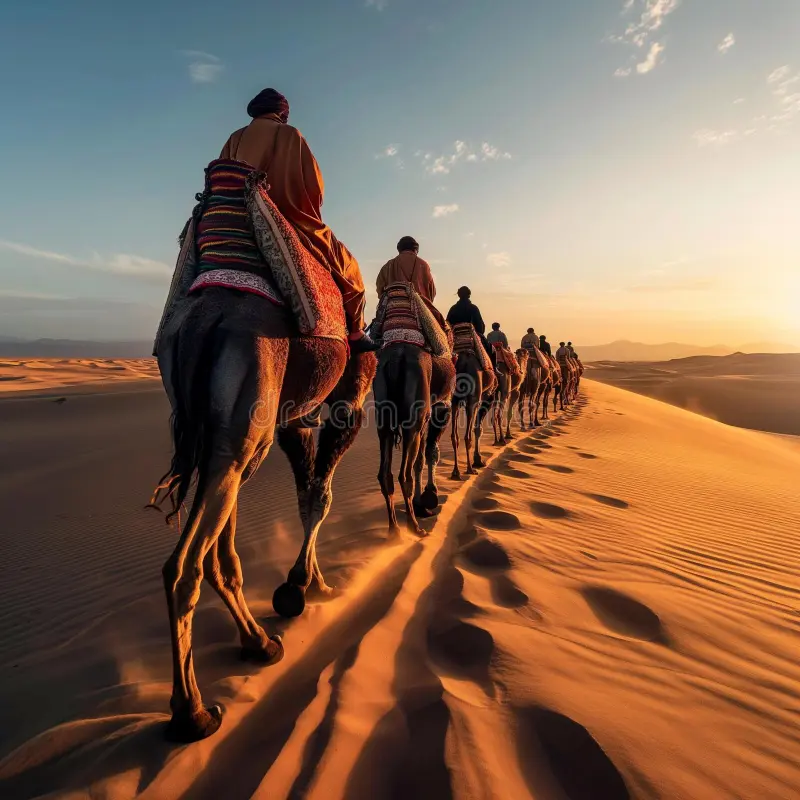
We can imagine the ancient world easily, a place where empires exist in seclusion — China, with its great wall, Rome, with its great roads; or Persia, with its great palaces. However, the links between these civilisations existed in a complex network of trading paths that wound through mountains, deserts and oceans thousands of miles long. These routes are referred to as the Silk Road, and in addition to goods, they also transported ideas, religions, and cultures. The Silk Road is one of the greatest engines of world interaction in history.
The Origins of the Silk Road
The origin of the Silk Road can be traced back to the second century of the Common Era, when China was under the Han Dynasty. Silk, being a fabric unfamiliar to a significant portion of the world, was in demand among the elites in the faraway regions, especially in Rome. Silk was light, strong, and glittering, which made it symbolic and gave rise to the desire to trade over long distances.
Silk was not the only item. Chinese merchants sold jade, porcelain, and paper, while Central Asian merchants sold horses and wool. India provided spices and precious stones, and the Romans supplied glassware, wine, and silver. These goods were moved, which became the foundation of the global economy long before the modern age.
Geography: A Path of Peril and Promise
The Silk Road hardly called for just one road; it was an array of interconnected roads that overlapped each other. Sandstorms and bandits were perpetual threats for the caravanserai travelling through the sands of Central Asia (Taklamakan and Gobi), which frequently led to. Other pathways cut through the harsh ranges of the Great Pamirs and Hindu Kush, facing challenges from avalanches and thin air even for hardened traders.
Nevertheless, no challenges could deter those traders. Along the way, fortified inns called caravanserais emerged and gave refuge and rest to the exhausted travellers. The highway ports grew into tiny cultural centres where traders from Arabia, China, and India exchanged languages and tales along with their goods.
The Exchange of Ideas
The ideological exchange was probably as powerful as the exchange of goods. Religions moved to various parts of the Silk Road easily: Buddhism went to China, spreading among monks and scholars. Merchants and missionaries also provided new grounds for Nestorian Christianity and Islam. The result of this mixing of religions was a trail of temples, mosques and monasteries along the trade tracks. The same was the case with technological innovations.
The invention of paper in China was brought to the Middle East and eventually to Europe and transformed knowledge recording and sharing. Gunpowder, another Chinese invention, revolutionised warfare when it reached the West.
Empires and the Silk Road
In the history of human existence, there were empires that emerged and collapsed along the Silk Road, making their own fate. Eastern trade was fuelled by the need of the Romans to use luxuries, but Rome feared that the gold would trickle out of its borders in exchange for silk. The Byzantine Empire eventually came onto the scene as a force and even tried to smuggle silkworms out of China in a bid to break the Chinese monopoly.
The Mongol Empire of Genghis Khan, centuries later, established a kind of relative peace called the Pax Mongolica. The empire spanned from China to Eastern Europe, allowing merchants to travel long distances with reduced risks. This stability revitalised trade, and wealth was showered on cities such as Samarkand and Kashgar, which became glittering capitals of art, architecture, and scholarship.
The Decline of the Silk Road
The decline of the Silk Road started in the late Middle Ages. The Ottoman Empire’s rise resulted in trade restrictions and high taxes between the East and the West. Meanwhile, European explorers were in search of other sea paths to Asia, and this resulted in the Age of Exploration.
The voyage of Vasco da Gama that reached the entirety of Africa and the expedition that was led by Christopher Columbus to the west shifted the balance of trade in the world to favour the sea-based routes. By the 16th century, much of the old glory of the Silk Road remained, albeit in the form of remnants of the routes that remained in use to trade in the region.
Images of Vasco De Gama and Christopher Columbus
The Legacy of the Silk Road
Nevertheless, the heritage of the Silk Road is massive in spite of its loss. It is considered to be one of the first types of globalisation, which proves that human societies have never been isolated. The foods that we consume, the technologies we work with and even the religions we follow have spread throughout history by this historic network.
Contemporary projects, such as the Belt and Road Initiative, intentionally call to mind the memory of the Silk Road and aim to restore economic and cultural connections throughout Eurasia. Historians, archaeologists, and explorers search for the remnants of caravanserais, cities, and artefacts from centuries of trade.
Conclusion
The Silk Road was not just a pathway; it was a living pathway for civilisations. It demonstrated that regardless of wide distances and cultural barriers, human beings can be united by one thing: curiosity, desire, and the need to have contact. The Silk Road might have been based on goods, but the real jewels were ideas and culture. The Silk Road is a reminder of the fact that the world has been woven together in some manner or other in the ever-shifting sands of history.