





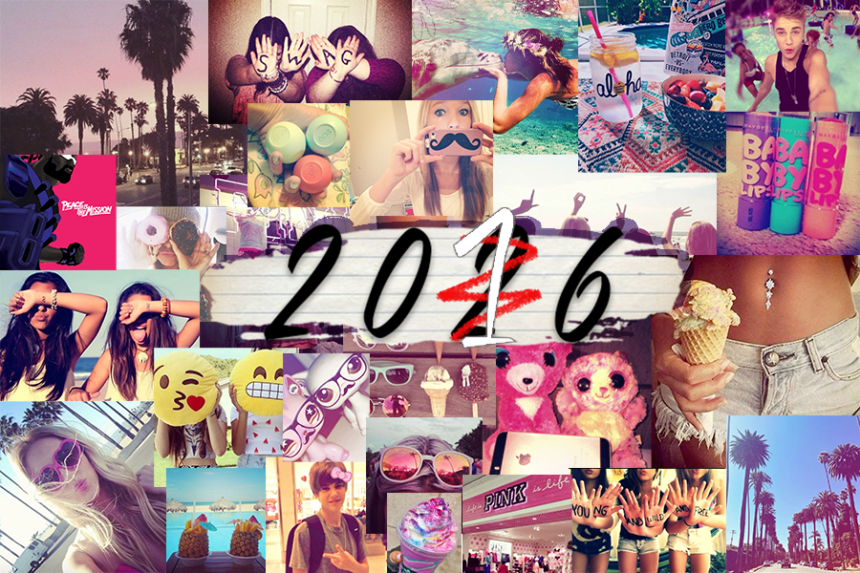
2026 is welcoming back 2016: musical-style TikToks, bold wing liners, Justin Bieber and the unmistakable Snapchat dog filter. The hashtag ‘2016’ stands at 2.6 million videos on TikTok. This seemingly harmless trend is in fact the cultural inability to build boundaries with nostalgia. Our surprising u-turn to the past is symptomatic of the very human fears of an imagined future that feels increasingly uncertain and dystopian.
As the world starts to drown in illusions and the artificial, the rawness of the past becomes a refuge. While AI influencers like Lil Miquela rise to fame through their engineered, eerily perfect bodies, people seek the candid, messy, and often badly lit Instagram posts from 2016. They signal authenticity in a digital landscape where it is becoming impossible to verify. Psychology Today states, “People use nostalgia as a palliative to dampen sadness.” Therefore, nostalgia becomes almost like a psychological stabiliser, a drug, designed to keep you addicted to the comfort of the past when the present numbs you through its mirages.
This pattern presents itself in our consumer behaviours as well. According to Circana, the revenue for wired headphones grew by 20% in early 2026. Wired headphones represent simplicity and a pre-algorithmic era; they bring back memories of untangling their cords, and that reminiscence of struggle itself is consoling. In contrast, the newer Bluetooth headphones are void of any similar memories; they connect in an instant — you don’t have to readjust the headphone jack multiple times till you find the ideal volume. The efficiency of today’s world is robbing us blind of the very frictions and inconveniences that once made our experiences memorable.
Cultural nostalgia is also a fight against the welcoming of false minimalism. Research conducted by the Science Museum Group in 2020 analysed around 7,000 everyday objects from 1800 to 2020 and found an increase of the colour grey. But as the beiges replace the bright blues and the neutrals take over the neons, curated perfection can only last for a while. A study titled The Colour of Nostalgia explains that “despite the complexity of nostalgia, the saturation of colour associations expresses, to some extent, how positive individuals feel about nostalgia”. This suggests colour acts as a strong marker for emotional intensity; the more vivid and bright the memory, the more intense the nostalgia. In order to taste the bittersweet feeling, people crave colour. And when the modern world starves us of that desire, we resurrect old habits and practices that are drenched in vibrancy to recycle memories and fulfil the greed of nostalgia. It stems from the same fear: the experiences of today will never bring the same level of nostalgia as the experiences of yesterday.
But beyond the comforting feeling nostalgia invites, it’s equally a money-making machine. Businesses exploit feel-good memories to increase revenue when new ideas begin to expire. According to Global Market Insights, digital cameras have made a comeback, with them being valued at USD 24.4 billion in 2025. The Y2K aesthetic is back in fashion, with low-rise jeans growing to 49% from 2024 to 2025 in search interest. These revivals allow companies to monetise the past without the cost of innovation.
We see the same pattern with music as well. The 2011 Jennifer Lopez song On the Floor re-entered the charts after 15 years, boosted by the Prime Video series Off Campus. Justin Bieber’s nostalgic classics, like Baby and Sorry, also have reemerged in the charts. As nostalgia drives consumption, consumption drives revenue. It becomes the ideal economic strategy: low risk, low effort and commercially efficient.
Yet, the past, present and future do not have to be viewed as separate entities. They are deeply connected and often overlap, and so as we carry the gifts of the past, it is important not to get lost in the ‘then’. We can hold onto the positives, but we must be aware they will evolve and reshape as time comes along. Nostalgia can be an extraordinary sensation, but it shouldn’t intoxicate you into living life in reverse.