





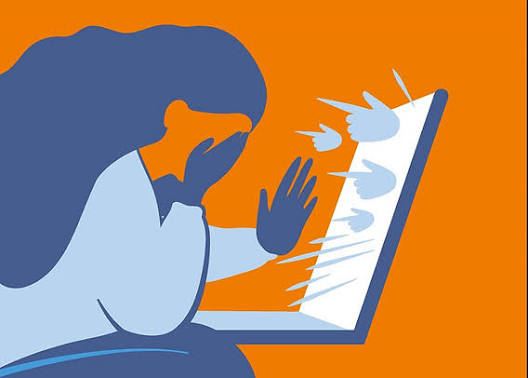
From young girls to teenagers to older ladies, all women have experienced some form of harassment at least once in their lives. Harassment comes in many shapes and forms, some common ones being catcalling on the streets, passive-aggressive comments from strangers and family members alike, and, a recently developing one — cyberbullying.
Physical harassment like staring and dirty comments are more easily recognised as a direct result of the patriarchy, but desperate times call for desperate measures, and that is how a new form of harassing females has developed. Regardless, no matter what face it appears in, harassment is harassment, and it is our duty to recognise every variant of it.
First, why does it occur every day in society? The answer to this involves a blend of deep-seated gender inequality, normalisation of misogynistic behaviours, and power imbalance. No one bats an eye when a woman is whistled at while passing on the street, and this is because this exact behaviour has been excused so often that no one even thinks of punishment anymore.
This misogynistic system is one that has been built steadily on the base of hundreds of years’ worth of women’s suffering. The law refuses to punish these acts due to the abundance of these crimes, but is the relation between these not a vicious cycle? If the law punished even the smallest acts, the smallest acts wouldn’t be so abundant — it’s a self-causing cycle that cannot be abolished due to the incompetence and the deep-rooted misogyny of the judicial system. To those unaffected, these cases are simply small inconveniences not worth their precious time and attention, and that is why this cycle never ends.
With the surge in social media usage, a space meant for empowerment and safety has transformed into an arena of gender-based hatred, targeted attacks, and cyberbullying. Research states that 73% of females globally experience some sort of online violence. Online bullying is a direct reflection of the everyday sexism that is present in the typical patriarchal society (Megarry, 2014, p. 49).
With even more accessibility, people have many more ways to harass women, including sending death threats, generating disgusting content, and creating deepfakes.
Gradually, this misogyny has inevitably bled into interactions on social media. Many people argue that it is a different, unrelated thing that allows the faceless profile picture to curse and obliterate the female content creator.
The simple truth is this — the same system allowing one to make moves on women on the streets is the same system allowing one to shame, curse, and harass a woman online. Countless accounts of online harassment are found on every platform, accounted for by normal female commenters, social media users, and female content creators. These include highly offensive messages and pictures and sometimes go as far as calls.
To point to a certain case amongst thousands, here are the words of a hopeless friend trying to take action against a long-term offender who has been harassing his female friend online:
“So there’s a friend of mine. She has been getting harassed online for 2-3 years by this one guy. He has given her death threats and keeps making new accounts and finding her accounts. She’s too scared and wants to reply to him back out of fear that he’ll do something or her family will be involved. What can I do? I have countless screenshots of him begging him to talk with her, plus death threat screenshots…”
This was posted a year ago by an anonymous user on the online internet forum called Reddit. Upon searching, one can find thousands of these discussions on Reddit, stories of females experiencing physical and online harassment alike.
So, how is this related to physical attacks? Both physical attacks and online harassment come from the same things: the audacity of men to do these things, and the audacity of men to excuse these things. The patriarchal ‘logic’ followed by well over half the population of males in Pakistan and worldwide says that it’s okay to harass a woman and then blame her for being ‘too emotional’, ‘too dramatic’, or ‘too serious’.
Patriarchal males’ empathy towards females ends where their convenience ends. It’s convenient to lecture your wife, daughter, or sister about being cautious of men, and it’s also convenient to be the man you warn your relatives about to other women.
With this severe lack of awareness and abundance of arrogance comes continuous suffering for women and continuous unaccountability for men. How much longer will this go on? Whether it is throwing acid on a woman because she’s better than you, or AI generating a woman’s naked body to bring her shame, one thing remains the same — the patriarchy that allows them to do this without consequence.
Moreover, sufficient efforts to remove or even regulate these crimes are not being made. If a woman is harassed online, the most she can do is report the offender online and hope it works out. She is left hopeless for any sense of justice against what is done to her — whether it is a death threat or an AI-generated video of her in an inappropriate setting, she is left to fend for herself against offenders and ineffective app regulations.
The government does not regulate AI and it serves as a powerful tool, both for work and blackmail. Even without AI, people curse lewdly at female content creators, and all they get for it is a mere online restriction. How many comments until someone is held accountable? Why is it so hard to take action?
When the reports do go through, and the crimes catch someone’s attention, what punishment is given? Little to no punishment is given to perpetrators, whether they harassed a woman on the street or on a social platform. Countless cases have been buried under the guise of the crime not being serious enough, the perpetrators not being old enough, or the victims lacking evidence.
Although specific cases are not revealed to the public, reports reveal that around 1,500 cybercrimes were reported in 2021, including complaints of online harassment, blackmail, and image-based abuse, and the perpetrators were not formally prosecuted due to the FIA failing to submit charge sheets in most cases.
Data dating back to hundreds of years ago shows that women have been constantly harassed by people, and more than half of the cases go unreported due to fear and stigma, among various other reasons. As residents of this world, women are owed the simple existence of safety.
Women are owed protection against danger, and most of the time these dangers tend to be caused by other humans rather than natural causes. The law owes women safety and justice against their perpetrators, and society owes women the safety to report their crimes without being shamed, fearing negative consequences and being disowned by society.
It is only when these online crimes are treated with the same seriousness and intensity of physical crimes can justice really start to serve. The world owes these women safety, and these women are all the women around you: your mother, your daughter, your sister, your wife. Only when you realise the intensity of heinous crimes against women on a daily basis can the world begin to pay back every woman for her endless suffering, caused by everyone simultaneously.
This piece is wonderfully written and very thought provoking. I do hope we can find a solution for online harassment towards women! The writer has gained my respect with such incredible writing.
Wow!
It’s a great read, very informative ❤️