





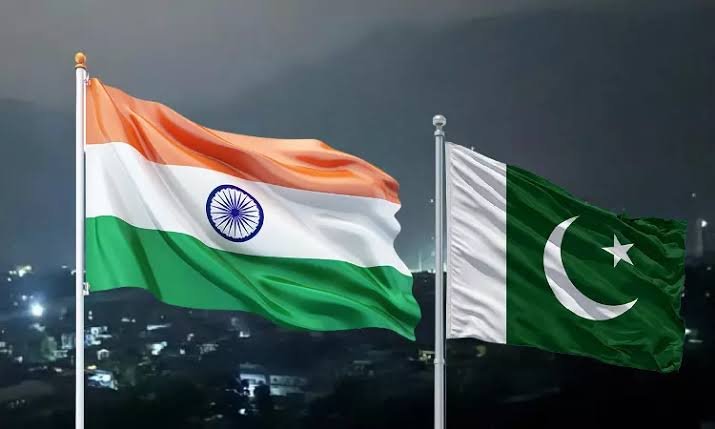
May 2025 saw an armed conflict between Pakistan and India when India launched air strikes against Pakistan after the Pahalgam incident. It was a very non-serious act, as both the countries are nuclear powers, and increased tensions between them will bring nothing but devastation. Experts fear that any long-term conflict can lead to nuclear warfare, and a nuclear war will affect the whole world.
As former Prime Minister Imran Khan said in his speech at the UN General Assembly: “When a nuclear-armed country fights to the end, it will have consequences far beyond the borders; it will have consequences for the whole world.”
Pakistan and India have never enjoyed cordial relations since partition in 1947. They have been at war many times. A major bone of contention between them is the Kashmir issue. India has illegally occupied Kashmir through the use of force. Pakistan wants this issue resolved according to UN resolutions and the will of the Kashmiris. But India is not ready to act upon the UN resolutions. The people of Kashmir should be given the right to decide about their future by themselves, and their decision should be wholeheartedly welcomed by both Pakistan and India. The only solution to this issue is dialogue, where the stakeholders of both countries should sit at the negotiating table and chalk out a comprehensive plan in the best interest of Kashmiris, acceptable to all parties.
There is a mutual distrust between the two. India blames Pakistan for every terrorist activity in India, as evident from the May 2025 conflict. Back in February 2019, India blamed Pakistan for the Pulwama attack, and Indian air force jets crossed the border violating the Line of Control (LOC); two of them were targeted by the Pakistan Air Force, while an Indian pilot, Abhinandan, was also captured. Before this, India also blamed Pakistan for backing the terrorists involved in the Mumbai attacks in 2008.
Another major issue between the two is that of water distribution. The Indus-Waters Treaty was signed in 1960 by Ayub Khan and Jawaharlal Nehru under the observation of the World Bank, but it has been suspended by India after the May 2025 conflict. In the late 90s and early 2000s, the relationship between Pakistan and India was comparatively better; trade increased and bus-train services resumed.
Currently, Pakistan and India have their bilateral relations suspended. There is a constraint in diplomacy and decreased contacts at all levels. The increased political tensions between Pakistan and India have negatively impacted sports, particularly cricket. Both countries have not played a single bilateral series for decades. India doesn’t send its team to Pakistan for ICC tournaments; rather, their matches are played at neutral venues whenever Pakistan is hosting a tournament. The players of both teams don’t even shake hands with each other. The Indian captain also refused to receive the trophy from Pakistan’s Interior Minister. Why is there so much hatred between Pakistan and India? Both of them have fought three major wars that brought only dead bodies.
Wars don’t benefit anyone; on the other side, peace brings satisfaction and progress. Pakistan and India should try to break the ice and make collective efforts in the fields of trade, agriculture and technology for the betterment of their masses; the whole region will be benefitted. The peace of the subcontinent depends on bilateral trust and harmony between them.