





The one thing that stands out the most in modern homes with young kids is abundance. Baskets overflowing with colorful toys, shelves filled to the edges, and yet, quite often, a child is sitting in the middle of the room playing with any toy. Picking it up only to put it back down without showing any interest or connection to it. It feels like a contradiction, surrounded by abundance but still unengaged.
Childhood today is louder than how it used to be. Toys light up, play music and can move on their own. At first they seem interesting and almost impressive, but on a deeper observation they set subtle limitations. When you take a closer look, you realise that the play has been controlled by the toy more than the child himself. It decides the music, the action, and the results. It takes away the child’s sense of creativity and decision-making. The child, instead of creating the experience, simply follows it. What looks like engagement slowly turns into passive attention because the child just follows the toy.
This is where the shift in parenting begins to emerge. Under the influence of Waldorf and Montessori approaches, parents are accessing ease over simplicity and involvement. Fewer toys, open-ended objects and natural materials are slowly being replaced by shelves of plastic and battery-operated toys. The fact is simple: “When a toy does less, a child does more.”
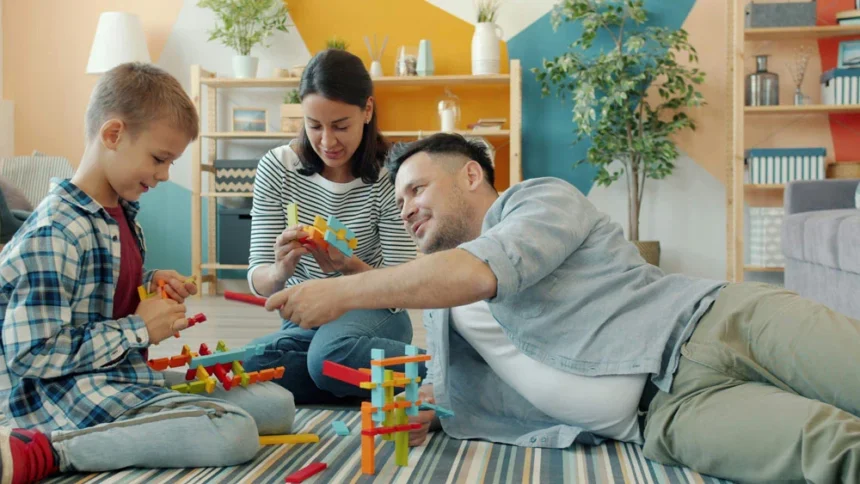
For instance, a set of wooden blocks does not tell the child what it is; instead, it allows an open-ended choice. It can be built into a house, a building, a tower, a bridge, or even a part of a completely imagined world. Leaving the hold in the child’s hands. Its value is not what it is but what it offers. This difference may seem small, but it holds greater impact.
This argument also relies on a psychological approach that says children are not always helped by constant stimulation. Too many colours, choices and noise make them feel overwhelmed rather than engaged. When everything demands attention, nothing truly holds it. With fewer toys, kids learn to stay focused and to hold on. They explore deeper and start making their own forms of entertainment.
This can easily be described by a simple example: give a child a tablet and a cardboard. A cardboard can turn into anything, taking the shape of a boat or aeroplane. On the other hand, a tablet has a defined set of instructions and games that performs exactly as it is designed, not more and not less. When one is inviting imagination, the other defines it.
In addition to that, modern parents these days tend to face a certain pressure of provision in abundance. Despite understanding the fact that battery-operated toys are not good enough, they are more tied to consumption. Toys are no longer seen as objects to play with but as tools of development. Social media feeds, advertisements, social trends and even casual conversations suggest more resources means better growth. In such an environment, even choosing less feels uncomfortable and embarrassing.
Therefore, minimalist parenting is not only about reducing clutter. It is a challenge to the belief that childhood requires constant optimisation and needs to be filled. Thus, it is a quiet way of resistance also. Instead, it demands space. Space for unplanned play, slow creations and sometimes space for boredom also. It shifts attention from what is given to what is experienced.
This approach is also a big question on the role of parenting. Rather than constantly adding new toys, the focus shifts on understanding and supporting the natural curiosities of a child. It recognises that development cannot be purchased or accelerated through objects. Rather, it is a slow process that requires imagination, time and interaction.
In the end, the question is not how many toys a child owns but how they learn to engage with the world around them. A room filled with toys can feel empty; meanwhile, a simple object can hold endless possibilities. Perhaps childhood is never meant to be filled with stimulation. Perhaps it was meant to have space. Space to think and to create. In empty spaces where there is nothing provided and everything needs to be created, a child does not only play but begins to understand the world in his own way.