





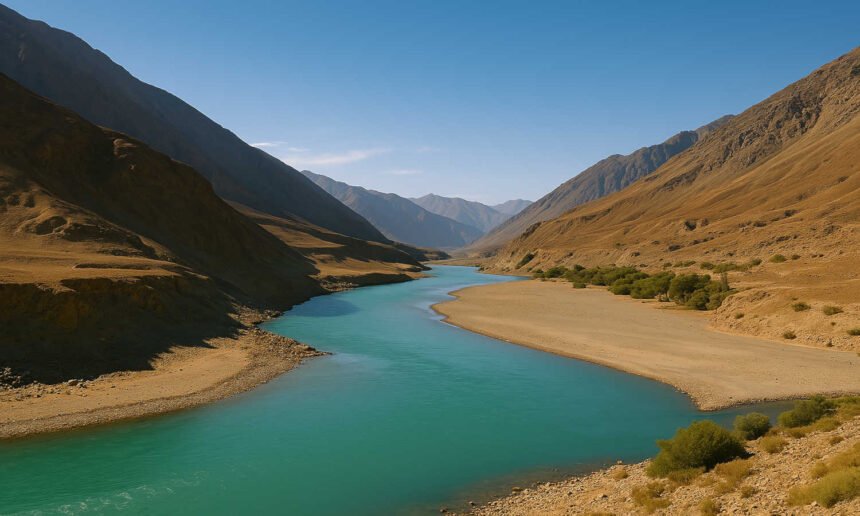
As glaciers melt due to rising global temperatures, the Indus River is currently experiencing its peak supply, providing more water than expected, especially during summers. This situation will most likely be followed by extreme shortages of water as the Indus loses its main source of water, converting the lifeline of millions of people into a seasonal stream and directly affecting the backbone of Pakistan’s economy in Punjab and Sindh’s fertile lands.
The Indus River Basin is not just water running through land; it is Pakistan’s absolute lifeline. It keeps over 240 million people alive and waters around 18 million hectares of farmland. High up in the cold peaks of the Upper Indus Basin, mountain streams generate about 60% of the river’s entire annual water volume. If you travel up past 3,500 m, you will see the huge snowpacks and glaciers that supply more than 65% of this flow. But this massive natural water engine is starting to break down because global temperatures are rising much faster than our communities can handle. The Hindu Kush, Karakoram, and Himalayan glaciers are currently melting at an alarming rate. Right now, all this fast melting fills our rivers to the top. It looks like we have plenty of water, but this is a dangerous illusion. Environmental models show that the Indus will hit its final peak melt well before mid-century. Once that tipping point passes, the year-round flow will drop drastically. By 2050, an 8% drop in annual runoff will turn this ancient, permanent river into a seasonal stream that runs dry for part of the year.
We are currently living through this tricky phase of peak water. The main issue is that the water is not arriving when farmers actually need it. Right now, nearly 80% of the annual flow in the upper mountain streams happens over just three months, from mid-June to mid-September. That leaves the river completely empty and vulnerable during the dry winter months when crops still need water. Glaciers act like giant natural bank accounts that slowly release water during dry times, but when they shrink past a critical point, that steady winter flow will vanish. Snow and glacier melt make up more than 50% of the total volume running through the Indus Basin Irrigation System — the largest connected network of irrigation canals on Earth. When these ice reserves run out, the year-round flow stops. The great Indus will become an intermittent river, depending entirely on unpredictable monsoon rains and thin winter snowpacks that disappear in days.
Population Reliance and Water Stress Across the Indus Basin
- Indus River: 48.6 (Average Water Stress Index: High)
- Jhelum River: 37.5 (Average Water Stress Index: High)
- Chenab River: 22.2 (Average Water Stress Index: High)
- Ravi River: 18.2 (Average Water Stress Index: High)
- Beas River: 28.6 (Average Water Stress Index: High)
- Sutlej River: 6.7 (Average Water Stress Index: Low)
This huge shift will hit the agricultural heartland of Punjab like a massive shockwave. Farming in this province relies completely on predictable surface canals and steady groundwater levels. Punjabi farmers have spent generations balancing their crops between two main seasonal cycles: the kharif crops like cotton and rice planted from May to November, and the rabi crops like wheat grown from November to May. A seasonal Indus River completely breaks this timeless schedule. During the early planting season, when fields desperately need their very first watering, water levels at major dams like Tarbela, Mangla, and Marala will be far too low to fill the canals. Pakistan’s water availability per person has already dropped from a rich 5,260 cubic metres back in 1951 to just over 1,000 cubic metres today. We are standing right on the edge of total water scarcity. If the Indus turns into a seasonal stream by 2050, more than 300 million people who depend on this agricultural system will face regular food shortages and deep systemic droughts.
The entire situation is made much worse by our own broken, old infrastructure. Pakistan has one of the highest water waste rates in the world, yet our main reservoirs can store less than 30 days of river flow. Our colonial-era barrages and unlined dirt canals leak massive amounts of water into the ground and the air through seepage and evaporation before it can ever reach a single farm. At the same time, rising temperatures are expected to push up town, factory, and farm water demands by 5% to 15% by 2047. This is a massive threefold increase that is happening alongside a rapidly growing population. Without regular glacier water to keep the supply steady, old provincial water-sharing agreements like the 1991 Accord will likely fail, creating intense political fights between provinces. Punjab’s farmers are already struggling with dropping groundwater levels, and they are spending a fortune on fuel to pump what is left using tube wells. Very soon, running a farm will become completely impossible for them.
Actionable Solutions
Saving the Indus Basin from drying out requires real structural action, not just small policy papers or meetings. The river’s shift into a seasonal stream by 2050 is a real certainty if we keep doing what we are doing today. We must modernise our canal networks immediately by moving towards precision drip irrigation and solar-powered micro-irrigation to stop agricultural water waste. We also need to fix natural low-lying areas in the upper lands to act as small local reservoirs and enforce clear water-pricing rules to handle the heavy summer floods. Protecting the Indus Basin is no longer just a project for environmental groups; it is a basic requirement for our survival as a nation.