





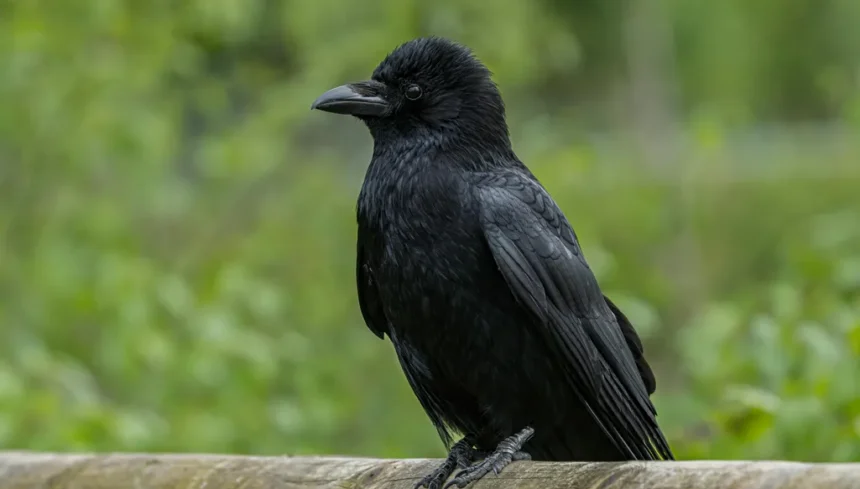
Ever heard the saying ‘never mess with a crow’? Well, whoever said that was probably a victim of the generational grudges that corvids can hold. Corvids (crows, ravens and magpies) are often underestimated greatly in many aspects.
Corvids do not just react to stimuli; they understand physical mechanics and solve abstract problems with deeply analytical, sequential, and physics-based logic. Crows can solve same-different relationship puzzles. Examples of this include the ability to match pairs of objects based on abstract traits like colour or shape. They use one tool to retrieve a second, longer tool, then use that second tool to reach food, excelling at multi-step planning by precisely matching tool shapes to physical needs without trial and error. In addition, crow populations pass down specific tool designs. The shapes of their hooks vary by region and adapt over time.
In the Aesop’s Fable test (a scientific cognition experiment based on “The Crow and the Pitcher,” where animals drop stones into a tube of water to raise the level and access a floating reward), corvids select heavy objects over light ones, understanding that floating objects will not sink to displace water. They resist immediate temptation for a better future reward, matching their impulse control with that seen in chimpanzees.
Corvids are smarter than many by understanding that other animals have independent thoughts. They also have a social status that they manage within their flock by changing their grooming and vocalising behaviours. Their social intelligence is shaped by a culture of theft. They assume others are lying or stealing because they lie and steal. Corvid logic is flexible and spreads through social learning across generations. Their logic involves perspective-taking as they track exactly who is looking at them to execute optical deception (e.g., faking hiding food). After a fight, bystander ravens will approach the victim. They preen and sit near the loser to reduce its stress and console it. Moreover, Raven populations develop unique vocal dialects as sounds change depending on their specific geographic territory.
Surprisingly, crows hold funerals for their fallen companions. When a crow discovers a dead companion, it triggers a distinct, multi-stage social sequence. Firstly, the finder bird emits a specific alert cry to recruit nearby birds; dozens of crows quickly arrive, forming a loud flock around the carcass on nearby branches, power lines, and rooftops. After a chaotic period of calling, the flock often falls into a tense, highly observant silence, staring down at the deceased bird, leaving within 15-20 minutes. Corvids use dead bodies as warning signs to evaluate environmental risk. They are asking a logical question: “What killed you, and how do I avoid the same fate?” If a funeral takes place in a specific tree or backyard, the flock will often completely abandon that foraging spot for days or even weeks, identifying it as a high-risk zone. In controlled experiments, researchers walked past crow populations while wearing a distinct mask and holding a taxidermied dead crow. The local crows immediately held a “funeral”, aggressively dive-bombing the masked person, memorising their face as a predator.
Corvids possess highly sophisticated facial recognition abilities that allow them to identify individual humans out of a crowd. They use this skill to categorise people into precise emotional profiles, such as dangerous threats or trusted caretakers, remembering faces for over 11 to 17 years.
Crows are just as big gossips as we are; they do not just remember faces individually; they pass this facial data across their social networks through two distinct types of learning.
Peer-to-Peer and generational. In peer-to-peer learning, a crow who spots a “dangerous” face sends an alarm call to recruit other nearby crows who observe the commotion, lock onto the human’s face, and memorise it as a threat even though that person never harmed them personally. In generational learning, parent crows actively teach their offspring which humans to hate. Brain scans of crows reacting to human faces reveal that their visual recognition mechanism mirrors our own. For a corvid, recognising a face is a deeply intertwined visual and emotional task. They do not just see your eyes and nose; they recall exactly how you made them feel.
While urbanisation drives many animal species to local extinction, corvids are global urban exploiters. Their success in human-dominated environments relies on behavioural plasticity, risk assessment, and dietary flexibility. Corvids actively weaponise human architecture; for example, carrion crows in Japan drop hard walnuts into pedestrian crosswalks, utilising cars as nutcrackers and waiting for the red light to safely retrieve the food. Due to urbanisation and an overall lack of natural twigs, crows have been forced to improvise. They regularly steal wire clothing hangers from balconies to build structural, wind-resistant nests on utility poles and skyscrapers. Moreover, crows track human schedules with extreme precision. They learn garbage collection days for specific neighbourhoods, school recess schedules, and outdoor restaurant closing hours to optimise their food-finding efficiency while minimising danger. To maximise city living, urban corvids drastically compress their home ranges and reduce defence aggression. Their nesting territories overlap extensively around major food hubs like landfills or public parks, shifting their social structure from pairs to massive, communal networks.
So, next time you see a crow, don’t underestimate them, for they are a lot smarter than they look.